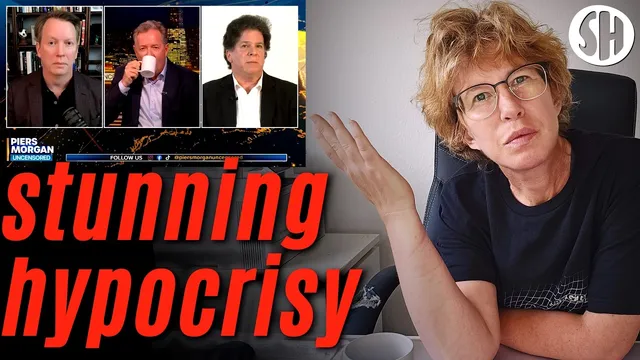
Physicists are afraid of Eric Weinstein -- and they should be
Based on Sabine Hossenfelder's video on YouTube. If you like this content, support the original creators by watching, liking and subscribing to their content.
Hossenfelder argues the backlash against Eric Weinstein is driven by selective enforcement of standards and group dynamics rather than uniquely fatal technical flaws.
Briefing
Eric Weinstein’s “geometric unity” is being attacked less for its technical merit than for what it threatens to reveal about how theoretical physics polices credibility. Sabine Hossenfelder argues that Weinstein is, personally, “a good and fairly normal person,” and that the backlash surrounding his appearance on Piers Morgan—alongside Sean Carroll—has turned into a coordinated hate campaign that physicists themselves would not tolerate if the target were less prominent.
At the center of the dispute is Weinstein’s long-running attempt at a “theory of everything,” framed as a unification program. Hossenfelder describes the standard model as built from symmetry groups—U(1), SU(2), and SU(3)—and notes that unification efforts typically search for a larger group that contains these symmetries. The catch is that there are infinitely many candidate groups, so physicists have proposed thousands of unified theories. Because larger groups usually imply extra structure beyond the standard model, these proposals often predict new particles; when those particles aren’t observed, proponents either invoke dark matter or dark energy or other mechanisms. Hossenfelder’s own stance is skeptical: unification has produced too many speculative models with no evidence for decades.
Weinstein’s approach, as Hossenfelder portrays it, differs mainly in methodology rather than ambition. She sketches a connection between Einstein’s four-dimensional spacetime metric tensor and the group-theoretic structure of SO(10). The metric tensor has 16 components but only 10 independent entries due to symmetry, and Weinstein’s idea is to link those “10s” to the generators of a larger unification structure—effectively “doubling” the gravitational part in a way meant to yield something like SO(10). Hossenfelder concedes the concept is “a big sketchy” and that the details would need substantial work, but she insists the mathematics is broadly in the same neighborhood as other foundation-focused theoretical work.
The controversy spikes around Sean Carroll’s criticism on the Morgan show. Carroll’s complaint is that Weinstein’s notes lack the kind of concrete outputs that would earn serious attention: a clear Lagrangian, explicit calculations, and testable predictions—such as plots for dark matter or dark energy scenarios (redshift versus distance), relic abundance estimates, and mechanisms like anomaly cancellation. Hossenfelder counters that Carroll’s standards are selectively applied. She claims the field is full of similarly under-specified ideas—papers with ill-defined operators, missing Lagrangians, and “future work” that never arrives—yet those efforts are tolerated because they fit established networks and norms.
Hossenfelder broadens the charge into a critique of group behavior. She alleges that public attacks on Weinstein function as a defense mechanism for a community worried that his prominence exposes how “rotten” parts of theoretical physics can be. She also disputes a rumor that Perimeter Institute avoided association with Weinstein unless he donated money, calling it implausible for how seminar invitations work and suggesting the episode reflects fear within the academic ecosystem. She highlights support from Brian Keating and Curt Jaimungal, arguing that people punished them for engaging with Weinstein rather than joining the pile-on. In her view, the backlash is not about whether geometric unity is uniquely bad; it’s about whether it is uniquely visible—and whether that visibility makes insiders uncomfortable.
Cornell Notes
Sabine Hossenfelder defends Eric Weinstein’s “geometric unity” against a wave of criticism, arguing that the backlash is driven more by professional group dynamics than by unusually poor technical content. She describes how unification programs often start from symmetry groups like U(1), SU(2), and SU(3) and then embed them into larger groups, which can generate many speculative theories and extra particles. Weinstein’s distinctive sketch, she says, links the 10 independent components of the spacetime metric tensor to an SO(10)-type group structure by modifying the gravitational sector. Hossenfelder concedes the work is incomplete—missing a Lagrangian and concrete predictions—but claims similar incompleteness is common across theoretical foundations and is usually ignored. The stakes, in her framing, are whether public criticism is selectively enforced to protect field norms.
What is “geometric unity,” and how does Hossenfelder connect it to unification via symmetry groups?
Why does Hossenfelder say Weinstein’s work is incomplete, yet still not uniquely unacceptable?
What specific criticism did Sean Carroll make on the Piers Morgan appearance, according to Hossenfelder?
How does Hossenfelder respond to the idea that physicists should demand stronger predictions from Weinstein?
What does Hossenfelder claim about the Perimeter Institute rumor, and what does she say it reveals?
Who does Hossenfelder highlight as supportive, and what reaction does she say followed?
Review Questions
- How does Hossenfelder connect the standard model’s symmetry groups (U(1), SU(2), SU(3)) to the logic of unification via larger groups?
- What concrete elements does Carroll demand from Weinstein’s theory, and which missing components does Hossenfelder also list?
- According to Hossenfelder, what mechanism explains why Weinstein attracts harsher public criticism than many similar foundation-focused proposals?
Key Points
- 1
Hossenfelder argues the backlash against Eric Weinstein is driven by selective enforcement of standards and group dynamics rather than uniquely fatal technical flaws.
- 2
Unification efforts often embed the standard model’s symmetry groups (U(1), SU(2), SU(3)) into larger groups, but the abundance of candidate groups leads to many speculative theories.
- 3
Weinstein’s “geometric unity” is described as linking the 10 independent components of the 4D metric tensor to an SO(10)-type group structure by modifying the gravitational sector.
- 4
Hossenfelder concedes Weinstein’s notes lack a Lagrangian, anomaly cancellation details, and clear testable predictions, but claims similar gaps are common in theoretical foundations.
- 5
Carroll’s criticism centers on missing concrete calculations and plots for dark matter/dark energy scenarios, including relic abundance estimates.
- 6
Hossenfelder disputes a Perimeter Institute donation rumor as implausible and uses it to argue that fear and career risk shape academic behavior.
- 7
She highlights support from Brian Keating and Curt Jaimungal and claims they were punished for engaging with Weinstein rather than joining the pile-on.