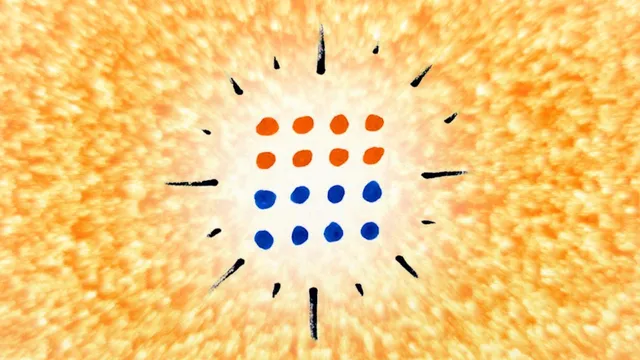
Picture of the Big Bang (a.k.a. Oldest Light in the Universe)
Based on minutephysics's video on YouTube. If you like this content, support the original creators by watching, liking and subscribing to their content.
The cosmic microwave background is ancient radiation released when the early universe became transparent after electrons combined with protons to form hydrogen.
Briefing
The cosmic microwave background (CMB) is the universe’s oldest light—radiation that has traveled for about 13.7 billion years and now reaches Earth after being stretched by the expansion of space from hot, early-universe light into microwaves. It matters because this faint glow functions as a snapshot of the cosmos when it was young, dense, and nearly uniform, offering a direct way to read the universe’s early conditions and see the seeds that later grew into galaxies.
In the first moments after the Big Bang, the universe was extremely hot and compact, with matter so smooth that it behaved like a nearly featureless “cosmic soup.” In that state, electrons were not bound to atoms; they roamed freely, scattering light constantly—like light bouncing around inside a stellar interior. As the universe expanded, it cooled. Eventually, the temperature dropped enough that electrons and protons could finally combine into hydrogen atoms. Once electrons were locked into atoms, they stopped interacting strongly with the radiation. The result was a major transition: the universe became transparent, and the previously trapped light streamed outward largely without further scattering.
That released radiation is what astronomers detect today as the CMB. During its long journey, space itself stretched the wavelength of the light, shifting it from an initial “sunlight-white” spectrum into the microwave band. The CMB’s present-day temperature is about 2.725 kelvin (roughly minus 270 degrees Celsius). Crucially, the CMB is not perfectly uniform. Careful measurements reveal tiny temperature variations—small “bumps” across the sky—on the order of one part in one hundred thousand.
Those minute irregularities are widely interpreted as the imprint of quantum fluctuations in the early universe. As the cosmos continued to expand and cool, gravity amplified these slight differences. Regions that were slightly denser attracted more matter, gradually building the large-scale structure seen today: planets, stars, galaxies, and superclusters. In this way, the CMB is more than an ancient glow; it is the starting point from which the universe’s “curds” of structure congealed.
The transcript also emphasizes how the CMB can be visualized and explored through an interactive “ADVENTURE!” map at bigbangregistry.com, designed to present the microwave sky as if it were a fantasy geography. The map includes overlays such as infrared views and references to constellations and galaxies, framing the CMB as the first picture of the universe taken in its infancy—an observational foundation for understanding how today’s cosmic landscape emerged.
Cornell Notes
The cosmic microwave background (CMB) is the oldest light in the universe, arriving after roughly 13.7 billion years of travel. Early on, free electrons scattered radiation so thoroughly that the universe was opaque; once cooling allowed electrons and protons to form hydrogen atoms, scattering dropped and the radiation streamed freely. Expansion stretched that radiation into microwaves, leaving a nearly uniform sky with a temperature of about 2.725 K (−270°C). Tiny variations of about one in 100,000 are interpreted as quantum fluctuations that later grew under gravity into the large-scale structures—galaxies and superclusters—seen today. The CMB therefore acts as a direct “starting point” record of the universe’s hot, smooth youth and the seeds of cosmic structure.
Why did the early universe trap light, and what changed to make it transparent?
How does the CMB’s microwave temperature connect to the Big Bang’s original light?
What do the small “bumps” in the CMB represent, and how large are they?
How do tiny early irregularities become galaxies and superclusters?
Why is the CMB considered a “first picture” of the universe?
Review Questions
- What physical process caused the universe to shift from opaque to transparent, and what particle change enabled it?
- How does cosmic expansion transform the CMB’s original light into microwaves, and what is the present-day temperature?
- Why are CMB temperature variations of about one in 100,000 considered important for later structure formation?
Key Points
- 1
The cosmic microwave background is ancient radiation released when the early universe became transparent after electrons combined with protons to form hydrogen.
- 2
Free electrons in the hot early universe scattered light constantly, keeping the cosmos opaque until cooling reduced scattering.
- 3
Expansion stretched the released radiation from an initial hot spectrum into microwaves, producing a present-day temperature near 2.725 K (about −270°C).
- 4
The CMB is nearly uniform but contains tiny temperature variations of roughly one part in 100,000 across the sky.
- 5
Those small fluctuations are interpreted as quantum fluctuations that later grew under gravity into galaxies and superclusters.
- 6
The CMB provides a direct observational record of the universe’s early conditions at the transparency transition, serving as a starting point for cosmic structure formation.