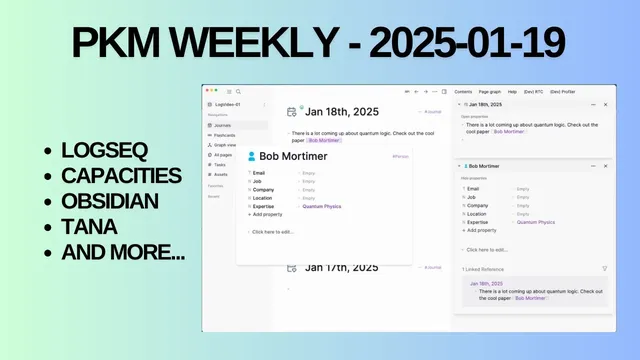
PKM (Personal Knowledge Management) Weekly Update - 2025-01-19
Based on Ed Nico's video on YouTube. If you like this content, support the original creators by watching, liking and subscribing to their content.
A Reddit thread reflects widespread PKM exhaustion: many users can’t find an app that integrates seamlessly across Windows and Apple while still making export and note capture easy.
Briefing
Personal knowledge management (PKM) app users are still chasing the same holy grail: a tool that works smoothly across devices, makes capture painless, and doesn’t turn organization into a second job. A Reddit post captured that fatigue directly—someone tried a long list of popular note apps (including Obsidian, Bear, Apple Notes, UpNote, Google Keep, and Logseq) and still couldn’t find a seamless Windows-and-Apple workflow with easy exporting. The thread’s 80+ comments signal how common the frustration is, and it sets the tone for a weekly roundup focused on what’s improving—and what still breaks.
Capacities is the biggest headline in the update stream. Recent changes include easier embedded views, adaptive app icons, improved ordering controls, faster “collect all blocks” behavior, better PDF rendering, and a batch of bug fixes. Behind the scenes, Capacities also appears to be progressing on a calendar integration: a preview accidentally slipped into the app, drew feedback for being easy to set up but buggy, then got removed so it wouldn’t reach broader testing. The expectation is a beta release soon.
Offline and sync behavior also got attention. Users can now download media with more control—either everything or only the media required for notes—meaning some images/files may be unavailable offline, but the tradeoff is more predictable storage and usability. Capacities users also flagged a table-view annoyance: a wrapped “summary” column becomes effectively unusable because it can’t be hidden or masked. Discord chatter suggests a toggle or setting to control column wrapping is in the works.
Voice notes are getting practical integration. A user guide walks through connecting voice notes to Capacities using webhooks, requiring only a voice note, a Capacities account, and a Relay.app access token. That same theme—making capture faster—shows up across other apps.
Logseq remains in active development, with ongoing “DB version” work tracked via weekly change logs. The database version is still evolving, but it’s already usable on test.logseq.com, with guidance not to rely on it for day-to-day work because updates can break or change behavior. The DB version promises richer properties and querying: daily notes can link to users, and those links can expose tags/properties that can be turned into tables and different views. A key takeaway from the discussion: it’s not an either/or switch—Markdown and DB version workflows are expected to coexist.
Tana updates are smaller but pointed: progress indicators, paste/headings improvements, and “meta prompt generation” that leverages GPT for images, plus bug fixes. There’s also a student/NGO discount process and a push for an affiliate webinar (delayed multiple times, now planned for Tuesday 21st). Meanwhile, Obsidian-related community activity highlights plugin templates, folder-structure curiosity, and a “gems of the year” voting effort hosted in Discord.
Across the wider ecosystem, the roundup repeatedly returns to a single question: is a new feature worth it if sync, import, or reliability still feels fragile? Remote Note Pro is criticized for sync friction and an AI feature that reportedly fails often, while other apps are leaning into collaboration and database views—sometimes at the cost of polish for core personal workflows. The week ends with teasers about offline-first capabilities (notably Notion’s direction) and a new “all-in-one file system” concept called SendLabs that aims to treat desktop files as PKM primitives rather than forcing notes into a separate app.
Cornell Notes
PKM users are still searching for tools that feel effortless across devices, and the weekly update highlights where major apps are improving—and where friction remains. Capacities leads with upgrades to embedded views, PDF rendering, offline media downloads, and a developing calendar integration (preview removed due to bugs). Logseq’s DB version is progressing via frequent change logs and is already testable on test.logseq.com, with richer property-based querying expected, while Markdown and DB workflows are planned to coexist. Tana adds GPT-driven meta prompt generation for images and continues refining core editing features, while community activity around Obsidian focuses on templates, plugins, and how people structure their vaults. Reliability, import, and sync quality remain recurring deciding factors for users considering migration.
Why does the Capacities calendar integration matter, and what happened with the preview?
How did Capacities change offline behavior, and what tradeoff comes with it?
What table-view problem affects Capacities users, and what solution is being discussed?
What is the practical status of Logseq’s DB version, and how should users treat it?
What does the Logseq DB version add beyond the Markdown experience?
What recurring migration pain points appear across the roundup?
Review Questions
- Which Capacities improvements directly affect offline usability, and what limitation comes with the “required only” download option?
- How does Logseq’s DB version differ from Markdown in terms of properties and querying, and why is test.logseq.com usage still cautioned?
- What kinds of user feedback led to the removal of the Capacities calendar preview, and what does that imply about release readiness?
Key Points
- 1
A Reddit thread reflects widespread PKM exhaustion: many users can’t find an app that integrates seamlessly across Windows and Apple while still making export and note capture easy.
- 2
Capacities’ recent updates include embedded view improvements, better PDF rendering, and multiple bug fixes, alongside progress toward calendar integration.
- 3
Capacities now offers offline media downloads in two modes—download everything or only media required for notes—trading completeness for storage control.
- 4
Capacities’ table view has a usability issue with wrapped summary text; a toggle or setting to control column wrapping is reportedly being worked on.
- 5
Logseq’s DB version is actively evolving and available on test.logseq.com, but it’s still not recommended for full daily reliance due to potential breaking changes.
- 6
Logseq’s DB version is expected to deliver richer property-based querying and multiple views, while Markdown and DB workflows are intended to coexist.
- 7
Across apps, migration decisions hinge on import/bulk migration support and reliability (especially sync and AI feature stability), not just new features.