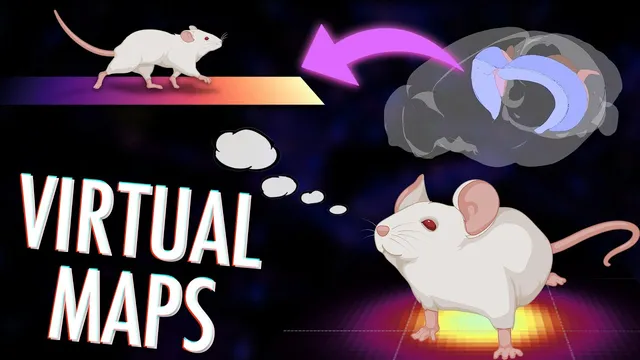
Place cells: How your brain creates maps of abstract spaces
Based on Artem Kirsanov's video on YouTube. If you like this content, support the original creators by watching, liking and subscribing to their content.
Individual hippocampal neurons fire at preferred locations, forming a tiled internal representation of space through place fields.
Briefing
Hippocampal “place cells” don’t just light up when an animal is somewhere—they can be manipulated to change behavior, providing direct evidence that these neurons help build the brain’s internal maps of space. In classic recordings from rats, individual hippocampal pyramidal neurons fire at specific locations, creating a tiled representation of where the animal is within an environment. The key distinction is that a “place cell” is the neuron, while its “place field” is the region of the outside world that reliably drives that neuron’s spikes.
Place fields are not limited to flat ground. Experiments with freely flying bats show that place fields can form roughly spherical patterns in three-dimensional space, and rats navigating cubic mazes represent the full volume, including vertical movement. This matters because it suggests the hippocampal circuitry supports navigation in the real geometry animals experience, not just in simplified 2D layouts.
The strongest causal evidence comes from virtual reality experiments. Mice run on a spherical treadmill while a computer updates a surrounding visual scene, producing a convincing illusion of movement through a virtual track. Even though the animal’s body stays fixed, hippocampal activity still forms place fields that tile the virtual space. Researchers then used targeted stimulation to force certain neurons to spike at the wrong times. Stimulating neurons that normally fire near the end of the track—while the mouse is still far away—can trigger the mouse to start licking for reward as if it had already reached the end. Conversely, stimulating neurons that normally fire near the start can make the mouse “believe” it is earlier in the track, sometimes causing it to run past the virtual boundary, like crashing through a wall. The behavioral shift links hippocampal place-cell activity to the construction of the cognitive map rather than mere correlation.
Once place fields exist, the next question is how they change. Hippocampal representations “remap” across environments: a neuron that fires in one location in one setting may fire elsewhere—or not at all—in a different setting. The extent of remapping depends on how similar two environments are. Large changes like repainting walls and moving furniture can reorganize many place fields, while subtle changes such as adding a small picture may leave most fields intact. In some cases, remapping follows environmental transformations: rotating a cue card in a cylindrical chamber can rotate place fields while preserving their relative structure, and altering wall aspect ratios can stretch place fields with the box.
Remapping also responds to non-spatial information. Changing odor or inducing fear through mild electric shocks can cause place cells to shift even when the chamber itself stays the same—turning a familiar “restaurant” map into something drastically altered after a traumatic event. This points to a broader role: place-cell activity carries information not only about position, but also about context and events tied to that position.
That broader role challenges the term “place cells.” In a sound-frequency joystick task, hippocampal neurons show firing peaks for preferred frequencies and near-silent activity for distant ranges, behaving like place cells but in an abstract acoustic space. The hippocampus appears to track continuous variables relevant to the task—spatial coordinates in navigation, sound frequency in the joystick experiment—suggesting a flexible mapping system that can support memory and planning beyond physical location.
Cornell Notes
Hippocampal place cells form a tiled representation of where an animal is, and their activity can be causally linked to navigation behavior. In virtual reality, mice generate place fields that map onto the virtual track even while physically head-fixed, and mis-stimulating neurons can make mice behave as if they are at the wrong location. Place fields remap across environments depending on similarity, and they can also shift with non-spatial changes like odor or fear conditioning, tying location to context. Evidence from a sound-frequency joystick task suggests these neurons can encode abstract continuous variables, not only physical position. Together, the findings support the idea that the hippocampus constructs cognitive maps that generalize beyond space.
What did early hippocampal recordings reveal about how space is represented?
How do place cells handle three-dimensional movement?
Why are virtual reality experiments crucial for testing causality?
What behavioral effects occur when place cells are stimulated at the wrong times?
How does remapping show that place-cell activity encodes more than coordinates?
What evidence suggests place cells can operate in abstract spaces?
Review Questions
- How do virtual reality and targeted stimulation together support a causal role for hippocampal place cells in navigation?
- What patterns of remapping would you expect when two environments differ slightly versus dramatically, and why?
- How does the sound-frequency joystick task challenge a purely spatial interpretation of “place cells”?
Key Points
- 1
Individual hippocampal neurons fire at preferred locations, forming a tiled internal representation of space through place fields.
- 2
Place fields extend into three dimensions, supporting navigation for animals that move vertically or fly.
- 3
In virtual reality, hippocampal place fields map onto virtual space even when the animal is physically head-fixed.
- 4
Mis-timing place-cell spikes can shift behavior, including premature reward-seeking and boundary-crossing, indicating a causal role in cognitive maps.
- 5
Place fields remap across environments based on similarity, and they can also remap with non-spatial cues like odor and fear.
- 6
Hippocampal activity can represent abstract continuous variables, as shown by neurons tracking sound frequency in a joystick task.