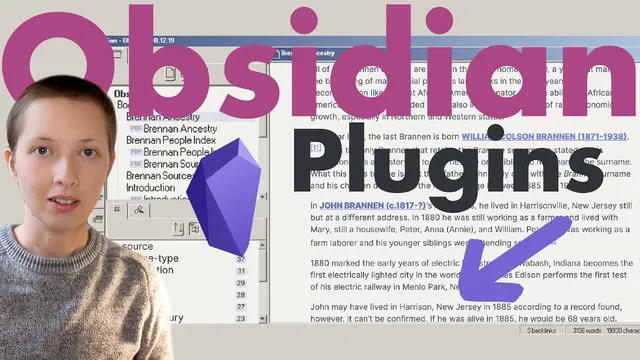
Plugins I use in Obsidian for book writing
Based on Red Gregory's video on YouTube. If you like this content, support the original creators by watching, liking and subscribing to their content.
Install Pandoc and use the Obsidian Pandoc plugin to export Markdown into LaTeX-based PDFs with more layout control than Obsidian’s default PDF export.
Briefing
Obsidian can be turned into a full book-writing system for a family-history project by combining Markdown export, structured metadata, automated linking, and lightweight “database” views. The biggest practical hurdle is getting polished PDFs out of Markdown—Obsidian’s built-in export options weren’t enough—so the workflow pivots on a two-step setup: install Pandoc, then use the Obsidian Pandoc plugin to export pages into a more controlled PDF format (specifically via LaTeX). The tradeoff is that not everything (like fancy Obsidian plugins) transfers cleanly into the final PDF look, but the approach fits the project’s mostly text-and-metadata style.
From there, the vault is organized around book structure and repeatable front matter. Instead of relying only on files and tags, the project uses a dedicated “book” folder with chapter/part sections, each paired with a PDF preview that can be updated as writing progresses. Pages include YAML-style metadata between three dashes at the top, and tags are used to label chapters. A key upgrade is the ability to nest tags—turning a simple “chapter” tag into a hierarchical “part/chapter” tag—so the same content can be grouped and navigated more naturally.
Tag management becomes a separate productivity layer with Tag Wrangler. Renaming a tag via right-click updates every occurrence across the vault, avoiding the tedious manual search-and-replace that would otherwise be required when reorganizing “chapter” into “part/chapter.” For citations and sourcing, Footnote Shortcut adds hotkeys to automate Markdown footnotes, letting the writer generate the standard footnote syntax (inline marker plus a bottom-of-page definition) without slowing down.
The workflow then connects sources to indexes and PDFs. Each family or book section has its own index page, and links use IDs (like cs1, cs17) to route readers to the correct entry. To keep this consistent, templates do most of the heavy lifting. With Templater, the writer creates a “new source” skeleton for front matter, then uses commands (such as tp.file.title) to pull metadata fields into the body of the page. The template also moves the newly created file automatically into the correct folder path using Obsidian’s folder/file linking conventions. After that, “extract current selection” pushes the relevant content into the appropriate index page, generating the link structure that ties everything together.
Finally, Dataview turns the metadata at the top of pages into clickable tables. By querying fields like year and type from tags, the writer can produce an index-style table that sorts entries (for example, by year ascending) and links directly back to the underlying notes. Additional tools round out the system: Advanced Tables for faster table authoring and formulas (like summing a column), Admonition for Notion-like callouts, Dictionary for definitions and synonym suggestions with a sidebar, and Obsidian’s graph view for visual grouping by tags (including the “part/chapter” hierarchy). The result is a repeatable pipeline: write in Markdown, maintain structured metadata, auto-generate indexes and links, and export clean PDFs for each book section.
Cornell Notes
A family-history book can be built in Obsidian by treating Markdown notes as structured records and automating the parts that normally break down: PDF export, tag organization, footnotes, and index linking. The workflow uses Pandoc plus the Obsidian Pandoc plugin to export Markdown into LaTeX-based PDFs with better layout control than Obsidian’s default export. It then relies on YAML front matter, nested tags (e.g., part/chapter), and Tag Wrangler to rename tags across the entire vault. Templater automates creating “source” pages, extracting metadata into the body, moving files into the right folder, and feeding selections into index pages. Dataview converts that metadata into sortable, clickable tables so indexes behave like lightweight databases.
Why does the workflow depend on Pandoc instead of Obsidian’s built-in PDF export?
How do nested tags and Tag Wrangler reduce maintenance when reorganizing a book’s structure?
What role do footnotes and Footnote Shortcut play in keeping sources readable?
How does the system connect individual source notes to family indexes and PDF previews?
How does Templater turn front matter into reusable, correctly filed source pages?
How does Dataview make metadata act like a searchable database?
Review Questions
- What specific export pipeline is used to produce better-formatted PDFs, and what limitation comes with it?
- Describe how nested tags and Tag Wrangler work together to keep a large vault consistent during structural changes.
- How do Templater and Dataview complement each other in building index pages and sortable tables from front matter metadata?
Key Points
- 1
Install Pandoc and use the Obsidian Pandoc plugin to export Markdown into LaTeX-based PDFs with more layout control than Obsidian’s default PDF export.
- 2
Use YAML front matter plus nested tags (like part/chapter) to encode book structure directly in each note.
- 3
Rename tags across the entire vault with Tag Wrangler to avoid manual edits when reorganizing chapters and parts.
- 4
Automate footnote creation with Footnote Shortcut so citations stay consistent while writing.
- 5
Use Templater to generate source-page skeletons, pull metadata fields into the body, and automatically move new files into the correct folder.
- 6
Build family/source index pages by extracting selections into the right index and linking entries by ID.
- 7
Turn metadata into clickable, sortable “database” tables with Dataview, using fields like year and type from front matter.