Poker Hands Probabilities with Combinatorics
Based on Duddhawork's video on YouTube. If you like this content, support the original creators by watching, liking and subscribing to their content.
Use to count rank selections and multiply by suit choices when suits are independent.
Briefing
Combinatorics can turn Texas Hold’em hand rankings into exact counts—and those counts translate directly into probabilities that explain why “good” hands are rare. Using combinations and suit/rank choices from a 52-card deck, the transcript derives how many 5-card poker hands fall into key categories (straight flush, four of a kind, full house, flush, straight, three of a kind, two pair, one pair, and high card) and then divides each by the total number of 5-card selections, .
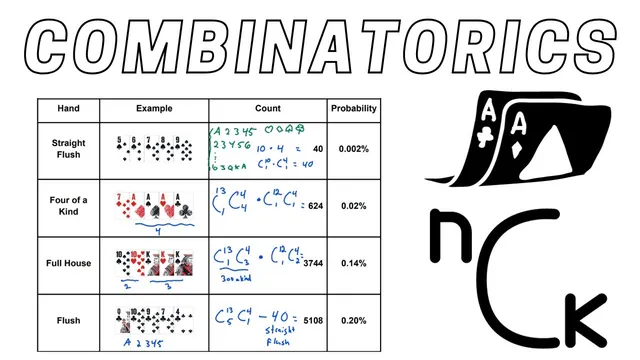
A straight flush requires five consecutive ranks in the same suit. There are 10 possible sequences of ranks (including A-2-3-4-5 as the “low” straight and 10-J-Q-K-A as the “high” straight). Each sequence can occur in any of 4 suits, giving straight flushes. Four of a kind comes from choosing one rank out of 13, taking all 4 suits for that rank, and then choosing the remaining fifth card from the other 12 ranks (4 suit options each). That yields hands, about 0.02%.
Full houses combine a three-of-a-kind plus a pair. The count starts by choosing the rank for the triple (13 choices) and selecting 3 of its 4 suits (). Then it chooses the rank for the pair from the remaining 12 ranks and selects 2 of its 4 suits (). The result is 3,744 full houses, about 0.14%—still uncommon.
Flushes are five cards of the same suit with no repeated ranks, but they must exclude straight flushes to avoid double-counting. The transcript counts flushes by choosing 5 distinct ranks from 13 and assigning a suit (4 choices), then subtracts the 40 straight flushes already counted. Straights are counted separately as 10 rank sequences, with each of the 5 cards able to take any suit (), and then subtracting the 40 straight flushes again.
Three of a kind is built by choosing the rank for the triple (13 choices), selecting 3 of its 4 suits (), then choosing two additional distinct ranks from the remaining 12 and assigning suits independently ( choices each). The transcript notes that having three of the same rank prevents the hand from being a straight flush, so no subtraction is needed. Two pair uses ways to pick the pair ranks, then suit choices for each pair, and finally a fifth card from the remaining 11 ranks with 4 suit choices. One pair chooses a rank for the pair (13), selects 2 of its 4 suits, then chooses 3 other distinct ranks from the remaining 12 and assigns suits.
The most frequent outcomes are one pair and high card. The transcript gives a one-pair count around 1,098,240 (about 42%), and a high-card count around 1,302,540 (about 50%), after subtracting straights, flushes, and straight flushes from the raw “five distinct ranks and suits” total. The takeaway is strategic: roughly 92% of hands are one pair or worse, so poker success depends heavily on playing—often bluffing and extracting value—when the starting hand is not “strong.”
Cornell Notes
Combinatorics turns poker hand categories into exact counts by selecting ranks and suits from a 52-card deck and then dividing by . The transcript derives key examples: straight flushes total , four of a kind totals 624, and full houses total 3,744. Flushes and straights require careful subtraction to avoid double-counting straight flushes. The most common results are one pair (about 42%) and high card (about 50%), meaning “better than a pair” hands are rare (about 7.6%). That rarity drives strategy: most hands are weak, so learning to play bad hands matters.
How many straight flushes exist, and why does the count equal ?
What is the logic behind the 624 hands for four of a kind?
Why do flush and straight counts subtract 40 straight flushes?
How is a full house counted from rank and suit choices?
Why is one pair so common compared with four of a kind?
Review Questions
- Which categories require explicit subtraction terms to prevent double-counting, and what overlap causes it?
- Re-derive the straight flush count by listing the 10 possible rank sequences and multiplying by suit choices.
- Using the transcript’s method, set up (but don’t fully compute) the combinatorial expression for the number of two pair hands.
Key Points
- 1
Use to count rank selections and multiply by suit choices when suits are independent.
- 2
Straight flushes come from 10 consecutive rank sequences (Ace-low through Ace-high) times 4 suits, totaling 40.
- 3
Four of a kind is counted by choosing the rank (13), taking all 4 suits, then choosing the kicker from 12 remaining ranks with 4 suits each, totaling 624.
- 4
Full houses require a triple and a pair: choose the triple rank (13), choose 3 suits (), then choose the pair rank (12) and 2 suits (), totaling 3,744.
- 5
Flushes and straights must subtract the 40 straight flushes to avoid double-counting hands that satisfy both patterns.
- 6
Three of a kind and two pair can be counted without subtraction in the transcript’s approach because the structure prevents straight flush overlap.
- 7
Strategically, one pair (~42%) and high card (~50%) dominate, so most starting hands are weak; success depends on playing bad hands effectively, including bluffing.