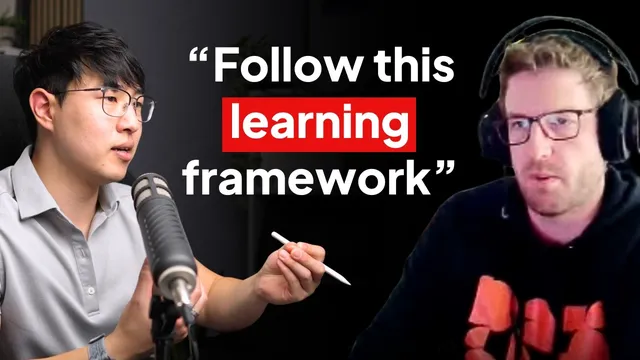
Private Lecture: How to Remember EVERYTHING You Read
Based on Justin Sung's video on YouTube. If you like this content, support the original creators by watching, liking and subscribing to their content.
Retention improves when learners build “snowballing” connections so new information attaches to an emerging big picture instead of staying isolated.
Briefing
Learning retention fails when new information stays isolated or when “progress” becomes an illusion—both outcomes turn study time into learning debt. The core fix is “snowballing”: quickly building high-quality connections so each new piece has a place to stick, and the overall mental picture becomes less overwhelming over time. When information doesn’t connect, it either fades after shallow understanding or becomes “blind debt,” where notes and tools (like second-brain systems or AI-assisted summaries) create a veneer of expertise that collapses when real recall or decisions are required.
The lecture frames effective learning as managing cognitive load through a repeated zoom-in/zoom-out cycle. At the start, learners should expect overwhelm—like dumping a thousand-piece jigsaw puzzle onto a table—because the brain needs enough pieces to form a big picture. Avoiding that overwhelm by only collecting notes or passively storing facts bypasses the organizing work that turns information into usable expertise. The danger isn’t just forgetting; it’s also building confidence without functional recall. Blind debt is especially costly in professional settings because errors may not surface until months later, when decisions or applications go wrong and the underlying knowledge gap becomes hard to diagnose.
To prevent both shallow isolation and blind debt, the method aims for a “goldilocks” cognitive zone: not so low that learning becomes rote and meaningless, and not so high that the brain tries to juggle too many interconnected pieces at once. Passive strategies that rapidly reduce cognitive effort create an illusion of learning—everything feels easier, but the knowledge never integrates. Overly complex strategies that demand all connections at once are also biologically unrealistic for most people. Instead, learners should repeatedly take a segment, organize it, then reintegrate it into the growing whole—starting with “edges” (obvious clusters) and expanding the frame as each segment becomes less overwhelming.
Snowballing accelerates once a partial big picture is 50–60% formed. At that point, new information has fewer possible locations, so integration becomes faster and memory and depth improve naturally because accurate organization requires exploring details. The lecture then shifts from principles to implementation, using a practical template.
First, learners “get the lay of the land” by collecting major keywords for the topic—often 15 for familiar areas, and 50–100 for brand-new domains. The goal is to deliberately feel confused at the start, because that confusion signals the brain has enough pieces to begin building connections. Next, learners narrow to roughly 4–6 “pillar” keywords (either by selecting the biggest landmarks for a broad overview or by filtering for a deep trench). From there, the key is hypothesizing a schema: not just finding any relationship, but finding the most meaningful one for how the knowledge will be used. Relevance is treated as a symptom of connection, not a guarantee; learners may need to actively find the path of relevance.
Finally, the lecture recommends free-form handwritten infinite-canvas mind mapping to capture relationships in a way that preserves flow, reveals how ideas are organized, and makes gaps visible. Digital tools can later replicate the same structure once the handwritten approach is fluent. The takeaway is a learning system built for retention: create a big enough puzzle to start, organize in manageable segments, reintegrate repeatedly, and test understanding by challenging the schema until it becomes functional expertise rather than stored information.
Cornell Notes
Retention improves when learners build “snowballing” connections—fast, high-quality links that let each new idea attach to an emerging mental big picture. Study time becomes learning debt when information stays isolated (shallow understanding that fades) or when it becomes “blind debt” (notes and tools create confidence without functional recall). The method uses a goldilocks cognitive-load cycle: expect initial overwhelm, then repeatedly zoom in to organize a segment and zoom out to reintegrate it, so the overall puzzle becomes progressively less overwhelming. Implementation starts with keyword collection to map the terrain, then narrows to 4–6 pillar concepts and builds an interconnected schema that reflects how knowledge will actually be used. Hand-drawn infinite-canvas mind maps help reveal gaps and keep thinking in flow.
What makes study time turn into “learning debt” or “blind debt,” and why does that matter professionally?
Why should learners expect overwhelm early, and what’s the risk of trying to avoid it?
How does the “zooming in and out” cycle prevent both rote learning and overload?
What is the practical starting template for building a snowballing learning system?
How should learners choose relationships between concepts—does “relevance” guarantee good learning?
Why does the lecture recommend free-form handwritten infinite-canvas mind mapping?
Review Questions
- What are the two main failure modes of learning described (isolation vs blind debt), and how would each show up when applying knowledge at work?
- Describe the goldilocks cognitive-load strategy. How does it differ from both passive rote learning and “connect everything at once” approaches?
- Walk through the keyword-to-schema process: how does keyword collection lead to pillar concepts and then to meaningful relationships?
Key Points
- 1
Retention improves when learners build “snowballing” connections so new information attaches to an emerging big picture instead of staying isolated.
- 2
Isolation creates learning debt because understanding without integration fades over time and can require relearning later.
- 3
Blind debt happens when notes, mind maps, or AI summaries create confidence without functional recall, leading to costly errors when decisions must be made.
- 4
Effective learning uses a goldilocks cognitive-load cycle: expect early overwhelm, then repeatedly zoom in to organize segments and zoom out to reintegrate them.
- 5
Passive strategies that quickly reduce cognitive effort create an illusion of learning; overload strategies that demand all connections at once are also counterproductive for most people.
- 6
A practical implementation starts with keyword collection to map the terrain, then narrows to about 4–6 pillar concepts before building an interconnected schema.
- 7
Hand-drawn infinite-canvas mind maps help preserve thinking flow and make gaps visible, improving calibration and long-term retention.