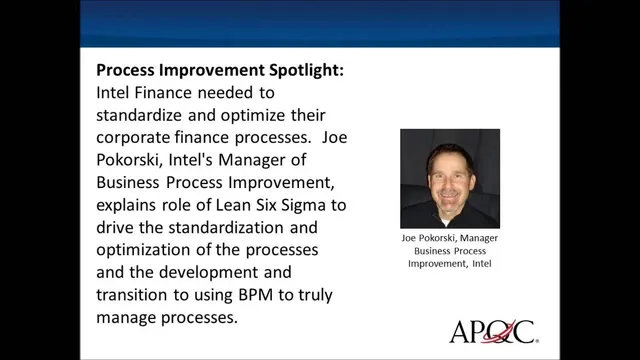
Process Improvement Spotlight: How Intel used Six Sigma to Optimize Corporate Finance Processes
Based on APQC's video on YouTube. If you like this content, support the original creators by watching, liking and subscribing to their content.
Intel’s end-to-end process shift targets both lower cost and more predictable performance by standardizing and centralizing finance work through shared service centers.
Briefing
Intel’s corporate finance push toward end-to-end process management is driven by two practical goals: cutting cost through standardization and centralization, and improving predictability so finance teams can stay ahead of deadlines and compliance requirements. By moving away from a purely functional view of work toward a true end-to-end process view, Intel aims to reduce “diving catches” (late surprises) and build confidence that processes are working consistently—supported by measurement and higher-quality outputs.
A central challenge sits in building a usable process inventory. Intel’s business process improvement leader describes process documentation less as a one-time exercise and more as an “art than a science,” because each finance workflow has natural beginning and end points, plus touch points where handoffs occur. The work requires direct engagement with the people who actually run the processes to map how work flows in practice, rather than forcing a rigid template. Even when the goal is standardization, the inventory must reflect real variations across teams and cases.
The finance transformation is tightly linked to Intel’s legal and compliance obligations. Business process management (BPM) is positioned as a way to produce high-quality outputs and to measure whether those outputs meet expectations. That measurement matters because missing a deadline or failing to follow an accounting standard can trigger scrutiny from government regulators. In that framing, process optimization isn’t just an efficiency play; it’s a risk-control mechanism that helps finance execute its “keep Intel legal” mission while freeing capacity for more value-added work.
Six Sigma plays a targeted role rather than acting as the default method for every improvement effort. Intel uses Six Sigma and Lean, but the choice depends on data availability and the nature of the problem. In finance processes where there isn’t enough data to support strong statistical conclusions, Intel leans more on Lean concepts and Kaizen events to drive improvements. The approach is pragmatic: use Six Sigma when it fits the evidence, and use Lean when the process needs faster, iterative refinement.
For BPM to last beyond initial wins, Intel emphasizes sustained management support. A kickoff is not enough; process owners must keep momentum through regular feedback loops to senior management about how processes perform over time. Without that ongoing attention, interest fades and processes backslide. Intel also highlights adoption strategy: sharing results through peer-to-peer discussions, where senior controllers from one organization demonstrate benefits to their counterparts in another, can be more persuasive than external consulting alone—especially when the management chain visibly endorses the effort.
Cornell Notes
Intel’s finance process improvement centers on shifting from functional workflows to end-to-end process management to reduce cost and increase predictability. Standardization and centralization via shared service centers are meant to lower expenses while measurement helps teams confirm processes are working and staying ahead of deadlines and accounting standards. BPM is tightly tied to compliance: higher-quality outputs and performance tracking reduce the risk of regulator challenges. Six Sigma is used selectively when enough data exists for statistical conclusions; Lean and Kaizen events fill gaps where data is insufficient. Long-term success depends on active senior management support, resources for process owners, and peer-to-peer selling of results through management-backed adoption.
Why did Intel move from a functional view of finance processes to an end-to-end view?
What makes building a process inventory difficult in corporate finance?
How does BPM connect to Intel’s compliance and legal priorities?
When does Intel use Six Sigma versus Lean or Kaizen events in finance?
What keeps BPM from fading after early success?
Why does peer-to-peer communication help BPM adoption more than outside consulting?
Review Questions
- How do standardization and centralization through shared service centers contribute to both cost reduction and predictability in finance processes?
- What criteria does Intel use to decide between Six Sigma and Lean/Kaizen approaches in corporate finance workflows?
- What mechanisms ensure BPM remains effective over time rather than reverting after initial improvements?
Key Points
- 1
Intel’s end-to-end process shift targets both lower cost and more predictable performance by standardizing and centralizing finance work through shared service centers.
- 2
Process inventories require direct engagement with process owners to identify natural start/end points and real touch points, since each case varies.
- 3
BPM supports compliance by producing measurable, high-quality outputs that help avoid missed deadlines and accounting-standard violations that can trigger regulator scrutiny.
- 4
Six Sigma is applied selectively when sufficient data exists for statistical conclusions; Lean and Kaizen events are used when data is too limited for strong statistical analysis.
- 5
BPM longevity depends on active senior management support, adequate resources, and regular feedback loops to prevent backsliding.
- 6
Adoption improves when senior controllers share results peer-to-peer within the management chain, rather than relying on external persuasion alone.