Processes: What They Mean for Organizations
Based on APQC's video on YouTube. If you like this content, support the original creators by watching, liking and subscribing to their content.
APQC treats organizational work as repeatable processes that transform inputs into outputs, and that framing is essential for improvement.
Briefing
APQC’s core message is that organizations improve performance and benchmark more effectively when they define their work in terms of organizational processes—inputs transformed into outputs—using a shared classification system. Most organizations accomplish work through repeatable processes, even if they label them as departments, functions, or agencies. Without a clear, common definition of those processes, it becomes difficult to measure productivity, track leading and lagging indicators, identify critical success factors, and decide what to change or what to learn from other organizations.
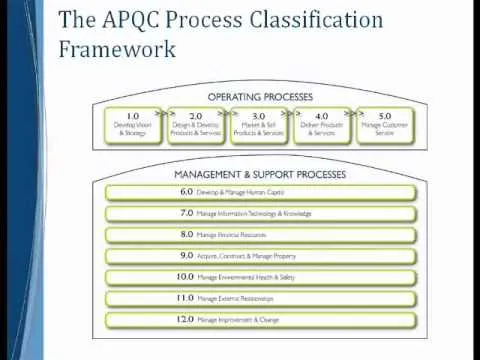
To solve that problem, APQC points to its Process Classification Framework (PCF), developed in the early 1990s as a general model for classifying processes across companies. The PCF gives organizations a common language for discussing how work gets done and supports governance around that work. That common vocabulary matters because process names vary widely—procurement can be called buying, purchasing, material acquisition, and more—yet the underlying activities need to be comparable if benchmarking is going to produce useful insights.
A practical example illustrates what goes wrong without process alignment. In a benchmarking effort focused on a “call center,” one organization repeatedly hit roadblocks: other companies turned them away, saying they didn’t have a call center. The mismatch came from terminology and scope. The benchmarking team’s target function actually operated as a broader contact center, handling customer inquiries through calls, web-based requests, email, and field service. By using the PCF to break the work into specific activities, the team could describe what they wanted to learn in a way that matched the other organizations’ real capabilities, and the benchmarking effort regained momentum.
APQC describes the PCF as an enterprise-wide structure that starts with 12 major process categories. Those categories then break down into process groups and further into process activities. Organizations are encouraged to study the framework and adapt it to their own structure; differences in process groups and activities are expected. The key is that the framework helps teams understand how processes work, how they should be measured, and where improvement efforts should focus.
The HR example shows how the PCF can drill down to a specific process group: within the human capital (HR) area, a process group labeled 6.4 describes a detailed HR domain. APQC argues that having this kind of process map supports improvement in two ways: teams can identify what to change by examining the process itself, and they can align processes to organizational objectives and goals. In short, process clarity enables better measurement, better benchmarking conversations, and better internal alignment—three prerequisites for turning performance improvement from guesswork into a structured effort.
Cornell Notes
APQC frames organizational work as a set of processes that take inputs (from outside or other internal groups), act on them, and produce outputs. Because process names and boundaries vary across organizations, benchmarking and performance measurement fail when teams lack a shared definition of what “the process” actually is. APQC’s Process Classification Framework (PCF), created in the early 1990s, provides a common language for classifying work into enterprise-wide categories, process groups, and activities. The framework helps organizations identify what to improve, measure performance consistently, and align processes with goals. A contact-center benchmarking example shows how using PCF activity-level descriptions can resolve mismatches caused by terminology like “call center.”
Why does APQC emphasize defining processes before trying to improve performance or benchmark?
How does the Process Classification Framework (PCF) help create a common language across organizations?
What went wrong in the “call center” benchmarking attempt, and how was it fixed?
What is the PCF’s structure at the enterprise level, and how does it get more specific?
How does drilling down to a specific HR process group support improvement and alignment?
Review Questions
- What measurement and improvement tasks become harder when an organization lacks a common process definition?
- How does the PCF’s category → process group → activity structure support both benchmarking and internal alignment?
- In the contact-center example, what specific difference in scope caused other organizations to reject the benchmarking request?
Key Points
- 1
APQC treats organizational work as repeatable processes that transform inputs into outputs, and that framing is essential for improvement.
- 2
Without shared process definitions, organizations struggle to measure productivity, interpret indicators, set critical success factors, and choose what to change.
- 3
APQC’s Process Classification Framework (PCF) provides a common language for comparing how work gets done across organizations.
- 4
Benchmarking fails when teams rely on labels like “call center” instead of describing the underlying activities and scope.
- 5
The PCF starts with 12 enterprise-wide process categories and drills down into process groups and activities for actionable measurement.
- 6
Using PCF helps organizations align processes to objectives and goals by mapping what actually happens inside each functional area.
- 7
Organizations should adapt the PCF to their own structure, since process groupings and activities may differ while still remaining comparable.