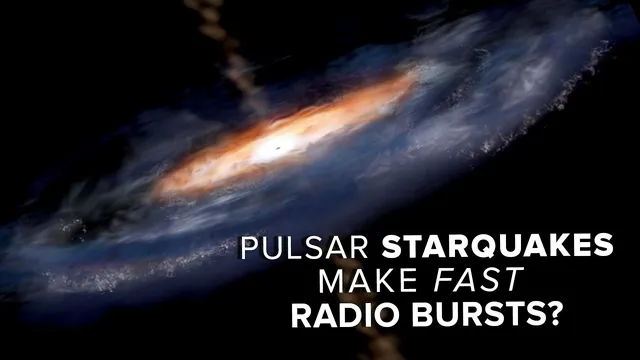
Pulsar Starquakes Make Fast Radio Bursts? + Challenge Winners! | Space Time | PBS Digital Studios
Based on PBS Space Time's video on YouTube. If you like this content, support the original creators by watching, liking and subscribing to their content.
A repeating FRB implies the emitting object survives, making catastrophic, one-time destruction scenarios like supernovae and black-hole-forming collapses unlikely.
Briefing
Fast radio bursts (FRBs) are no longer pinned to one-off cosmic catastrophes. After astronomers found a repeating FRB—detected multiple times in 2012 and 2015 by the Arecibo telescope—researchers concluded the source must survive the bursts. That shift rules out “destroy-the-source” scenarios such as supernovae or neutron stars collapsing into black holes, and pushes attention toward young, rapidly rotating neutron stars whose rotation glitches and starquakes can trigger intense, short-lived radio flashes without necessarily ending the object’s life. The repeating behavior also changes the odds for discovery: with repetition now confirmed, scientists can hope to catch the mechanism in action rather than only inferring it from one-off events.
The transcript also ties FRBs to a broader theme in cosmology: how light travels through the universe’s changing conditions. One challenge question asked how far cosmic microwave background (CMB) photons have traveled to reach Earth. The answer is straightforward—about 13.7 billion light-years, matching the age of the universe—because the photons have been traveling at the speed of light since the CMB was released.
A second, more “mathy” challenge asked for the average distance a photon could travel before encountering an electron around the time of recombination, when the universe was filled with plasma. At that stage, free electrons scatter light efficiently, described by the Thomson scattering cross-section (6.65 × 10^-29 m^2). The calculation starts by estimating the electron density at recombination. Using a baryonic mass for the observable universe of about 10^53 kilograms and assuming roughly one electron per proton, the transcript estimates ~6 × 10^79 electrons in the observable universe. Then it scales the universe’s size back to recombination using the CMB redshift (1,089), shrinking today’s radius (46.6 billion light-years) to about 42.3 million light-years at that time. Spreading the electrons through the resulting volume yields an electron density near 200 million electrons per cubic meter.
With electron density and scattering cross-section in hand, the mean free path emerges as the characteristic distance over which a photon’s possible paths become effectively blocked—about 7,500 light-years. Even though that is tiny compared with the universe’s size at recombination, it supports a key physical picture: the pre-recombination universe was still “opaque,” with light frequently scattered, preventing it from streaming freely until recombination reduced the number of free electrons. The transcript closes by announcing challenge winners and prize details, but the scientific takeaway is the same: repeating FRBs narrow the search for their engines, while recombination-era scattering explains why the early universe couldn’t let light travel unhindered.
Cornell Notes
Fast radio bursts can repeat, and that single observational fact sharply narrows the list of possible origins. A repeating FRB detected by Arecibo in 2012 and 2015 implies the emitting object survives the bursts, making “one-time destruction” scenarios like supernovae or black-hole-forming collapses unlikely. Instead, the leading idea becomes young, rapidly rotating neutron stars whose glitches and starquakes can generate brief, intense radio flashes.
The transcript also uses two CMB challenge problems to illustrate photon travel in the early universe. CMB photons have traveled about 13.7 billion light-years at light speed since the CMB was released. Before recombination, free electrons scattered light efficiently; using the Thomson cross-section and an estimated electron density at recombination yields a mean free path of roughly 7,500 light-years, showing why the early universe was opaque.
Why does a repeating fast radio burst rule out many “cataclysmic” explanations?
What observational detail anchors the repeating-FRB argument?
How far have CMB photons traveled to reach us, according to the challenge solution?
Why are free electrons such a problem for photons before recombination?
How is the mean free path near recombination estimated, and what value results?
What does a mean free path of ~7,500 light-years imply about the early universe’s transparency?
Review Questions
- What specific observational change (repetition) forces a shift from “destroy-the-source” FRB models to neutron-star-based mechanisms?
- Using the Thomson scattering cross-section and an electron density estimate, how does one conceptually define mean free path for photons in a plasma?
- Why does the universe’s redshift at recombination matter for converting today’s size into the earlier volume used for density calculations?
Key Points
- 1
A repeating FRB implies the emitting object survives, making catastrophic, one-time destruction scenarios like supernovae and black-hole-forming collapses unlikely.
- 2
The repeating FRB discussed was detected multiple times (2012 and 2015) using the Arecibo telescope, strengthening the case for non-cataclysmic origins.
- 3
Young, rapidly rotating neutron stars are favored because rotation glitches and starquakes can generate intense radio bursts without necessarily destroying the star.
- 4
CMB photons have traveled about 13.7 billion light-years to reach Earth, corresponding to the universe’s age and light-speed propagation.
- 5
Before recombination, free electrons scattered light efficiently due to the Thomson scattering cross-section (6.65 × 10^-29 m^2).
- 6
Estimating electron density at recombination using baryonic mass, electron counts, and redshift scaling yields a mean free path of about 7,500 light-years.
- 7
A mean free path much smaller than the universe’s size at recombination explains why the early universe was opaque to light.