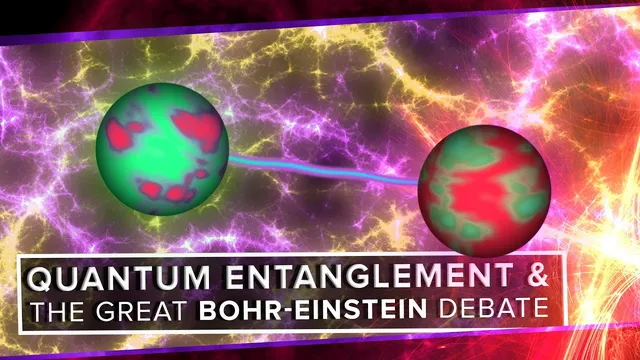
Quantum Entanglement and the Great Bohr-Einstein Debate | Space Time | PBS Digital Studios
Based on PBS Space Time's video on YouTube. If you like this content, support the original creators by watching, liking and subscribing to their content.
Entanglement intensifies a conflict between realism (definite properties independent of observation) and locality (no faster-than-light influence).
Briefing
Quantum entanglement forces a choice between two cherished ideas: that physical reality exists independently of observation (realism) and that influences cannot act faster than light (locality). The core dispute traces back to Niels Bohr’s Copenhagen interpretation versus Albert Einstein’s insistence on an objective, underlying reality. Bohr treated quantum systems between measurements as a “fuzzy mixture” of possibilities described by a wave function; only measurement yields definite outcomes. Einstein countered that the wave function must be incomplete, implying hidden variables that would restore a more classical picture—while still respecting locality.
Einstein, Boris Podolsky, and Nathan Rosen sharpened the challenge with the EPR paradox. They argued that if entangled particles share connected properties, then abandoning realism would also require abandoning locality, because any instantaneous link would violate the relativity-based rule that cause and effect can’t propagate faster than light. In entanglement experiments, two particles interact briefly and then separate, yet their properties remain correlated in a way that depends on how measurements are chosen. Under Copenhagen-style collapse, measuring one particle collapses the shared entangled wave function, instantly fixing the partner’s outcome—creating the “spooky action at a distance” Einstein disliked.
The turning point came in 1964, when John Stewart Bell proposed a way to test the competing assumptions experimentally. Bell derived Bell inequalities—numerical predictions that local hidden-variable theories should obey. If entanglement experiments violate those inequalities, then local realism cannot hold in the form Einstein and colleagues envisioned. The practical challenge is that entangled states are fragile: any stray interaction can destroy the entanglement. Still, experiments in the early 1980s led by Alain Aspect used entangled photon pairs and measured correlations in polarization. The results violated Bell inequalities, including setups designed so that any putative influence would have to travel faster than light.
Those findings have since been reproduced over increasing distances, and related demonstrations such as the delayed choice quantum eraser reinforce the same message: the correlations match quantum mechanics and undermine models that rely on local hidden variables. But the experiments do not automatically settle which philosophical pillar falls first. Bell’s own view was that the inequalities disprove locality, while realism might be rescued by abandoning the idea that influences must be local.
Relativity remains intact because no experiment allows controllable faster-than-light information transfer. Instead, the “influence” shows up only when measurement results are compared after the fact, preserving causality even if the underlying account feels non-classical. That leaves multiple interpretations on the table: Copenhagen remains consistent with quantum observations, while realist hidden-variable approaches can survive only by giving up locality. Examples include De Broglie-Bohm pilot-wave theory and proposals involving Einstein-Rosen bridges (wormholes) to connect entangled systems. The many-worlds interpretation offers another route by keeping realism and locality at the cost of branching outcomes. In short, entanglement doesn’t just reveal a weird quantum trick—it redraws the boundary of what “real” and “local” can mean in physics.
Cornell Notes
Entanglement links separated particles so that measurement outcomes are correlated in a way that depends on the chosen measurement settings. Bohr’s Copenhagen interpretation treats the wave function as a complete description until measurement collapses it, while Einstein argued the wave function is incomplete and that hidden variables should restore objective reality. Bell’s 1964 inequalities provided a decisive test: if local hidden variables exist, correlations must obey specific numerical limits. Experiments—especially those by Alain Aspect using entangled photon polarization—violated Bell inequalities, ruling out local realism in the Einstein-style sense. The results still preserve relativity’s causality because they do not enable faster-than-light information transfer; the “nonlocality” appears only in correlations revealed after measurements are compared.
What does realism mean in physics, and why does quantum mechanics threaten it?
How do Bohr and Einstein differ on what the wave function represents?
What is the EPR paradox trying to force, and how does locality enter?
What did Bell inequalities accomplish that earlier debate couldn’t?
Why did Alain Aspect’s experiments matter, and what did they measure?
Does violating Bell inequalities prove faster-than-light communication is possible?
Review Questions
- How do Bell inequalities connect the assumptions of local hidden variables to measurable correlation patterns in entangled experiments?
- What specific role does measurement choice (measurement axis) play in producing entanglement correlations?
- Why can entanglement violate locality without enabling faster-than-light communication?
Key Points
- 1
Entanglement intensifies a conflict between realism (definite properties independent of observation) and locality (no faster-than-light influence).
- 2
Bohr’s Copenhagen interpretation treats the wave function as complete between measurements, with definite outcomes emerging only at measurement.
- 3
Einstein, Podolsky, and Rosen argued that abandoning realism would require abandoning locality, motivating the EPR challenge.
- 4
John Stewart Bell converted the debate into testable Bell inequalities that local hidden-variable theories must satisfy.
- 5
Experiments led by Alain Aspect using entangled photon polarization violated Bell inequalities, undermining local hidden-variable explanations.
- 6
Relativity’s causality survives because entanglement experiments do not permit faster-than-light information transfer—only post-measurement correlations are revealed.
- 7
Multiple interpretations remain viable only by changing assumptions: Copenhagen keeps quantum collapse, while realist hidden-variable approaches sacrifice locality or adopt alternatives like many worlds.