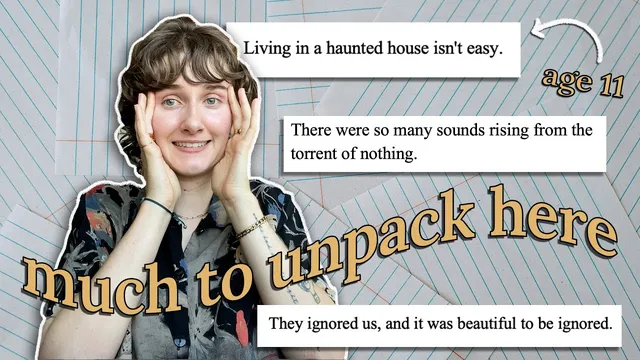
reacting to the flash fiction I wrote as a teenager😬
Based on ShaelinWrites's video on YouTube. If you like this content, support the original creators by watching, liking and subscribing to their content.
Multiple pieces rely on trapped isolation (can’t leave, lone survivor, or purposeless wandering) as the core engine for tension.
Briefing
Teen flash fiction from grades six through nine is less about plot and more about atmosphere—black skies, trapped characters, and high-drama imagery—yet the writing often collapses under its own melodrama. Across multiple pieces, the recurring setup is a narrator stuck in an uncanny place (a cove, a haunted house, a storm-battered beach), with stakes that sound enormous but rarely come with clear reasons, rules, or consequences. The result is a distinctive teenage style: long, lyrical monologues that pivot suddenly into threat, then end without fully landing the emotional payoff.
“The Cove” centers on a lone human living in a perpetual-night shoreline where the sand is black and the water is “a nightmare.” The narrator insists they can’t leave and that someone—possibly ghosts—has left messages and bones in the sand, while also rejecting belief in ghosts. The tone is intentionally ominous, but the tension feels manufactured: the narrator repeatedly signals danger (“I could die,” “someone is watching”) without establishing why escape is impossible or what the “raven” actually represents. A raven sits on a rocky shelf, never moving or speaking, until it suddenly screeches and then disappears—leaving the narrator “truly alone.” The emotional punch lands more as a jolt than a payoff, because the stakes are declared rather than earned.
“The Figure” pushes the same pattern into a post-apocalyptic register. A lone figure walks past wreckage—broken-down vehicles, abandoned shops, a closed school—while waves personified as cautious, taunting creatures roll in and out. The prose leans heavily on sensory accumulation (wind, rain, footsteps) and on time-bending phrasing (“minutes…hours…days…seconds…fractures of time”), but the figure’s motivation stays stubbornly blank: nothing is interesting, and the only purpose is walking. The piece reads like a mood experiment—beautifully constructed images and rhythm—without a coherent “why,” so the ending feels like a refusal to provide meaning.
“Ink and Diamonds” is the most overtly lyrical. It builds a lake-world of shimmering tar-like water and diamond-crushed dawns, then layers metaphor after metaphor—breath like a cedar tree, lungs like paper bags, roots growing from skin—while also introducing seemingly unrelated antagonists and “ancient languages.” The imagery can be striking, but the emotional logic doesn’t connect: nature reverence clashes with an unclear “sea” threat, and the narrative drifts into non sequiturs. The final line (“We used to go down to the lake, but not anymore”) invites two readings—growing up and losing magic, or a literal apocalypse—yet the middle never clarifies which.
“Ghostly Nights,” written around age 11 after being selected for a district anthology, shows the earliest version of the same template: a haunted-house narrator who never fully explains how they got there, who can’t leave, and who experiences constant supernatural pressure (a dark sky, eerie shadows, a candle that drives off ghosts, an organ that plays different songs every day). The piece even includes a point-of-view shift the reader can feel, but the core ingredients—trapped isolation, mystery without answers, and vivid gothic images—are already in place. Taken together, the work is a snapshot of teenage ambition: strong sensory instincts and memorable metaphors, paired with uncertainty about structure, causality, and emotional payoff.
Cornell Notes
These flash fictions share a consistent teenage blueprint: a narrator trapped in an eerie environment, surrounded by ominous imagery, with threats that feel big but often lack clear explanation. “The Cove” uses a lone-human-in-perpetual-night setup and a raven that shifts from silent watcher to sudden screech and disappearance, leaving the narrator “truly alone.” “The Figure” keeps the same emptiness of motive—everything is ruined and stormy, yet the figure only walks, even as time fractures. “Ink and Diamonds” leans hardest into lyrical metaphor, but the emotional logic and world rules stay fuzzy, making the ending ambiguous. “Ghostly Nights” shows the earliest form: haunted-house isolation, a candle-versus-ghosts dynamic, and an organ of changing music—still without answers for how or why the narrator is trapped.
What recurring narrative “engine” drives multiple pieces, and how does it affect reader payoff?
How does “The Cove” create suspense, and why does it feel under-supported?
What technique does “The Figure” use to build a post-apocalyptic mood, and what’s missing?
Why does “Ink and Diamonds” feel both impressive and confusing at the same time?
What early-structure traits show up in “Ghostly Nights,” and what do they foreshadow?
Review Questions
- Which story most clearly uses a “silent watcher” figure, and what emotional effect does that figure’s sudden change create?
- Pick one piece and list two examples of vivid imagery; then explain what information is missing that prevents the stakes from feeling fully real.
- How do the endings of “Ink and Diamonds” and “The Cove” differ in ambiguity, and what earlier details push each ending toward its interpretation?
Key Points
- 1
Multiple pieces rely on trapped isolation (can’t leave, lone survivor, or purposeless wandering) as the core engine for tension.
- 2
Atmosphere is built through recurring gothic visuals—black sand, dark skies, haunted interiors—more than through plot mechanics.
- 3
Stakes are often declared (“could die,” dread, danger) without clear causes or rules, weakening emotional payoff.
- 4
Teenage style shows a pattern of long monologues that pivot suddenly into threat, then end before the reader gets full explanation.
- 5
Lyrical metaphor is a strength: several images are striking even when the surrounding logic is unclear.
- 6
World rules and motivations frequently stay vague, making endings ambiguous (especially in “Ink and Diamonds”).
- 7
Earlier work (“Ghostly Nights”) already contains the later template: mystery, isolation, and supernatural phenomena without clear origin.