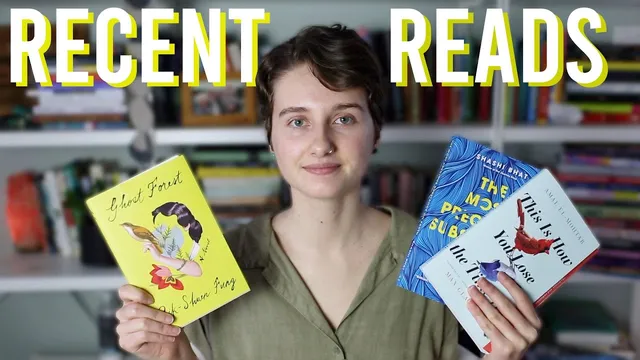
Recent Reads #37 | Internet novels & plotless beauty
Based on ShaelinWrites's video on YouTube. If you like this content, support the original creators by watching, liking and subscribing to their content.
Ratings are treated as personal measures of enjoyment and subjective craft, not as judgments of a book’s universal artistic value.
Briefing
Book ratings in this “Recent Reads” episode come with a clear philosophy: enjoyment and craft assessments are treated as personal, not as a verdict on a book’s inherent worth. That framing sets up a run of sharply opinionated reactions—ranging from lyrical refugee fiction to internet-satire form experiments—where the value of each novel is measured less by universal “goodness” and more by how it landed emotionally and artistically.
The first major standout is “What Strange Paradise” by Amar El Akkad, structured across two timelines and two young lives: Vonna, a teen on a tourist island, and Ammar, a Syrian refugee boy whose ship survives a storm and who washes ashore. The praise centers on prose that feels both evocative and hyper-real about war, plus characters that operate like embodiments of ideas without turning into cardboard. The novel’s blend of lyrical impressionism with stark realism is explicitly compared to Mohsin Hamid’s “Exit West,” not because the themes match, but because the stylistic balance does.
Shelley Parker-Chan’s “She Who Became the Sun” shifts the focus to 14th-century China and a peasant girl, You, who inherits her dead brother’s identity and fate by joining a monastery. The strongest moments are internal: You’s interiority and emotional conflict. The book weakens, in this reader’s view, when the narrative leans harder into external action and war, pulling attention away from the character’s inner development. There’s also a wish for more romance development—especially given the novel’s disguised-identity, gendered tension setup.
Ali Smith’s “Summer,” the final installment of the “Seasons Quartet,” is described as airy and philosophically bright, with the series’ habit of rooting itself in current events—this time including references to the 2020 pandemic. Still, it lands as the weakest of the quartet for two reasons: the interpersonal situation is least compelling, and the writing is less experimental than earlier books. The ranking that follows—“Winter” first, then “Autumn,” then “Spring,” then “Summer”—signals where the series’ formal play felt most alive.
Science fiction and form become the next battleground. “This Is How You Lose the Time War” by Amal El-Motar and Max Gladstone delivers a romance built from time agents exchanging messages across a conflict between Red (a post-singularity technotopia) and Blue (a single vast consciousness embedded in organic matter). The concept is called “pure genius,” and the world is praised for tactile originality and detail. Yet the reader struggles with mechanics and stakes: why the war requires mutual destruction when timelines can coexist, and how time travel functions. The romance is also seen as slightly over-weighted compared with the world-building.
Other reactions broaden the range. “The Idiot” by Elif Batuman is praised for capturing mid-90s Harvard life as a year of questions rather than conclusions, with small moments feeling meaningful and people feeling hyper-specific. “No One Is Talking About This” by Patricia Lockwood is split: the internet-mirroring first part is brilliant at recreating the absurdity of being online but doesn’t progress emotionally, while the second part hits hard, including a content warning for abortion access-related tragedy.
The episode closes with quieter, character-centered works (“Ghost Forest” by Pik Shweng Fung, “The Most Precious Substance on Earth” by Shashi Bhat) and one disappointment (“Rest and Be Thankful” by Emma Glass), where intense pediatric-hospital labor sometimes feels like intensity without enough emotional payoff. Across the list, the throughline is how form, interiority, and emotional pacing determine whether a book feels alive on the page—regardless of any universal ranking of “best.”
Cornell Notes
This episode treats book ratings as personal—measuring enjoyment and subjective craft impressions rather than declaring universal artistic value. “What Strange Paradise” is praised for lyrical, war-aware prose and characters that feel like real people while reflecting ideas. “She Who Became the Sun” is strongest in You’s interiority, but the war-driven middle is seen as weakening internal character development and romance momentum. “Summer” is airy and philosophically rich yet judged the least experimental and least compelling of the “Seasons Quartet.” Several other novels are evaluated through form and emotional pacing: “This Is How You Lose the Time War” earns high praise for concept and world detail but leaves mechanics/stakes too fuzzy; “The Idiot” succeeds by making small, contemplative moments feel purposeful.
Why does the episode’s rating philosophy matter for interpreting the scores given to each book?
What makes “What Strange Paradise” stand out stylistically and structurally?
Where does “She Who Became the Sun” gain and lose momentum, according to the reader?
How does “This Is How You Lose the Time War” balance romance, world-building, and clarity?
What is the core tension in the reaction to “No One Is Talking About This”?
Why does “Ghost Forest” resonate despite its sparse, airy structure?
Review Questions
- Which books in the episode are praised primarily for interiority, and which are praised primarily for plot/world mechanics?
- How does the reader’s preference for character-driven narratives shape the criticisms of “She Who Became the Sun” and the praise for “The Idiot”?
- What kinds of clarity problems (mechanics, stakes, emotional progression) repeatedly affect the reader’s enjoyment across different genres?
Key Points
- 1
Ratings are treated as personal measures of enjoyment and subjective craft, not as judgments of a book’s universal artistic value.
- 2
“What Strange Paradise” is praised for combining lyrical, impressionistic prose with hyper-realistic depictions of war across two timelines.
- 3
“She Who Became the Sun” is strongest when it digs into You’s interiority; the war-focused middle is criticized for reducing inner character development and romance momentum.
- 4
“Summer” is described as airy and philosophically rich but judged the weakest “Seasons Quartet” entry due to less compelling interpersonal stakes and reduced experimental form.
- 5
“This Is How You Lose the Time War” earns major praise for originality and tactile world detail, while losing points for unclear time-war mechanics and stakes.
- 6
“No One Is Talking About This” is split: the online-form first part is brilliant but emotionally non-progressive, while the second part delivers strong impact with a sensitive content warning.
- 7
“Ghost Forest” succeeds through sparse, poem-like negative space that still builds a full emotional picture of characters and grief.