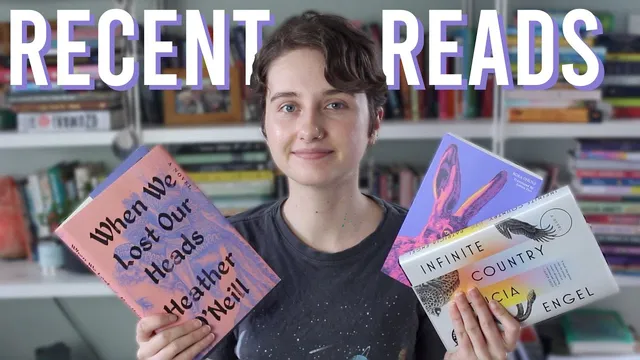
Recent Reads #38 (while a kitten is climbing on me)
Based on ShaelinWrites's video on YouTube. If you like this content, support the original creators by watching, liking and subscribing to their content.
“Summer Water” earns praise for escalating vignettes and a close-but-external POV effect, but leaves the reader uninvested because characters never deepen and the ending payoff feels rushed.
Briefing
A month of reading delivered a clear pattern: many of these books impressed most at the sentence level—voice, form, and atmosphere—while emotional payoff and character intimacy often lagged. The result was an eclectic stack that felt shaped less by a grand theme than by delayed deliveries, with each title landing as its own experiment in style and effect.
Sarah Moss’s “Summer Water” opens on a Scottish park of rental cabins where multiple families and visitors orbit one another over a single day. The structure of escalating vignettes and Moss’s unusual point of view—close to characters yet still oddly external—creates technical momentum. But the book’s payoff arrives too quickly, and the narrator’s distance prevents deep attachment. The chapter craft is memorable; the overall impact isn’t.
Isabella Wong’s debut poetry collection “Pebble Swing” hits harder through place-based imagery. Rooted in Vancouver (including details tied to the reader’s childhood), the poems pull nostalgia without relying on direct “relatability.” The collection leans more toward narrative or situation than strictly lyrical poetry, yet still lands with beauty and promise for what comes next.
Rachel Cusk’s “Second Place” follows a woman with a coastal property and a guest artist, tracking a summer of paintings and relationships. The prose runs breathless and internal, close to stream-of-consciousness. That intensity usually works for the reader, but here it buries immediacy and makes the storyline hard to track. Even when relationships shine—especially how the narrator perceives others—the book’s form feels like it swallows the plot.
“White on White” by Iseul Savas (translated by Sarah Booker) is praised for its classy, airy elegance and intimate tone, but criticized for shifting into “witnessing.” The narrator becomes compelling, yet the narrative turns so focused on observing Agnes that the narrator’s own progression stalls. The result is a beautiful atmosphere that costs the protagonist’s centrality.
The strongest emotional hit comes from Heather O’Neill’s “When We Lost Our Heads,” a Montreal historical novel about two girls, Marie and Sadie, whose intense friendship carries through their lives. O’Neill’s trademark blend of childlike strangeness and adult grit is described as uncanny but full of heart, with the relationship rendered as the engine of the book.
Monica Ojeda’s “Jawbone” (translated by Sarah Booker) blends horror with adolescence and surreal play, including inventive sections such as transcripts of therapy sessions. Still, clarity and payoff suffer: dense paragraphing, multiple timelines, and a least-convincing Clara thread leave some threads muddled, even if standout moments burn brightly.
Bora Chung’s “Cursed Bunny” (translated by Anton Hur) is a genre-hopping short story collection—sci-fi, horror, fable, fantasy—where the best pieces (like “The Head” with its replica-self horror) feel vivid, but other stories land as familiar and under-imaged.
Patricia Engel’s “Infinite Country” is commended for smooth, intentional prose and occasional gorgeous turns of phrase, yet characters feel distant and emotionally under-specified. The narrative ramps stakes late, but too late to generate urgency.
Finally, two verse works underline the same theme: “Where by Layli Long Soldier” is celebrated for its meticulous deconstruction of language and punctuation, while Maurice Meyers’s “Northwood” is called visually stunning and stylistically original, but its affair plot feels over-familiar and under-developed in transitions.
Across the stack, the through-line is that craft can be dazzling even when character connection, clarity, or narrative payoff doesn’t fully arrive.
Cornell Notes
The reading run is dominated by books that excel in style—voice, form, and atmosphere—while emotional connection and narrative payoff often fall short. “Summer Water” and “White on White” are praised for technical POV and elegant vibes, but criticized for distance from characters and a shift away from the protagonist’s own arc. “When We Lost Our Heads” stands out as the most satisfying blend of uncanny style and heart, driven by a powerful lifelong friendship. “Jawbone” and “Infinite Country” show how dense structure or late-ramping stakes can blur clarity and weaken urgency, even when prose is strong. Poetry and verse are treated as the clearest wins: “Pebble Swing” for place-based imagery and “Where” for language deconstruction.
What tends to happen when a book’s style is praised but its emotional payoff is criticized?
Which books are singled out for relationship-driven strength, and why?
How do the reader’s preferences shape reactions to poetry and verse?
What structural choices cause clarity or urgency problems in the more plot-driven novels?
Why does “genre range” help in some collections but not others?
Review Questions
- Which specific narrative techniques (POV distance, witness-focused narration, breathless internal style) most often reduce character attachment in these reviews?
- Pick two books praised for style and compare what kind of payoff each delivers (or fails to deliver). What differs about the ending or protagonist arc?
- How do clarity tools—timeline management, paragraph structure, and pacing of stakes—affect the reader’s sense of urgency and emotional connection?
Key Points
- 1
“Summer Water” earns praise for escalating vignettes and a close-but-external POV effect, but leaves the reader uninvested because characters never deepen and the ending payoff feels rushed.
- 2
“Pebble Swing” stands out for place-based imagery tied to Vancouver and childhood nostalgia, even while leaning more toward narrative/situational poetry than purely lyrical forms.
- 3
“Second Place” suffers from breathless, deeply internal prose that reduces immediacy and makes the storyline harder to follow, despite compelling relationship dynamics.
- 4
“White on White” delivers elegant, intimate vibes, but the narrative’s shift toward the narrator as a witness weakens the narrator’s own protagonist arc.
- 5
“When We Lost Our Heads” is the emotional high point, combining uncanny, childlike strangeness with adult grit and centering a lifelong friendship that carries the book.
- 6
“Jawbone” and “Infinite Country” show how dense structure or late stake escalation can blunt clarity and urgency, even when prose is strong or inventive.
- 7
Verse and poetry are repeatedly treated as the strongest matches: “Pebble Swing” for imagery, “Where” for language deconstruction, and “Northwood” for style—though its plot feels familiar.