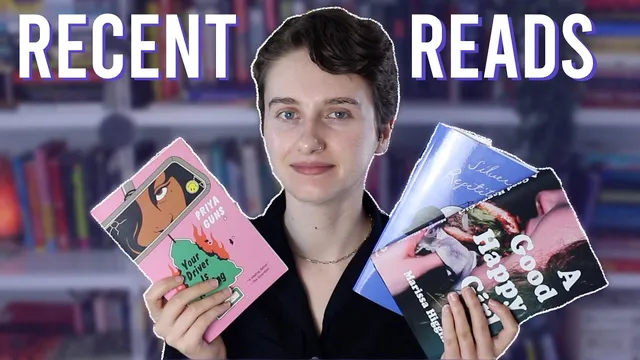
Recent Reads #55 | weird girl fiction & translated books
Based on ShaelinWrites's video on YouTube. If you like this content, support the original creators by watching, liking and subscribing to their content.
AA Basar’s “Boulder” is praised for delivering large emotional shifts in a short format by using time skips that communicate change through “blank spaces.”
Briefing
A standout theme across these recent reads is how sharply some short, translated, or formally inventive books can compress emotion—while other titles lose trust by over-directing the reader’s feelings. The clearest example is AA Basar’s “Boulder,” a very short, relationship-driven novel that spans years through time skips without feeling like filler. The story follows a woman who works on a ship, meets an Icelandic woman, and eventually moves to Iceland together; the relationship centers on love and a major disagreement about having a child. Basar’s narration is praised for its raw intensity and for an “inner world” that can be both fascinating and occasionally problematic—yet always compelling. The book’s efficiency is the point: big emotional shifts land in the “blank spaces,” where time jumps do the heavy lifting.
That same compression shows up in other ways, but not every book earns its emotional control. Sheila Hedy’s “How Should a Person Be” leans into autofiction and a playful, literal exploration of its central question. The narrator’s openness to confusion drives the reflection, producing a philosophical tone that doesn’t pretend certainty. Even with a middling rating (3.5), the appeal is clear: the form is flexible, vulnerable, and built around the idea that figuring yourself out is ongoing.
By contrast, Liv Little’s “Rosewater” disappoints for its tone and trust issues. The novel follows a woman kicked out of her apartment who moves in with a best friend and tries to make it as a poet. The criticism is specific: the prose feels over-narrated and overly sentimental, dialogue doesn’t sound natural, and the book tells readers how to feel—especially around sex work. The sex worker friend is depicted as empowered, but clients are treated with prejudice, and the overall framing reads as if the book assumes readers need to be guided into the “correct” stance.
Several heavier translated works land on intensity and trauma. Ktoi Lee’s “Solo Dance” centers a Taiwanese lesbian in Tokyo who survived corrective rape and now carries deep depression; the plot moves toward suicide plans after a final world-travel impulse. The reading experience is described as extremely intense and emotionally nuanced, with cultural context sometimes shaping character decisions in ways that may not track for every reader. E. Miles’s “Chelsea Girls,” read on a flight, offers flashes of insight but feels rambly and uneven, with a surprising emphasis on relationships with men compared with women.
After returning home, the list shifts toward psychological suspense, messy queer fiction, and classic short stories. Fawn Parker’s “What We Both Know” is praised for its dark, subtextual psychological tension as a writer ghosts a memoir for her father with Alzheimer’s—while uncovering unsettling truths about his past. Marissa Higgins’s “A Good Happy Girl” is enjoyable but criticized for lacking heat despite promising dynamics involving a dating setup with a married couple. Priya Guns’s “Your Driver Is Waiting” emerges as the favorite: a hyperreal, possibly Toronto-set story about a ride-share driver whose relationship spirals into disaster, with the main complaint being that the romance begins late and could have benefited from a slower build.
The episode closes with Raymond Carver’s “What We Talk About When We Talk About Love,” where the craft is admired—stories are efficient and quietly focused on everyday middle-class life—but the emotional payoff feels less compelling to this reader, especially given the collection’s classic, lesson-like endings. Across the stack, the strongest books are those that either trust the reader’s interpretation or use form—time skips, poetic structure, or tight short-fiction craft—to make emotion land fast and true.
Cornell Notes
These reads highlight a split between books that earn emotional control through form and pacing, and books that feel like they steer readers too explicitly. AA Basar’s “Boulder” is praised for compressing years and relationship stakes into a short page count using time skips that carry emotional weight. Sheila Hedy’s “How Should a Person Be” uses playful autofiction to explore how identity and self-understanding remain unfinished. Several titles in translated fiction are noted for intensity and cultural nuance, especially Ktoi Lee’s “Solo Dance,” while Liv Little’s “Rosewater” is criticized for over-narration and a heavy-handed stance on sex work. The list also includes psychological darkness in Fawn Parker’s “What We Both Know” and a standout favorite, Priya Guns’s “Your Driver Is Waiting,” for its hyperreal spiral into disaster.
Why does “Boulder” stand out among the shorter books on this list?
What makes “How Should a Person Be” feel distinctive in form and tone?
What specific issues reduce the impact of “Rosewater”?
How does “Solo Dance” handle trauma and cultural context?
Why is “Your Driver Is Waiting” the favorite, and what pacing issue remains?
What craft qualities does the reader admire in Raymond Carver’s collection, even if it doesn’t fully land emotionally?
Review Questions
- Which book uses time skips as a core storytelling mechanism, and what emotional effect does that create?
- What kinds of “trust” problems show up in the critique of “Rosewater,” and how do they connect to the sex-work depiction?
- How do pacing choices (like delaying a relationship) change the perceived impact of “Your Driver Is Waiting”?
Key Points
- 1
AA Basar’s “Boulder” is praised for delivering large emotional shifts in a short format by using time skips that communicate change through “blank spaces.”
- 2
Sheila Hedy’s “How Should a Person Be” stands out for playful, vulnerable autofiction that treats confusion as the engine of philosophical reflection.
- 3
Liv Little’s “Rosewater” loses momentum for this reader due to over-narration, overly sentimental framing, dialogue that feels unnatural, and an explicit stance that guides reader emotion.
- 4
Ktoi Lee’s “Solo Dance” is described as intensely heavy but emotionally nuanced, with cultural context sometimes shaping how character decisions make sense.
- 5
E. Miles’s “Chelsea Girls” contains moments of insight but feels rambly and uneven, with a stronger focus on relationships with men than the reader expected.
- 6
Fawn Parker’s “What We Both Know” blends psychological darkness with subtext, as a daughter ghosts a father’s memoir while uncovering disturbing family truths.
- 7
Priya Guns’s “Your Driver Is Waiting” is the standout favorite for its hyperreal setting and escalating spiral, though the romance begins late and could have used a slower build.