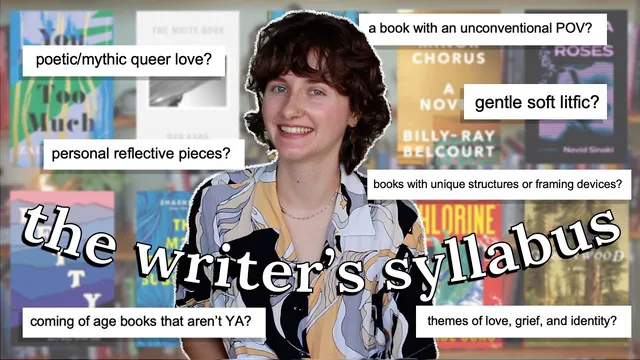
recommending you the *perfect* book to become a better writer | the writer's syllabus ep. 2
Based on ShaelinWrites's video on YouTube. If you like this content, support the original creators by watching, liking and subscribing to their content.
Reader prompts drive the recommendations, with each book selected to model a particular writing craft need rather than a general “best of” list.
Briefing
A writing-class syllabus built from reader-submitted prompts turns into a fast, curated set of book recommendations—each chosen to model a specific craft problem, from grief and queer myth to unconventional POVs and nested narrative structures. The through-line is practical: match the emotional and technical effect a writer wants, then study how a novel achieves it.
One prompt asks for characters processing grief tied to purposeful parental separation and a parent’s death. The recommendation lands on Lisa Co’s The Levers, set in China with a mother and son separated when the son is adopted by an American family. Even with the mismatch in exact details, the book is credited for hitting the “right notes” emotionally, treating separation and bereavement with depth rather than sentimentality.
Another request targets queer love and identity delivered through mythic, poetic language. Navidiv Saki’s Medusa of the Roses follows a gay couple in Iran, where their relationship is illegal; one partner goes missing and the main character moves through a myth-charged journey. The style is described as a blend of literary fiction, crime noir, and Greek/Persian myth—“electric,” sexy, and explicitly queer—while also being compared to Cava Akbar’s Martyr in themes and tone.
For writers who want gentler, softer literary fiction without turning conflict into hopeless despair, the list points to Next Year for Sure by Zoe Lee Peterson. It’s framed as compassionate and richly textured despite its softness: a decade-long couple exploring polyamory. The author’s stated motivation—writing about “good people doing their best” rather than morally depraved characters—becomes part of the pitch.
Several prompts pivot to form. For unconventional POV, Feverdream by Savannah Schwab is recommended as horror with a notably “wackiest” structure: a woman wakes immobilized in a rural hospital in Argentina, while a ghost boy’s voice narrates their conversation and recounts the prior three days. For multi-POV without head-hopping, Astra by Cedabowers is offered as a niche but precise fit: the central character is never the narrator, and each chapter is told by different people close to her across her life.
The syllabus also tackles coming-of-age that feels true rather than cliché, including surreal elements. The Most Precious Substance on Earth by Shashi Bot is described as a realistic, trauma-steeped coming-of-age centered on a teenager sexually assaulted by a teacher, followed through later life. Chlorine by Jade Song adds mythic body horror via a competitive swimmer who longs to become a mermaid, while Bad Fruit by Ella King and Betty by Tiffany McDaniel broaden the range with controlling family dynamics and an epic, gritty-but-slightly-magical family saga.
Finally, the most structurally ambitious recommendations respond to recurring requests for unique structures, framing devices, and nested narratives. How It Works Out by Miriam Lrad uses branching realities for a couple’s relationship. The Extinction of Arena Ray by Jennifer Croft layers metaphiction through translators, footnotes, and translation-as-narrative. Penance by Eliza Clark reframes true crime as fictionalized interviews, emphasizing unreliability. Greenwood by Michael Christie organizes a family saga like tree rings, moving backward and forward through time around a near-future world where trees survive only in rare places.
Across all these picks, the goal is consistent: use literature as a toolkit—study how specific books generate grief, tenderness, queer myth, psychological depth, or formal experimentation—then apply those techniques to the writer’s own work.
Cornell Notes
The recommendations are organized around reader prompts, treating books like models for specific writing problems. Grief, queer identity, gentle literary fiction, unconventional POV, reflective nonfiction, coming-of-age without YA clichés, and structurally complex narration all get targeted titles. Several picks emphasize craft through form: Feverdream uses a ghost-boy POV conversation; Astra tells a life story through surrounding characters without entering the central character’s head; and multiple books use nested or metafictional framing. The practical payoff is clear: writers can study how each novel achieves a desired emotional effect or narrative technique, then adapt those strategies to their own projects.
Which recommendation best matches grief tied to parental separation and a parent’s death, and what makes it fit emotionally?
What book is suggested for queer love and identity delivered with mythic, poetic language?
For writers who want soft, compassionate conflict without bleakness, what title is recommended and why?
Which recommendation uses a highly unconventional POV and how does the narration work?
What books are recommended for unique structures and metafiction, and what are the core structural tricks?
Review Questions
- Pick one craft goal (grief, queer mythic language, gentle conflict, unconventional POV, reflective nonfiction, or nested structure). Which specific recommended title best matches it, and what concrete narrative feature supports that choice?
- Compare Astra by Cedabowers with a typical single-POV novel: how does the “never from her perspective” constraint change what the reader learns and how?
- Choose one structurally experimental book (How It Works Out, The Extinction of Arena Ray, Penance, or Greenwood). What formal device organizes the story, and what emotional or thematic effect does that device likely produce?
Key Points
- 1
Reader prompts drive the recommendations, with each book selected to model a particular writing craft need rather than a general “best of” list.
- 2
The Levers by Lisa Co is recommended for grief and guilt tied to parental separation and bereavement, emphasizing emotional depth over exact premise matching.
- 3
Medusa of the Roses by Navidiv Saki pairs queer love with mythic, poetic language and genre blending (literary fiction, crime noir, Greek/Persian myth).
- 4
Next Year for Sure by Zoe Lee Peterson is positioned as gentle literary fiction that keeps conflict compassionate, centered on a decade-long couple exploring polyamory.
- 5
Feverdream by Savannah Schwab demonstrates unconventional POV through a conversation between a woman and a ghost boy’s voice that reconstructs the prior three days.
- 6
Astra by Cedabowers offers a multi-POV life story told by people around Astra across her timeline, explicitly avoiding narration from Astra’s own head.
- 7
Several titles use nested or metafictional structures—branching realities, translation layers, fictionalized true crime, and tree-ring time structure—to show how form can carry meaning.