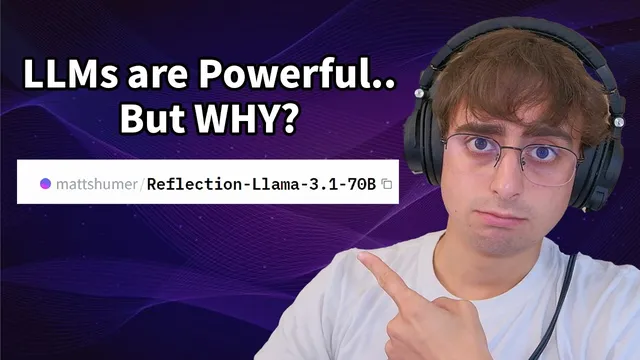
Reflection 70b Controversy is PROOF our Perspective on LLMs is wrong.
Based on MattVidPro's video on YouTube. If you like this content, support the original creators by watching, liking and subscribing to their content.
Reflection 70b was promoted as top open-source performance using reflection tuning, but early community tests reported major underperformance.
Briefing
Reflection 70b’s rollout has turned into a credibility and benchmarking flashpoint for the open-source LLM community—because the model’s advertised “reflection tuning” promise doesn’t consistently translate into reliable performance, and an API mismatch has raised suspicions of misrepresentation. Matt Schumer, CEO of HyperWrite AI, announced Reflection 70b as the “world’s top open-source model,” trained with reflection tuning, a technique meant to let LLMs correct their own mistakes during inference. Weights were released and users quickly reported that the model underperformed expectations. Schumer then uploaded new weights, and results improved slightly, but the community still can’t agree whether the gains come from the underlying fine-tuning or simply from using the right prompting setup.
The controversy sharpened when an API version—offered during the same period—appeared to route to Claude 3.5 Sonnet rather than the released Reflection 70b weights. Reddit users reportedly identified the behavior as Claude 3.5 Sonnet with prompting techniques applied, which would imply the API wasn’t actually serving the Reflection 70b model users thought they were testing. No definitive resolution is presented in the transcript, leaving a lingering question: was this an honest mix-up, a technical error, or something more deliberate?
To cut through the uncertainty, the transcript describes hands-on testing of a Reflection 70b model hosted on Hyperbolic Labs, using fp16 weights from Hugging Face—explicitly not the API Schumer distributed. In early checks, the model behaves plausibly on simple questions (for example, it correctly answers that it has no favorite color). But the differences emerge on a classic “letter-counting” challenge: “How many L’s are in this sentence…”. Reflection 70b produced the correct total number of “L”s in the example, yet the intermediate counting reasoning was internally inconsistent—suggesting it may be getting the right answer for the wrong reasons. By contrast, ChatGPT was described as giving the wrong total while performing the “right” counting logic.
The transcript then compares prompting approaches. A GPT-4o-style model, when given a system prompt designed to mimic Reflection 70b’s reflection behavior, reportedly counts correctly and arrives at the correct final answer. That undermines the idea that reflection tuning alone is the decisive factor. The core takeaway becomes a methodological one: fine-tuning versus system prompting can blur together in practice, especially as models scale and become better at following instructions.
The transcript’s broader argument is less about declaring a winner and more about what the episode reveals. It suggests that reflection tuning may still add value for some tasks, but the community needs cleaner comparisons—ideally the same technique applied across multiple model sizes (including the awaited 405B “Reflection” version) and standardized benchmarks that vary system prompts deliberately. Until then, the Reflection 70b saga functions as a wake-up call: LLM performance may depend as much on prompting strategy as on training-time changes, and public claims without transparent evaluation can quickly erode trust.
Cornell Notes
Reflection 70b was marketed as a benchmark-leading open-source model trained with “reflection tuning,” a method intended to help LLMs correct mistakes during inference. After release, early community tests found it underperformed, prompting new weight uploads. A separate API reportedly behaved like Claude 3.5 Sonnet with prompting, raising concerns about whether users were actually getting Reflection 70b. Hands-on testing described in the transcript found Reflection 70b could sometimes produce correct answers while using flawed intermediate counting, and that GPT-4o with a matching system prompt could replicate the behavior. The episode highlights how hard it is to separate the effects of fine-tuning from the effects of system prompting, and why stronger, controlled benchmarks are needed.
What claim triggered the controversy around Reflection 70b?
Why did community trust fracture after the initial release?
What did the transcript’s testing suggest about Reflection 70b’s “reflection” behavior?
How did system prompting complicate the fine-tuning vs. prompting debate?
What benchmark gap does the transcript identify?
Review Questions
- In the transcript’s example, how can a model produce the correct final answer while still showing flawed intermediate reasoning?
- What evidence in the transcript suggests that system prompts can mimic some effects attributed to reflection tuning?
- Why would comparing multiple model sizes (e.g., 70B vs. an expected 405B) be important for isolating the impact of fine-tuning versus prompting?
Key Points
- 1
Reflection 70b was promoted as top open-source performance using reflection tuning, but early community tests reported major underperformance.
- 2
Updated weights improved results slightly, yet the community still can’t tell whether gains come from fine-tuning or from prompting setup.
- 3
A separate API reportedly behaved like Claude 3.5 Sonnet with prompting, raising unresolved questions about what users were actually accessing.
- 4
Hands-on tests described in the transcript found Reflection 70b could reach correct answers while using inconsistent intermediate steps in a letter-counting task.
- 5
System prompting alone (a reflection-mimicking system prompt) reportedly enabled GPT-4o to perform similarly, blurring the fine-tuning vs. prompting distinction.
- 6
The transcript argues for stronger, controlled benchmarks—varying system prompts and comparing across model sizes—to determine what reflection tuning truly adds.
- 7
The awaited 405B Reflection model is positioned as a key test case for whether scaling makes prompt-following behave more like native fine-tuning.