S11E1 - Molarity, Molality, Mass Percent, and Mole Fraction
Based on ChemistryNotes Videos's video on YouTube. If you like this content, support the original creators by watching, liking and subscribing to their content.
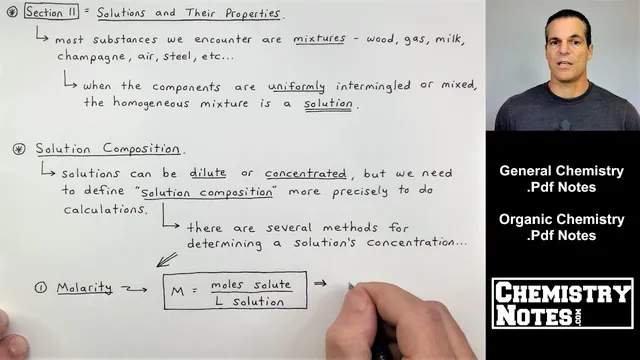
A solution is a homogeneous mixture formed when a solute dissolves in a solvent.
Briefing
Solution chemistry starts with a simple need: mixtures can be uniform, but their “strength” must be measured precisely for calculations. When a solute dissolves in a solvent to form a homogeneous mixture, the result is a solution—one that can be described as dilute or concentrated qualitatively, yet quantified using specific composition measures. The most widely used approach is molarity, defined as moles of solute per liter of solution. That definition matters because it links directly to how many particles of solute are present in a given volume, making it the default unit for many general chemistry problems.
The notes lay out five standard ways to express solution composition. Molarity (M) equals moles of solute divided by liters of solution; “one molar” means one mole per liter. Molality (m) uses a different denominator: moles of solute divided by kilograms of solvent, with “one molal” meaning one mole per kilogram. Mass percent (% by mass) measures the solute’s mass relative to the total mass of the solution: grams of solute divided by grams of solution, multiplied by 100. Mole fraction (χ) shifts from mass to moles, defined as moles of solute divided by total moles (solvent plus solute). Normality (N) is less common and is defined as equivalents of solute per liter of solution, often used in acid–base contexts.
After introducing the units, the material points out where each one tends to show up. Molarity, mass percent, and mole fraction are described as the most popular overall, while molality becomes especially important later when discussing colligative properties such as freezing point depression and boiling point elevation.
The worked example ties the definitions to a real calculation. An H2SO4 solution is given as 3.75 M and has a density of 1.230 g/mL. To find mass percent, the density provides the mass of solution per volume: 1.230 g of solution per 1 mL, converted to 1 liter for alignment with the molarity-based “per liter” setup. Using molarity, 3.75 moles of H2SO4 per liter are converted to grams by calculating the molar mass from the formula (2 H, 1 S, 4 O), yielding 368 g of H2SO4 per liter of solution. Mass percent then becomes 368 g solute divided by 1230 g total solution, times 100, giving 29.9%.
To compute molality, the example switches to kilograms of solvent. The mass of solvent is found by subtracting solute mass from total solution mass: 1230 g − 368 g = 862 g of water (the solvent). Converting 862 g to 0.862 kg allows molality to be calculated as 3.75 moles of H2SO4 divided by 0.862 kg of water, resulting in 4.35 molal. The takeaway is that the same solution can be expressed in different units depending on whether the denominator is volume, total mass, or solvent mass—choices that strongly affect how problems are solved.
Cornell Notes
Solutions are homogeneous mixtures where a solute dissolves in a solvent. Because “dilute” and “concentrated” are vague, solution composition is quantified using units such as molarity, molality, mass percent, mole fraction, and normality. Molarity is moles of solute per liter of solution, while molality is moles of solute per kilogram of solvent. Mass percent uses mass of solute over mass of solution (times 100), and mole fraction uses moles of solute over total moles. These definitions matter because later calculations—especially colligative properties—depend on which denominator is used.
Why does molarity use liters of solution instead of kilograms of solvent?
How do mass percent and mole fraction differ even though both use a “fraction” idea?
What is the key distinction between molality and molarity in the denominator?
How does density help convert a molarity problem into a mass percent calculation?
Why is normality treated as less common than molarity, molality, mass percent, and mole fraction?
Review Questions
- Given a solution with known molarity and density, what additional information is needed to compute mass percent?
- A solution has the same solute amount but different solvent mass. Which unit (molarity or molality) will change differently, and why?
- How do you compute mole fraction from a mixture if you know the moles of solute and moles of solvent?
Key Points
- 1
A solution is a homogeneous mixture formed when a solute dissolves in a solvent.
- 2
Molarity (M) = moles of solute per liter of solution; “1.0 M” means 1 mole per liter.
- 3
Molality (m) = moles of solute per kilogram of solvent; it requires solvent mass, not total solution mass.
- 4
Mass percent (% w/w) = (mass of solute / mass of solution) × 100, using the total mass including both solute and solvent.
- 5
Mole fraction (χ) = moles of solute / (moles of solvent + solute), using total mole counts.
- 6
Normality (N) = equivalents per liter and is most often used for acid–base calculations.
- 7
In the example, 3.75 M H2SO4 with density 1.230 g/mL yields 29.9% mass percent and 4.35 molal after converting between volume, total mass, solute mass, and solvent mass.