S12E2 - Rate Laws: Differential Rate Laws and the Integrated Rate Law
Based on ChemistryNotes Videos's video on YouTube. If you like this content, support the original creators by watching, liking and subscribing to their content.
Rate laws express how reaction rate depends on reactant concentrations, typically using data taken near time zero to avoid reverse-reaction complications.
Briefing
Rate laws are the key link between what’s happening chemically and how fast it happens: they express how a reaction rate depends on reactant concentrations. To keep the math clean, the discussion focuses on reactions studied right after time zero, when the forward reaction has started but reverse reactions are negligible. In that early window, the rate depends only on reactants because products haven’t accumulated yet.
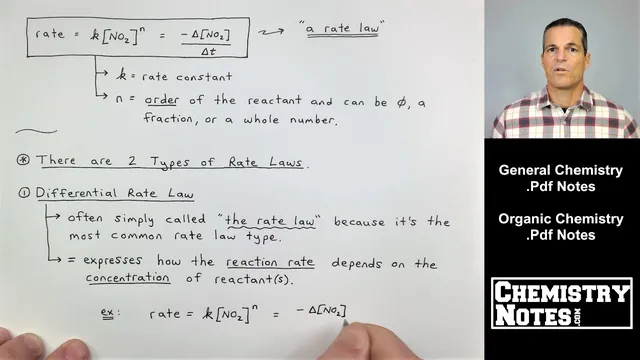
Using a representative reaction where nitrogen dioxide (NO2) converts to nitric oxide (NO) and oxygen (O2), the rate is written in the standard differential form: rate = k[NO2]^n. Here, k is the rate constant and n is the order with respect to NO2, which can be 0, fractional, or an integer (with typical course values of 0, 1, or 2). The same rate law can also be expressed as rate = −Δ[NO2]/Δt, tying the rate directly to how quickly the reactant concentration decreases over time.
Two types of rate laws are distinguished. The differential rate law relates reaction rate to concentration, capturing how changing reactant levels affect speed. The integrated rate law instead connects reactant concentration to time, showing how concentrations evolve as the reaction proceeds. These two are interlocked: knowing the differential rate law’s form lets one derive the integrated rate law, and vice versa. Which one to use depends on what a problem provides—concentration versus time points typically call for the integrated form, while rate versus concentration information points to the differential form.
Knowing the rate law matters because it lets chemists work backward from observed kinetics to infer the reaction’s mechanistic steps. Once the rate law is established, it becomes a diagnostic tool for identifying which elementary processes and pathways can produce the observed dependence on reactant concentrations.
The practical challenge is determining the order(s), meaning the values of n (and, for multi-reactant systems, the orders for each reactant). The notes illustrate this with the decomposition of dinitrogen pentoxide (N2O5) at 45°C: 2 N2O5 → 4 NO2 + O2. Concentration data for disappearing N2O5 are tracked from 0 to 2000 seconds, showing a declining curve as the reactant is consumed and the reaction slows (the slope becomes less steep over time). Two specific data points are extracted from the graph: when [N2O5] = 0.90 M, the instantaneous rate is 5.4 × 10^-4 M/s; when [N2O5] = 0.45 M, the rate is 2.7 × 10^-4 M/s.
Because halving the N2O5 concentration halves the reaction rate, the order with respect to N2O5 is 1. With only one reactant in the rate dependence, the reaction is first order overall as well. The next step—reserved for later—is handling reactions with multiple reactants, where the method of initial rates is used to determine each reactant’s order.
Cornell Notes
Rate laws describe how reaction rate depends on reactant concentrations, using expressions like rate = k[reactant]^n. The discussion focuses on measurements near time zero so reverse reactions are negligible and products are essentially absent, making the rate depend only on reactants. Two forms are emphasized: the differential rate law links rate to concentration, while the integrated rate law links concentration to time. Knowing the rate law is crucial because it allows chemists to infer the reaction mechanism by working backward from kinetic behavior. An example decomposition of N2O5 shows that when [N2O5] drops from 0.90 M to 0.45 M, the rate drops from 5.4×10^-4 to 2.7×10^-4 M/s, indicating first-order dependence (n = 1).
Why are rate laws usually determined using data taken right after time zero?
What do k and n mean in the differential rate law rate = k[NO2]^n?
How do differential and integrated rate laws differ, and how are they connected?
Why does knowing a rate law help with understanding reaction mechanisms?
How was the order in the N2O5 example determined from the data?
Review Questions
- In what way does the differential rate law differ from the integrated rate law, and what does each one relate (rate vs. concentration or concentration vs. time)?
- For a reaction with rate = k[A]^n, what happens to the rate if [A] is halved when n = 2?
- In the N2O5 example, what numerical evidence shows that the reaction is first order in N2O5?
Key Points
- 1
Rate laws express how reaction rate depends on reactant concentrations, typically using data taken near time zero to avoid reverse-reaction complications.
- 2
The differential rate law is commonly written as rate = k[reactant]^n, where k is the rate constant and n is the order.
- 3
Differential rate laws relate rate to concentration, while integrated rate laws relate concentration to time; knowing one determines the other.
- 4
Determining the rate law is important because it helps chemists infer the reaction’s mechanistic steps by working backward from kinetic behavior.
- 5
To find reaction orders, compare how the instantaneous rate changes when a reactant concentration changes, using extracted data points from concentration–time plots.
- 6
For the decomposition 2 N2O5 → 4 NO2 + O2 at 45°C, halving [N2O5] from 0.90 M to 0.45 M halves the rate, indicating first-order dependence (n = 1).