S12E3 - How to Determine the Form of the Rate Law: The Method of Initial Rates
Based on ChemistryNotes Videos's video on YouTube. If you like this content, support the original creators by watching, liking and subscribing to their content.
Write the differential rate law with unknown exponents (orders) for each reactant, e.g., rate = k[NH4+]^n[NO2−]^m.
Briefing
Determining the form of a reaction’s rate law becomes a matter of experiment rather than guesswork: the method of initial rates extracts the reaction orders (the exponents) by comparing how the measured rate changes when reactant concentrations change, then uses one experiment to solve for the rate constant k. For the reaction NH4+ + NO2− → N2 + 2H2O, the rate law is written in the differential form as rate = k[NH4+]^n[NO2−]^m, where n and m are found from concentration–rate data collected at the start of the reaction (time zero), before concentrations shift appreciably.
The core technique is to take ratios of rates from experiments that vary only one reactant at a time. Using experiments 1 and 2, the ratio rate2/rate1 is set up so that the unknown k cancels and one concentration term cancels as well, leaving a single power relationship. After substituting the tabulated concentrations and simplifying, the comparison yields m = 1. A second ratio using experiments 2 and 3 similarly isolates the other exponent, giving n = 1. With both orders in hand, the rate law reduces to rate = k[NH4+][NO2−]. The final step plugs values from any one experiment into the simplified law and solves for k; doing so produces k = 0.54 L/mol·s for this specific case. The units of k are emphasized as the hardest part because they depend on the overall reaction orders.
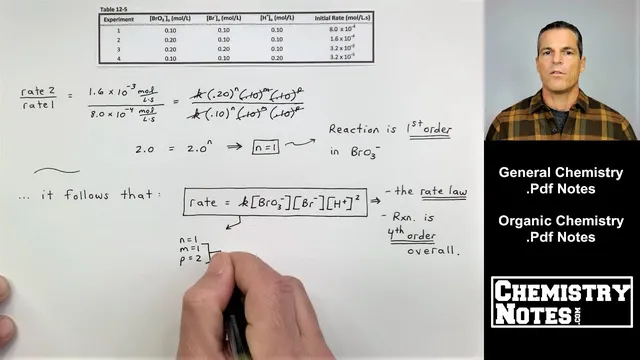
A second, more comprehensive example generalizes the same workflow to a reaction involving three reactants: BrO3− + Br− + H+ (with coefficients in the balanced equation that do not determine the orders). The differential rate law is written as rate = k[BrO3−]^n[Br−]^m[H+]^p. With four experiments available, the method again uses rate ratios chosen to cancel out unwanted terms. Comparing experiments 1 and 2 isolates n and gives n = 1 (first order in BrO3−). Repeating the ratio logic for Br− and H+ yields m = 1 and p = 2. The overall reaction order is then obtained by adding the individual orders: 1 + 1 + 2 = 4, so the reaction is fourth order overall.
Once n, m, and p are known, k is found exactly like before: substitute concentrations and the measured rate from any single experiment into rate = k[BrO3−]^1[Br−]^1[H+]^2. The calculation gives k = 8.0 L^3/(mol^3·s) (with units again reflecting the total order). The takeaway is procedural and practical: identify orders via initial-rate ratios that eliminate variables, then compute k using one experiment, while treating k’s units as a dynamic consequence of the exponents. Integrated rate laws are saved for later, since they introduce time dependence and different solution strategies.
Cornell Notes
Initial-rate experiments determine the exponents in a differential rate law by comparing how the measured rate changes when reactant concentrations change. For NH4+ + NO2− → N2 + 2H2O, the method uses ratios like rate2/rate1 so that k cancels and chosen concentration terms cancel, isolating m and n. The data yield m = 1 and n = 1, giving rate = k[NH4+][NO2−], and substituting one experiment gives k = 0.54 L/mol·s. A three-reactant example (BrO3−, Br−, H+) uses the same ratio strategy across four experiments to find n = 1, m = 1, p = 2, so the overall order is 4; then k is computed from one experiment (k = 8.0 L^3/(mol^3·s)). Units of k depend on the orders and must be handled carefully.
How does the method of initial rates determine the order with respect to a reactant?
Why do the balanced-equation coefficients (like 5 for Br− or 6 for H+) not determine the reaction orders?
What is the practical workflow once n and m (or n, m, p) are found?
How is the overall reaction order determined in the three-reactant example?
Why is k’s unit often described as the hardest part?
Review Questions
- In a differential rate law rate = k[A]^n[B]^m, what specific ratio of experiments would you choose to isolate n, and what must be true about the experiments for the cancellation to work?
- For a reaction with rate = k[BrO3−]^1[Br−]^1[H+]^2, what is the overall reaction order and how would you compute k from one experiment’s data?
- Why can two reactions with the same balanced-equation coefficients have different rate laws and different k units?
Key Points
- 1
Write the differential rate law with unknown exponents (orders) for each reactant, e.g., rate = k[NH4+]^n[NO2−]^m.
- 2
Use the method of initial rates: rely on measured rates taken at the start of the reaction so concentrations can be treated as effectively constant for the comparison.
- 3
Take ratios of rates from experiments (e.g., rate2/rate1) so k cancels, then choose experiments so one concentration term cancels and only one exponent remains.
- 4
Solve for each exponent by repeating the ratio strategy with different experiment pairs until all needed orders are determined.
- 5
After substituting the found exponents back into the rate law, compute k using any single experiment’s rate and concentrations.
- 6
Derive k’s units from the final rate law; k’s units depend on the orders and cannot be memorized universally.
- 7
Compute overall reaction order by summing the individual orders in the differential rate law.