S15E2 - How do Buffer Solutions Resist Changes in pH?
Based on ChemistryNotes Videos's video on YouTube. If you like this content, support the original creators by watching, liking and subscribing to their content.
A buffer resists pH change because added OH⁻ (or H⁺) is rapidly consumed by reacting with the buffer’s conjugate partner, preventing free-ion buildup.
Briefing
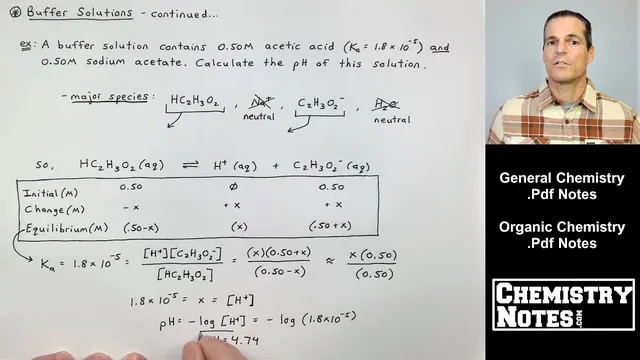
A buffer’s pH stays nearly steady when a strong base is added because the added OH⁻ is quickly “quenched” by reacting with the buffer’s weak acid, converting OH⁻ into water and shifting the acid/base pair only slightly. In the worked example, the buffer is made from 0.50 M acetic acid (HC₂H₃O₂) and 0.50 M sodium acetate (C₂H₃O₂⁻), giving an initial pH of 4.74. That starting point matters because it sets up the equilibrium between the weak acid and its conjugate base, so the system already has both partners available to absorb disturbances.
When NaOH is introduced, it dissociates completely into Na⁺ and OH⁻. If OH⁻ were allowed to remain in solution, the pH would jump dramatically—so the key question becomes what happens to the OH⁻. The buffer prevents accumulation: OH⁻ reacts essentially to completion with acetic acid, following the reaction OH⁻ + HC₂H₃O₂ → C₂H₃O₂⁻ + H₂O. Stoichiometry then shows the immediate “before/after” change in the buffer components: 0.010 moles of OH⁻ consume 0.010 moles of acetic acid in 1.0 L, lowering acetic acid from 0.50 M to 0.49 M while raising acetate from 0.50 M to 0.51 M. After this quenching step, the remaining equilibrium calculation uses the acetic acid/acetate pair with the updated concentrations.
Using Ka = 1.8 × 10⁻⁵ for acetic acid, the equilibrium yields [H⁺] ≈ 1.7 × 10⁻⁵ M, corresponding to a final pH of 4.76. That’s only a +0.02 pH unit change despite adding a strong base—illustrating the buffer’s resistance to pH shifts.
For contrast, the same amount of NaOH added to pure water produces a very different outcome. In 1.0 L, 0.010 moles NaOH gives 0.010 M OH⁻. The pOH is then −log(0.010) = 2.00, so pH = 14.00 − 2.00 = 12.00. Compared with neutral water at pH 7, that’s a +5.00 pH unit surge—orders of magnitude larger than the buffer’s +0.02 shift.
The takeaway is mechanistic: buffers work because free OH⁻ (or free H⁺, in the acid case) does not persist. It gets converted into water while the conjugate base (acetate) increases slightly, leaving the acid/base equilibrium to re-establish a nearly unchanged pH. The notes also point toward using the Henderson–Hasselbalch equation as a shortcut to the ice-table method once Ka (or Kb) is known, with further buffer strategy to come next.
Cornell Notes
The buffer made from 0.50 M acetic acid (HC₂H₃O₂) and 0.50 M acetate (C₂H₃O₂⁻) starts at pH 4.74. Adding 0.010 moles of NaOH to 1.0 L introduces OH⁻, but OH⁻ does not accumulate; it reacts essentially completely with acetic acid to form acetate and water. That quenching step shifts concentrations from 0.50/0.50 to 0.49 M acetic acid and 0.51 M acetate. Recomputing equilibrium with Ka = 1.8 × 10⁻⁵ gives pH 4.76, only +0.02. The same NaOH added to pure water yields pH 12.00, a +5.00 jump, because nothing is present to remove OH⁻.
Why doesn’t adding NaOH cause the pH to skyrocket in a buffer?
In the acetic acid/acetate example, what concentration changes occur after adding 0.010 moles of NaOH to 1.0 L?
How is the final pH (4.76) obtained after the quenching step?
What pH results if the same NaOH amount is added to pure water instead of a buffer, and why?
What’s the core mechanistic reason buffers resist pH change?
Review Questions
- If 0.010 moles of NaOH are added to 1.0 L of a buffer containing equal initial concentrations of a weak acid and its conjugate base, what stoichiometric changes should you expect in the acid and conjugate base concentrations?
- Why does the equilibrium calculation after quenching not include OH⁻ as a remaining species in the acetic acid/acetate example?
- How would the pH change differ qualitatively between adding NaOH to a buffer versus adding the same NaOH to pure water?
Key Points
- 1
A buffer resists pH change because added OH⁻ (or H⁺) is rapidly consumed by reacting with the buffer’s conjugate partner, preventing free-ion buildup.
- 2
For an acetic acid/acetate buffer, OH⁻ quenches by reacting with HC₂H₃O₂ to form C₂H₃O₂⁻ and H₂O essentially to completion.
- 3
In the example, adding 0.010 moles NaOH to 1.0 L shifts concentrations from 0.50/0.50 M to 0.49 M acetic acid and 0.51 M acetate.
- 4
Recomputing equilibrium with Ka = 1.8 × 10⁻⁵ changes pH only from 4.74 to 4.76 (+0.02) because the acid/base ratio changes slightly.
- 5
Adding the same NaOH to pure water yields [OH⁻] = 0.010 M, giving pH = 12.00, a +5.00 jump from neutral water.
- 6
The Henderson–Hasselbalch equation can serve as a shortcut to ice-table work when Ka (or Kb) is known.
- 7
Buffer effectiveness depends on having both weak acid and conjugate base present to absorb added strong acid/base.