S2E1 - Three Fundamental Laws of Chemistry; Law of Conservation of Mass; Dalton's Atomic Theory
Based on ChemistryNotes Videos's video on YouTube. If you like this content, support the original creators by watching, liking and subscribing to their content.
Conservation of mass requires that chemical reactions rearrange atoms without changing the total number of atoms of each element, which is why equations must be balanced.
Briefing
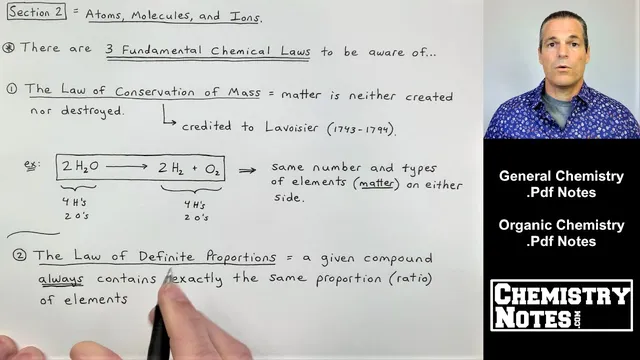
Chemistry’s three “fundamental laws” are introduced as the backbone for balancing reactions and predicting how elements combine—then tied directly to John Dalton’s early atomic theory. The most practical takeaway is that matter doesn’t vanish in chemical change: the law of conservation of mass says matter is neither created nor destroyed, so the total atoms on the reactant side must match the total atoms on the product side. That’s why chemical equations get balanced, such as keeping four hydrogen atoms and two oxygen atoms on both sides of a reaction.
From there, the focus shifts to how elements combine in fixed patterns. The law of definite proportions holds that a given compound always contains the same mass ratio of its constituent elements. Water is used as the example: in H2O, hydrogen and oxygen always appear in a 2-to-1 atom ratio, which corresponds to hydrogen contributing about 11.2% of the mass and oxygen about 88.8% (using atomic masses of 1.01 for hydrogen and 16 for oxygen). The key point is that changing the sample size doesn’t change the ratio—only the amount.
The third law, the law of multiple proportions, explains what happens when the same two elements form more than one compound. When two elements form a series of compounds, the mass ratios of the second element relative to the first element reduce to small whole-number ratios. The transcript contrasts this with definite proportions by emphasizing that multiple proportions compares the same element across different compounds. A carbon–oxygen example illustrates the idea: carbon monoxide (CO) and carbon dioxide (CO2) correspond to oxygen ratios of 1:1 and 2:1 relative to carbon, while intermediate non-integer formulas like CO1.5 are rejected because they would imply fractional “units.”
Dalton’s atomic theory is then presented as the historical explanation for why whole-number ratios show up so consistently. Dalton reasoned that if compounds combine in simple multiples, matter must be built from discrete units—atoms. His theory, dated to 1808, includes five postulates: elements consist of tiny indestructible atoms; atoms of the same element are identical; compounds form by combining atoms of different elements; chemical reactions rearrange atoms without changing them; and atoms cannot be divided further.
Two parts of Dalton’s framework are flagged as needing correction. First, atoms of the same element aren’t always identical because isotopes exist—atoms can differ in neutron number. Second, atoms are not indivisible: they contain subatomic particles, including protons, electrons, and neutrons. Even with those updates, Dalton’s core structure remains influential because it aligns with the three laws: conservation of mass, definite proportions, and multiple proportions. The lesson closes by previewing the next segment, which will look at early experiments used to characterize the atom.
Cornell Notes
Three chemical laws—conservation of mass, definite proportions, and multiple proportions—set the rules for how matter behaves in reactions and how elements combine. Conservation of mass requires the same atoms on both sides of a balanced equation. Definite proportions says a specific compound always has the same mass (and atom) ratio of elements, illustrated with water’s fixed 2 H to 1 O atom ratio. Multiple proportions says that when two elements form several compounds, the ratios of one element relative to the other reduce to small whole numbers, illustrated with carbon oxides (CO vs CO2). Dalton’s atomic theory (1808) explains these patterns using discrete atoms, later modified by isotopes and the discovery that atoms contain protons, electrons, and neutrons.
Why does balancing a chemical equation matter, and which law enforces it?
What does the law of definite proportions require for a compound like water?
How is the law of multiple proportions different from definite proportions?
How does the sample problem with nitrogen and oxygen demonstrate multiple proportions?
Which parts of Dalton’s atomic theory were later corrected, and what replaced them?
Review Questions
- How do conservation of mass and definite proportions each constrain what can appear on the reactant and product sides of a balanced equation?
- Using the idea of whole-number ratios, explain why CO1.5 is inconsistent with the law of multiple proportions.
- What two modifications are needed to Dalton’s atomic theory, and how do they relate to isotopes and subatomic particles?
Key Points
- 1
Conservation of mass requires that chemical reactions rearrange atoms without changing the total number of atoms of each element, which is why equations must be balanced.
- 2
Definite proportions means a specific compound always has the same mass ratio (and atom ratio) of its elements, independent of sample size.
- 3
Multiple proportions applies when two elements form multiple compounds; the mass ratios reduce to small whole-number ratios.
- 4
Dalton’s atomic theory (1808) used discrete atoms to explain why simple whole-number ratios appear in chemical formulas.
- 5
Dalton’s claim that atoms of the same element are identical is corrected by isotopes, which differ in neutron number.
- 6
Dalton’s claim that atoms cannot be divided is corrected because atoms contain protons, electrons, and neutrons.