S6E1 - Thermochemistry and the Nature of Energy. Potential vs Kinetic Energy, & the Transfer of Heat
Based on ChemistryNotes Videos's video on YouTube. If you like this content, support the original creators by watching, liking and subscribing to their content.
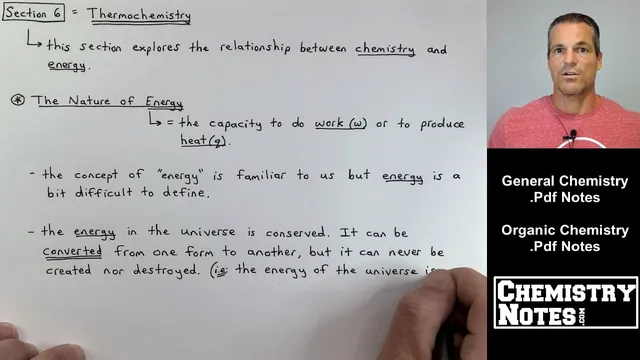
Energy is defined as the capacity to do work or produce heat, with work labeled W and heat labeled Q.
Briefing
Energy is defined as the capacity to do work or produce heat, and it obeys a strict rule: the total energy of the universe is conserved—never created from nothing and never destroyed, only converted between forms. That conservation principle sets the foundation for thermochemistry, where chemical processes are treated as energy transformations rather than just rearrangements of atoms.
Two major forms of energy anchor the discussion. Potential energy is stored energy tied to an object’s position or composition. Everyday examples include water held behind a dam, gasoline in a parked car, and a ball at the top of a hill. Potential energy also includes chemical potential energy—energy stored in the chemical bonds of reactants, which can later be released when those bonds break and new bonds form. Kinetic energy, by contrast, is energy of motion. A ball flying through the air or rolling down a hill illustrates how kinetic energy depends on an object’s mass and velocity.
The lesson then draws a careful line between temperature and heat, a distinction that often gets blurred. Temperature measures the random motion of particles in a substance. Heat, labeled with the symbol Q, is energy transfer driven by a temperature difference: it flows spontaneously from a hotter object to a cooler one. Heat is not a material substance and not a property “contained” in an object; it is energy in transit between systems.
That energy-transfer idea becomes concrete through chemical reactions. In combustion of methane, CH4 + 2 O2 → CO2 + 2 H2O + energy, the reaction releases energy as heat, making it exothermic. In exothermic reactions, some of the potential energy stored in chemical bonds is converted into thermal energy, which then transfers to the surroundings—so the reaction mixture and its container can feel hot to the touch. The framework uses the system/surroundings distinction: the system is the reaction (reactants and products), while the surroundings are everything else, such as the container and the environment.
The opposite pattern defines endothermic reactions. When heat flows into the system, the surroundings lose heat and can feel cold. An example given is N2 + O2 + energy → 2 NO2, where an energy input is required for the reaction to proceed. In notes, heat may appear as a “pseudo product” for exothermic processes (energy released) or as a “pseudo reactant” for endothermic processes (energy required).
Finally, the discussion points toward thermodynamics—the study of energy interconversions—and reiterates the first law of thermodynamics: the total energy of the universe remains constant, neither created nor destroyed. The next step in the course is to connect work to pressure and volume changes, building toward problem-solving in later episodes.
Cornell Notes
Energy is the capacity to do work or produce heat, and it is conserved: it can change form but cannot be created or destroyed. Potential energy is stored energy linked to position, composition, or chemical bonds; kinetic energy is energy of motion tied to mass and velocity. Temperature measures the random motion of particles, while heat (Q) is energy transfer that occurs spontaneously from hot to cold due to a temperature difference. Exothermic reactions release heat because chemical bond potential energy is converted into thermal energy that flows to the surroundings; endothermic reactions require heat input, so the surroundings lose heat. The system/surroundings distinction and the first law of thermodynamics (total energy constant) provide the organizing framework.
Why is energy conservation central to thermochemistry?
How do potential energy and kinetic energy differ, and what determines each?
What’s the difference between temperature and heat?
What does “system” and “surroundings” mean in reaction energy changes?
How can exothermic and endothermic reactions be identified using heat flow?
How do the methane combustion and nitrogen dioxide examples illustrate the concepts?
Review Questions
- How would you distinguish temperature from heat in a scenario where two objects exchange energy?
- In an exothermic reaction, where does the heat go, and what happens to the surroundings?
- Why does the system/surroundings distinction matter when writing energy changes for chemical reactions?
Key Points
- 1
Energy is defined as the capacity to do work or produce heat, with work labeled W and heat labeled Q.
- 2
The total energy of the universe is conserved: energy can be converted between forms but cannot be created or destroyed.
- 3
Potential energy is stored energy tied to position, composition, or chemical bonds; kinetic energy is energy of motion depending on mass and velocity.
- 4
Temperature measures random particle motion, while heat is energy transfer that occurs spontaneously from hot to cold due to a temperature difference.
- 5
Heat is not a material substance contained in objects; it is energy moving between systems.
- 6
Exothermic reactions release heat because chemical bond potential energy converts into thermal energy that flows to the surroundings.
- 7
Endothermic reactions absorb heat from the surroundings, so the surroundings lose heat and can feel cold.