S7E1 - Electromagnetic Radiation (EMR), the Electromagnetic Spectrum, & Energy/Frequency/Wavelength
Based on ChemistryNotes Videos's video on YouTube. If you like this content, support the original creators by watching, liking and subscribing to their content.
EMR types differ only by energy, frequency, and wavelength, which determine their positions on the electromagnetic spectrum.
Briefing
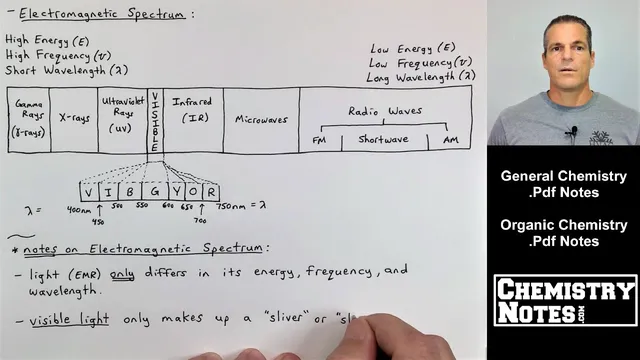
Electromagnetic radiation (EMR)—from gamma rays to radio waves—differs only in energy, frequency, and wavelength, and those differences determine where each type falls on the electromagnetic spectrum. The core takeaway is that high-energy EMR sits at the high-frequency, short-wavelength end, while low-energy EMR sits at the low-frequency, long-wavelength end. Visible light is just a narrow slice of that spectrum, spanning violet through red, with violet at about 400–450 nm and red at about 700–750 nm.
The spectrum is organized so that energy increases as frequency increases and wavelength decreases. Gamma rays appear at the highest-energy extreme (beyond Earth’s atmosphere), followed by X-rays, ultraviolet light (associated with sunburn), then the visible colors, and continuing down through infrared, microwaves, and radio waves (including FM, shortwave, and AM). A key practical point is that visible light’s colors correspond to specific wavelength ranges, but all EMR obey the same underlying physics: changing the wavelength and frequency changes the type of radiation.
To connect color to absorption behavior, the notes introduce complementary colors as a memory aid: “VIBER.” If an object absorbs violet light, it appears yellow; if it absorbs yellow, it appears violet. The same pairing logic applies to blue/orange and green/red, with indigo intentionally skipped for simplicity. This links what wavelengths are absorbed to what wavelengths are reflected or transmitted back to the eye.
Light is treated as a wave, and the relationship between wave motion and measurable properties becomes clear through a frequency-and-wavelength comparison. When more wave cycles pass a fixed point per second, frequency increases. In the examples, one set of waves completes three cycles per second at a “dock” (a fixed reference point), while another completes six cycles per second. The higher-frequency case also has a shorter wavelength—showing an inverse relationship: longer wavelength corresponds to lower frequency.
That inverse relationship is captured by the boxed equation λν = c, where λ is wavelength, ν is frequency, and c is the speed of light (3.0 × 10^8 m/s). Frequency is expressed in hertz (Hz), meaning cycles per second (s⁻1). The notes then walk through a numerical example: for red light with wavelength 6.50 × 10^2 nanometers (converted to meters as 6.50 × 10^-7 m), frequency is calculated as ν = c/λ, yielding 4.61 × 10^14 Hz. The takeaway is that once wavelength is known, frequency follows directly from λν = c—setting up the next steps for understanding how this wave behavior connects to atomic structure later in the course.
Cornell Notes
Electromagnetic radiation (EMR) ranges from gamma rays to radio waves and differs only by energy, frequency, and wavelength. The electromagnetic spectrum is ordered so high energy matches high frequency and short wavelength, while low energy matches low frequency and long wavelength; visible light is a small slice of the whole spectrum. Light behaves like a wave, where frequency counts cycles per second and wavelength is the distance between repeating points on the wave. The relationship λν = c (speed of light) ties wavelength and frequency together, letting you calculate one from the other. Complementary colors (VIBER) connect which visible wavelengths are absorbed to which colors appear.
How does the electromagnetic spectrum map energy, frequency, and wavelength?
What wavelength ranges correspond to visible colors like violet and red?
How do complementary colors explain what an object looks like when it absorbs certain wavelengths?
Why does frequency increase when wavelength decreases in wave diagrams?
What is the equation linking wavelength and frequency, and what do the symbols mean?
How is frequency calculated from wavelength in the red-light example?
Review Questions
- If an EMR wave has a shorter wavelength than another, what should happen to its frequency and energy?
- How does the mnemonic “VIBER” determine the apparent color when an object absorbs violet or blue light?
- Using λν = c, what steps and unit conversions are required to compute frequency from a wavelength given in nanometers?
Key Points
- 1
EMR types differ only by energy, frequency, and wavelength, which determine their positions on the electromagnetic spectrum.
- 2
High energy corresponds to high frequency and short wavelength; low energy corresponds to low frequency and long wavelength.
- 3
Visible light is a small band within the full EMR spectrum, with violet around 400–450 nm and red around 700–750 nm.
- 4
Complementary colors connect absorption to appearance: VIBER pairs violet/yellow, blue/orange, and green/red.
- 5
Light is modeled as a wave where frequency counts cycles per second at a fixed reference point.
- 6
The relationship λν = c (with c = 3.0 × 10^8 m/s) lets you calculate frequency from wavelength.
- 7
Frequency is measured in hertz (Hz), equivalent to s⁻1 (one cycle per second).