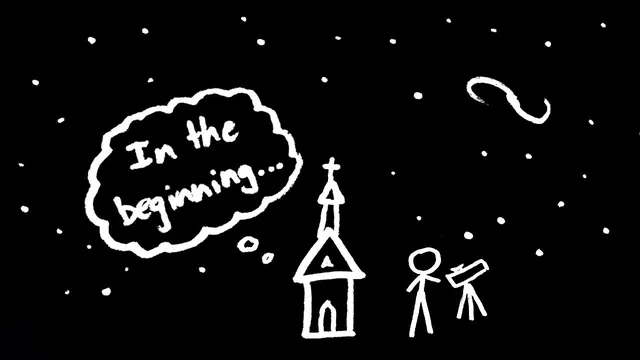
Science, Religion, and the Big Bang
Based on minutephysics's video on YouTube. If you like this content, support the original creators by watching, liking and subscribing to their content.
Hubble’s evidence for cosmic expansion, combined with general relativity, implies the universe was smaller, hotter, and denser in the past.
Briefing
The universe’s “beginning” is now treated as a consequence of cosmic expansion: rewind the expansion using general relativity and the cosmos shrinks back to a hot, dense early state everywhere, not from a single point. That scientific picture—first championed by Catholic priest Georges Lemaître—matters because it reframes religious “origin” language in light of measurable physics, while also highlighting what current models still cannot answer about the earliest moments.
Before expansion was established, many physicists assumed the universe was eternal and unchanging, an idea supported by the night sky’s apparent steadiness. Lemaître challenged that assumption by combining his mathematical work with new observational evidence from Edwin Hubble showing that distant galaxies are receding, implying the universe is expanding. With general relativity’s equations, Lemaître could effectively “rewind” cosmic history: the farther back in time, the smaller the universe must have been. The implication is straightforward—everything we can currently observe was once packed into a much smaller region of space, with the early universe dense and hot throughout.
Modern descriptions often call this event the “Big Bang,” but the transcript argues the name is misleading. The observable universe was indeed much smaller in the past, yet it was not a single point, and the rest of the universe was not confined to that same tiny location. The “everywhere stretch” framing emphasizes that space itself expanded everywhere at once. In an infinite (or effectively unbounded) spatial setting, there’s no need for expansion “into” empty surrounding space; space can stretch while still leaving room for more space to exist.
The transcript also takes aim at the term “big bang singularity.” “Singularity” suggests a single-point breakdown, but the real issue is that current physical models fail to describe the earliest, extremely compressed, extremely hot conditions. In that regime, even the concept of time becomes ill-defined within the prevailing equations—so the question “what happened before” may not be meaningful in the usual way. The analogy offered is the north pole: asking what lies “north of the north pole” is like asking for a “before” that the framework cannot define.
Still, the unknown beginning doesn’t settle the eternal-universe question. The transcript notes that experimental evidence does not rule out scenarios in which the universe had a prior phase—perhaps a previous contraction that ended in a bounce—leading into the expansion we observe, but without the same model-breaking singularity. If such “bounce” ideas survive further scrutiny, the universe could be eternal in some sense, forcing a reconsideration of how to interpret “in the beginning” language—especially for Lemaître’s own reading of it.
Cornell Notes
Cosmic expansion lets scientists run the universe’s history backward. Using Edwin Hubble’s evidence that distant galaxies recede and the mathematics of general relativity, Georges Lemaître showed that going back in time implies a much smaller, hotter, denser early universe everywhere. The “Big Bang” label is criticized as inaccurate: it wasn’t an explosion from a single point, but space stretching throughout the cosmos. The “big bang singularity” is also misleading; it marks a breakdown of current models when conditions become so extreme that even time may not be well-defined. Open questions remain about why the universe started in such a compressed state, and some evidence still allows bounce-like, potentially eternal-universe scenarios.
Why does Hubble’s observation push cosmology toward a beginning rather than an eternal, unchanging universe?
What does “everywhere stretch” mean, and how does it correct common misconceptions about the Big Bang?
Why doesn’t space need an external place to expand into?
What is the real problem behind the term “big bang singularity”?
How could the universe still be eternal despite the Big Bang framework?
Review Questions
- What specific observational input and theoretical framework allow cosmologists to “rewind” the universe’s history?
- How do the concepts of “everywhere stretch” and “not a single point” change the way you should visualize the early universe?
- Why does the breakdown of physical models make the question “what happened before the Big Bang?” potentially ill-defined?
Key Points
- 1
Hubble’s evidence for cosmic expansion, combined with general relativity, implies the universe was smaller, hotter, and denser in the past.
- 2
The early universe’s density and heat were distributed everywhere, so expansion is better understood as space stretching throughout rather than an explosion from a single point.
- 3
The “Big Bang” name is misleading because it can suggest a one-point origin and expansion into surrounding nothingness, neither of which matches the described model.
- 4
The “big bang singularity” label is also misleading; it reflects a breakdown of current theory under extreme conditions, not a literal single-point event.
- 5
If space is infinite (or effectively unbounded), expansion does not require an external region for space to expand into.
- 6
Current models struggle to explain why the universe began in a highly compressed state, leaving room for alternative scenarios such as bounce-like, potentially eternal-universe histories.
- 7
Evidence does not fully settle whether the universe truly began; some interpretations allow a prior phase that transitions into the observed expansion.