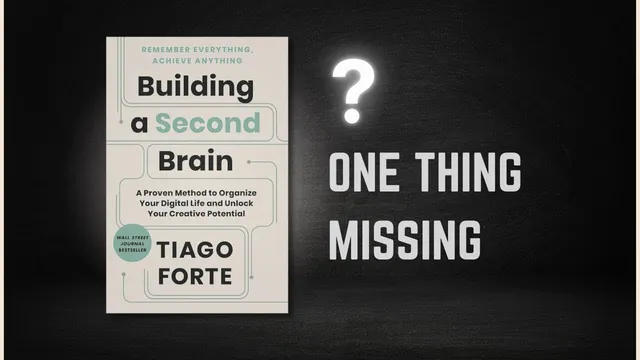
Second Brain: One thing you need to know!
Based on Darin Suthapong's video on YouTube. If you like this content, support the original creators by watching, liking and subscribing to their content.
Second brain’s CODE + PARA structure is well-suited for action-oriented information that needs fast retrieval for specific tasks.
Briefing
“Second brain” productivity systems are strongest for action-ready information, but they struggle with the slower, reflective kind of knowledge that grows over time. The core claim is that knowledge management needs a clear split between action information (what you must do next) and growth information (what you learn, refine, and build into deeper understanding). When that distinction is ignored, notes pile up in ways that are hard to retrieve for focused work—and harder to evolve into connected insights.
At the center of the popular “second brain” approach is the CODE method—Capture, Organize, Distill, Express—paired with a PARA organization scheme: Projects, Areas, Resources, and Archives. Capture external inputs into a personal knowledge base, organize them into the right PARA buckets, distill them down to their essence, and then express the knowledge through real output. For action-oriented materials—receipts, documents to file, inspiration for a presentation, trip plans—this structure is described as nearly ideal. It works like sorting items into labeled boxes so the right thing is easy to find when it’s time to act.
The critique begins when the same PARA structure is applied to growth information. Growth information is framed as “planting seeds”: books, podcasts, classes, and other inputs meant for reflection and long-term learning. The problem isn’t capturing or summarizing; it’s the organizing step. Growth notes often span multiple themes at once—philosophy, business, finance, innovation—so forcing them into a single project, area, or resource bucket becomes awkward. Even after distillation, the “express” step can surface too much unrelated material when someone wants only the business takeaways, for example, wading through philosophy notes to get to the point.
To address that mismatch, the creator proposes a separate framework for growth information called “productive thinking,” built around a four-step flow: Capture, Crystallize, Connect, Create. Capture is similar to second brain, but crystallize is the key difference: raw notes must be rewritten into the user’s own words to produce clean insights. Next, those insights are connected to a hub note (a high-level idea) and to other permanent notes, forming clusters of related understanding. The emphasis is on separating the polished insight from the source material while still preserving traceability—so the system shows both the “clean” idea and where it came from.
An example illustrates the contrast using a book summary workflow. Under second brain, the book’s notes can be captured and distilled, but organizing them into PARA becomes difficult because the content spans many topics. Under productive thinking, the same book becomes multiple crystallized permanent notes (e.g., leverage, financial freedom) that connect into clusters around hub concepts. Some clusters may “die out” if they never get connected further, but the structure is designed to support growth through ongoing linking.
The takeaway is pragmatic: second brain isn’t dismissed. If someone isn’t managing growth information at all, adopting second brain still beats doing nothing. But for people serious about turning learning into evolving, connected knowledge, the action/growth split—and a growth-first workflow that crystallizes and connects insights—matters.
Cornell Notes
The “second brain” method (CODE plus PARA) is presented as a strong fit for action-oriented information—items needed for specific tasks and decisions—because it sorts notes into Projects, Areas, Resources, and Archives for quick retrieval. The critique argues that growth information (books, podcasts, classes meant for reflection and long-term learning) doesn’t organize cleanly into PARA buckets, especially when a single source spans multiple themes. To manage growth, a separate “productive thinking” framework is proposed: Capture, Crystallize, Connect, Create. The crucial step is crystallizing—rewriting insights in one’s own words—then connecting those insights to hub notes and other permanent notes to form evolving clusters of understanding. This approach aims to keep insights “pure” while preserving links back to their sources.
What is the practical difference between action information and growth information in this framework?
Why does PARA (Projects, Areas, Resources, Archives) work well for action-oriented notes?
What breaks down when PARA is used for growth information?
How does “productive thinking” change the workflow for growth information?
What does “crystallize” accomplish that “distill” alone doesn’t?
Review Questions
- How would you decide whether a note belongs in action-oriented storage versus growth-oriented storage?
- In the example of summarizing a multi-topic book, what specific step makes PARA organization difficult, and how does productive thinking address it?
- What is the role of hub notes and permanent notes in turning individual insights into a growing cluster of knowledge?
Key Points
- 1
Second brain’s CODE + PARA structure is well-suited for action-oriented information that needs fast retrieval for specific tasks.
- 2
Growth information behaves differently: it’s reflective and meant to mature over time, so it often spans multiple themes that don’t fit neatly into PARA buckets.
- 3
The main friction for growth notes is the organizing step—forcing a single source into one project/area/resource can bury unrelated insights.
- 4
Productive thinking targets growth by adding a crystallize step that rewrites insights in the user’s own words to create clean, reusable ideas.
- 5
Connecting crystallized insights to hub notes and other permanent notes builds clusters that can expand as new learning is added.
- 6
Adopting second brain is still recommended over doing nothing if growth information isn’t being managed at all.