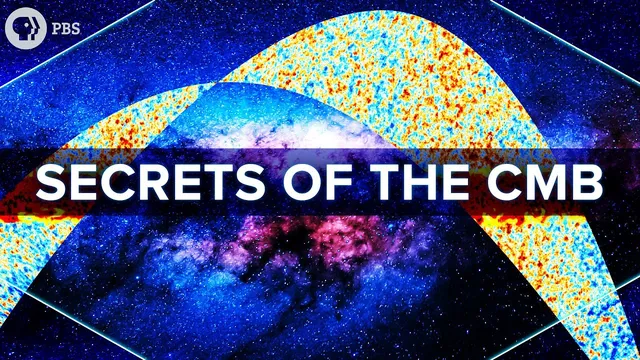
Secrets of the Cosmic Microwave Background
Based on PBS Space Time's video on YouTube. If you like this content, support the original creators by watching, liking and subscribing to their content.
The CMB’s temperature fluctuations reflect frozen-in phases of early baryon-photon density oscillations at recombination (~380,000 years after the Big Bang).
Briefing
The cosmic microwave background (CMB) isn’t just leftover radiation—it’s a snapshot of the early universe’s density “sound waves,” and the pattern of tiny temperature spots lets scientists measure what the universe is made of. Those spots differ from the average CMB temperature of about 2.7 kelvin by only about one part in 10,000, yet their sizes and spacing encode how matter and radiation behaved roughly 380,000 years after the Big Bang, when the universe first became transparent.
The key idea is that the early universe contained a plasma of baryons (ordinary matter) and photons (light) tightly coupled by gravity and pressure. Small regions that were slightly denser than average pulled in more matter, building pressure that pushed back—creating oscillations. Over time, these oscillations didn’t all “freeze” at the same stage. Some density fluctuations had just enough time to collapse once before recombination; others oscillated multiple times, producing a hierarchy of spot sizes on the sky. By treating the complicated network of oscillations as a stack of simpler modes (mathematically described using spherical harmonics), the CMB temperature map can be translated into a power spectrum—a histogram-like plot showing how many spots occur at each angular scale.
The power spectrum’s peaks act like a set of rulers. The first peak corresponds to fluctuations that completed exactly one collapse (or one collapse and expansion) by recombination. Because the oscillation speed is tied to the baryon-photon sound speed—over half the speed of light—the peak’s characteristic angular size maps to a physical scale of roughly half a million light-years at recombination. Measuring that angular scale requires geometry, and the match to the predicted physical size provides a test of spatial curvature. The observed result supports a geometrically flat universe, implying the total energy density is tuned to make curvature effectively zero.
The second peak helps determine the baryon fraction. Baryons behave like heavy masses on a spring: more baryons deepen the “fall” into overdense regions, boosting the odd-numbered compression peaks relative to the even-numbered rarefaction peaks. Using the relative heights of the first and second peaks yields a baryon content of about 5% of the universe’s total energy.
Higher peaks then probe the dark sector by comparing how different fluctuation sizes evolved during the universe’s early radiation-dominated era versus later matter domination. Small-scale modes that could oscillate during the brief radiation-dominated phase get enhanced differently, letting scientists infer when the transition occurred and how much dark matter exists. Putting the peak information together gives a modern energy budget: roughly 26.5% dark matter and 68.5% dark energy, with baryons at about 5%. The result is framed as a major consistency check because it aligns with independent measurements—dark matter from structures in galaxies and clusters, and dark energy from the accelerating expansion rate.
In short, the CMB’s faint static contains a precise record of early-universe physics. The peak structure turns that record into quantitative measurements of curvature and the relative amounts of baryons, dark matter, and dark energy—turning “random” noise into a cosmological inventory.
Cornell Notes
The CMB’s tiny temperature variations encode how early-universe density waves (baryon-photon oscillations) evolved before recombination, when light decoupled from matter. By decomposing the oscillations into simple modes and stacking them, the CMB map becomes a power spectrum with distinct peaks. The first peak functions as a “standard ruler,” and its angular size supports a geometrically flat universe, implying the total energy density is tuned to cancel curvature. The second peak’s height relative to the first constrains the baryon fraction (about 5%). Higher peaks reveal the dark sector by tracking how different scales oscillated across the radiation-dominated to matter-dominated transition, leading to about 26.5% dark matter and 68.5% dark energy.
Why do the CMB temperature spots form a predictable pattern of sizes rather than random scatter?
How does the first power-spectrum peak test whether the universe is flat?
What does the second peak reveal about baryons?
How do higher peaks help infer dark matter and the radiation-to-matter transition?
What final cosmic energy budget emerges from combining the peaks?
Review Questions
- What physical process sets the oscillation speed of the baryon-photon density waves, and why does that matter for the peak locations in the CMB power spectrum?
- How does converting an observed angular size of a CMB feature into a physical length depend on assumptions about spatial curvature?
- Why do odd-numbered and even-numbered peaks respond differently to changes in the baryon fraction?
Key Points
- 1
The CMB’s temperature fluctuations reflect frozen-in phases of early baryon-photon density oscillations at recombination (~380,000 years after the Big Bang).
- 2
A power spectrum turns the CMB spot pattern into peaks whose angular scales correspond to specific oscillation histories (how many compressions/expansions occurred before freeze-out).
- 3
The first peak acts as a standard ruler; matching its predicted physical scale to its observed angular size supports a geometrically flat universe.
- 4
The second peak’s height relative to the first constrains the baryon fraction, yielding roughly 5% of the universe’s total energy.
- 5
Higher peaks probe the dark sector by revealing how different fluctuation scales evolved across the radiation-dominated to matter-dominated transition.
- 6
Combining peak information gives an energy budget of about 5% baryons, 26.5% dark matter, and 68.5% dark energy.
- 7
Independent observations of structure formation and cosmic acceleration are presented as consistency checks for the same dark-matter and dark-energy fractions.