Seedream 4.0 is proof there’s no stopping AI Advancement
Based on MattVidPro's video on YouTube. If you like this content, support the original creators by watching, liking and subscribing to their content.
Cream 4.0 is presented as a photorealistic generator that can produce native 4K-looking images with convincing texture and minimal smoothing.
Briefing
Seedream 4.0 (referred to as “Cream 4.0” in the transcript) is being positioned as a major step forward in photorealistic image generation and, especially, image editing—strong enough to trade blows with Nano Banana in multiple real-world prompts. The standout claim is practical: it can produce native 4K-looking images that are hard to distinguish from camera photos, with convincing skin texture, natural imperfections, and realistic lighting. That matters because the gap between “AI-looking” and “camera-looking” images is where many tools still fail, and Cream 4.0 is presented as narrowing it sharply.
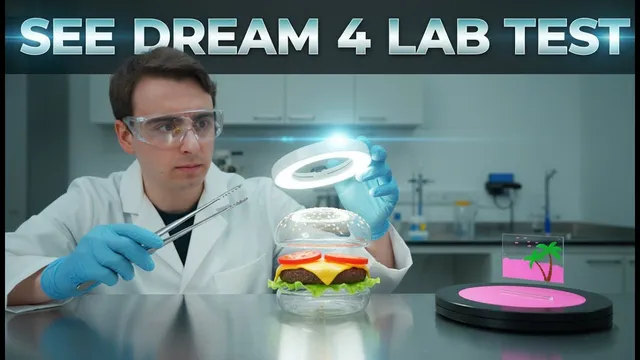
The transcript also emphasizes a specific editing strength: global, concept-level transformations that preserve the rest of the scene. In one test, a photo with water is edited so the entire ocean turns pink while maintaining white water wakes—an example of keeping geometry and surface detail intact while changing the dominant color. Another editing example turns burger buns into glass, and a separate case upscales and restores grainy, low-quality photos while retaining what the original image depicts. These are framed as the kinds of tasks creators actually need—color and material changes, background swaps, and restoration—rather than only generating a brand-new image from scratch.
A key part of the comparison is how each model handles spatial reasoning and prompt constraints. For a “burger buns only” prompt, Cream 4.0 is described as matching the intended spacing and camera angle more consistently in certain views, while Nano Banana shows more obvious cutoffs in others. The transcript also highlights a prompting technique used to “pin” the output to a camera aesthetic: starting the prompt with something like “img a number then CR2,” leveraging CR2 as a camera-specific format to push the model toward realistic photo characteristics rather than generic internet imagery.
Side-by-side generations across increasingly complex prompts show both strengths and limits. Cream 4.0 is credited with strong realism and better alignment with certain prompt details—such as “Mona Lisa losing at Mario Kart,” where the Nintendo Switch and the “losing” action are clearer. Nano Banana is sometimes favored for richer icon variety or closer adherence to particular narrative beats, including a “parliament of galaxies” prompt where Gemini 2.5 Flash reportedly includes more plausible galaxy names. In the final snail-and-castle prompt, Cream 4.0 is judged the winner for delivering the full castle-on-shell composition and a clearer sense of the two-snail setup.
Still, the transcript is candid about failure modes. Face consistency can slip, especially when changing a person into a new character; a one-letter change (“wizard”) works well, but other transformations can “paste” a lizard over a face or mush facial features. Physical continuity issues also appear, including a blemish (spaghetti) in the snail scene and an editing inconsistency where a character’s arm count flips when repositioned.
Access and cost are treated as a practical differentiator. Cream 4.0 is described as cheap to run—around 3 cents per generation—available via services like Fall AI and Replicate, with subscription options on consumer platforms such as Crea AI. The closing guidance is straightforward: choose Nano Banana for consistent characters across scenes, and choose Cream 4.0 when the priority is powerful edits and broad realism, particularly for whole-scene transformations.
Cornell Notes
Cream 4.0 is presented as a photorealistic image generation and editing model that can rival Nano Banana across many prompts. It’s credited with native 4K-looking outputs, convincing skin and texture, and edits that preserve scene structure while changing key elements—like turning an entire ocean pink while keeping white wakes. Comparisons suggest Cream 4.0 often handles spatial composition well in certain camera-angle-dependent cases, and it can align strongly with prompts when the prompt is “pinned” to a camera-photo style (e.g., using CR2). Despite strengths, it still shows weaknesses in face consistency and physical continuity, with occasional artifacts and odd compositing. Cost and access are framed as practical: roughly 3 cents per generation via platforms such as Fall AI and Replicate, plus subscription routes on consumer sites.
What makes Cream 4.0 stand out for creators beyond “cool AI images”?
How does the prompt format influence realism in Cream 4.0?
Where does Cream 4.0 beat Nano Banana in spatial reasoning?
What kinds of errors still show up with Cream 4.0?
How do the model choices differ depending on the goal?
Review Questions
- In the transcript’s comparisons, what evidence suggests Cream 4.0 is better at whole-scene edits than simple image generation?
- What does the “CR2” prompting approach try to control, and why does that matter for output realism?
- Which failure modes are most emphasized—face consistency, physical continuity, or compositing—and what examples are given for each?
Key Points
- 1
Cream 4.0 is presented as a photorealistic generator that can produce native 4K-looking images with convincing texture and minimal smoothing.
- 2
Editing is treated as its strongest differentiator, including global color/material changes that preserve scene structure (e.g., ocean-to-pink while keeping wakes).
- 3
Prompting can be “pinned” to a camera aesthetic using CR2-style prompt elements to push outputs toward realistic photo characteristics.
- 4
Side-by-side tests suggest Cream 4.0 often handles camera-angle-dependent spatial composition well, though Nano Banana can win on variety or specific narrative details.
- 5
Face and physical continuity remain weak spots, with examples like arm-count changes, “pasted” transformations, and occasional artifacts.
- 6
Character consistency across scenes is recommended to go with Nano Banana, while broad scene edits and realism-first work are recommended to start with Cream 4.0.
- 7
Cream 4.0 is described as inexpensive to run (about 3 cents per generation) via platforms like Fall AI and Replicate, with subscription options on consumer sites like Crea AI.