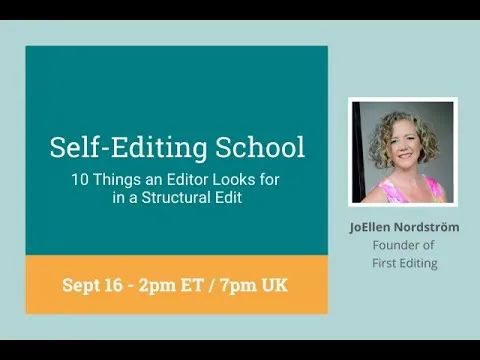
Self-Editing School: 10 Things an Editor Looks for in a Structural Edit with JoEllen Nordstrom
Based on ProWritingAid's video on YouTube. If you like this content, support the original creators by watching, liking and subscribing to their content.
Structural editing focuses on story foundations and arc mechanics, not grammar or punctuation.
Briefing
Structural editing is the high-level work of making sure a manuscript is a complete, coherent story—before grammar, line-level style, or punctuation get attention. The core finding is that editors treat structural revision as a checklist of story “foundations” and measurable story-arc mechanics: a complete beginning-middle-end, a clear blurb that promises the right plot, consistent formatting, named scenes, and then deeper checks on characters, scene balance, and where key turning points land. Getting these elements right matters because plot holes, weak character purpose, or mistimed turning points can’t be fixed by proofreading; they require structural change.
The session frames structural editing as fundamentally different from line editing or copy editing. Instead of focusing on sentence correctness, structural editors evaluate the manuscript’s bigger perspective: whether the story arc is intact, whether characters and backstory serve the plot rather than bog it down, and whether the manuscript delivers on the promise made to readers. A structural edit typically starts only after the author has a full manuscript—editing a fragment isn’t useful because the editor needs the entire story to assess arc, conflict, and resolution.
Three “must-do” foundations sit at the front of the process. First, the manuscript must be complete: it needs a beginning, middle, and end, with conflict and resolution, and a protagonist present throughout the story’s core movement. Second, the author must write a blurb—short, spoiler-free, and functioning like a compass. Editors use it to verify that the manuscript’s structure matches the promise of purpose and intrigue. Third, the manuscript must be properly and consistently formatted so chapters and scenes can be evaluated uniformly; scene breaks and chapter labeling should follow the same method throughout.
From there, the editor’s checklist becomes more analytical and self-editable. Each scene should be outlined and named so the author can see whether scenes actually push the storyline forward. Character balance is evaluated by building a list of characters, ensuring names and roles are clear (avoiding confusion from similar or misspelled names), and then checking whether each character is essential to the scenes they appear in—especially by tracking point of view and goals. The story arc is then tested against a traditional structure using five key scenes: inciting incident, plot point one, middle plot point two, plot point two (the low point), and the climax. The inciting incident marks a permanent world change; plot point one is the “point of no return”; the middle is the protagonist’s transformation from reactive to proactive; plot point two is the low point that raises stakes and tension; and the climax delivers the ultimate conflict that determines fate.
A major emphasis falls on timing and balance using word counts rather than page counts. Editors look for approximate placement ranges for the key scenes (e.g., inciting incident around 10–15% of total word count, plot point one around 20–30%, the middle around 45–55%, plot point two around 70–80%, and climax near 90%), and they assess whether the five key scenes are appropriately longer or shorter to maximize impact. The session also stresses that structural editing is iterative: after the first pass, the blurb must be cross-referenced against the manuscript to confirm the promise is delivered, revising either the story or the blurb depending on which is weaker.
The Q&A extends the framework: structural and developmental editing overlap, but structural work focuses on story “bones” and measurable form; developmental work grows into deeper story elements like character development and content. Authors are encouraged to use structural editing even for nonfiction when it relies on narrative arcs and transformation, and to select editors by requesting samples and ensuring the editor’s approach matches the author’s voice and needs. The session ends by pointing to a broader 38 story elements checklist as the deeper toolkit for evaluating characters, settings, plot mechanics, sensory detail, and scene purpose—areas that structural editing lays the groundwork for.
Cornell Notes
Structural editing checks whether a manuscript’s story foundations and arc mechanics hold up before sentence-level fixes. Editors require a complete manuscript (beginning, middle, end), a spoiler-free blurb that promises the story’s purpose, and consistent formatting so chapters and scenes can be evaluated. Named scenes and character tracking (including point of view and goals) reveal whether each scene advances plot rather than padding. The story arc is tested using five key turning points—inciting incident, plot point one, middle, plot point two (low point), and climax—then verified with approximate word-count placement ranges (e.g., inciting incident at ~10–15% and climax near ~90%). Finally, the blurb must match the manuscript; if not, either the story or the blurb gets revised.
Why does structural editing require a complete manuscript, not a draft fragment?
What role does the blurb play in structural editing?
How can an author self-check whether scenes actually serve the plot?
How do editors evaluate character balance at the structural level?
What are the five key story-arc scenes, and what does each one do?
Why does the session emphasize word-count ranges instead of page counts?
Review Questions
- What three structural “foundations” does the session say authors must complete before a structural edit can begin?
- How do the five key story-arc scenes differ in function (inciting incident vs. plot point one vs. middle vs. plot point two vs. climax)?
- If your blurb doesn’t match your manuscript after the first structural pass, what two revision paths does the session suggest?
Key Points
- 1
Structural editing focuses on story foundations and arc mechanics, not grammar or punctuation.
- 2
A structural edit typically requires a complete manuscript with a clear beginning, middle, and end, plus conflict and resolution.
- 3
Write a spoiler-free blurb that promises the story’s purpose; use it to evaluate whether the manuscript delivers.
- 4
Format chapters and scenes consistently so the structure can be assessed uniformly, including clear scene breaks and labeling.
- 5
Name and outline every scene to check whether each one advances plot and supports the blurb’s promise.
- 6
Track character purpose structurally by verifying roles, point of view alignment, and goals in each scene.
- 7
Use word-count placement ranges for key turning points (not page counts) and cross-reference the blurb against the final manuscript structure.