Self-study computational neuroscience | Coding, Textbooks, Math
Based on Artem Kirsanov's video on YouTube. If you like this content, support the original creators by watching, liking and subscribing to their content.
Computational neuroscience work often splits into data analysis and in silico simulations, both aimed at producing testable, mechanism-level insights.
Briefing
Computational neuroscience is best understood as a practical pipeline for turning messy brain data—and simplified mathematical models—into testable claims about how neural systems work. The field’s core work splits into two broad modes: analyzing large experimental datasets and running in silico simulations that probe mechanisms under controlled assumptions. A typical workflow starts with data such as calcium imaging recordings from astrocytes, then moves through denoising, filtering, selecting informative segments, extracting quantitative features, and linking those features to behavior or physiological state. It usually ends with statistical testing, visualization, and significance checks. In parallel, researchers build simplified models—often systems of differential equations—to reproduce observed dynamics and explore how changes in model structure (like cell geometry) alter outcomes. By “twisting and turning” parameters such as astrocyte morphology, simulations can reveal emergent behavior that experiments may not isolate cleanly.
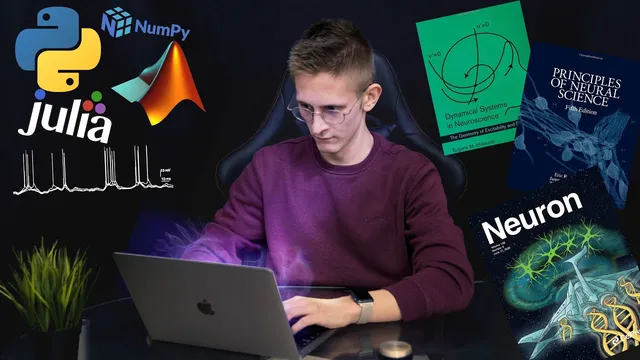
The practical takeaway is that computational neuroscience is less about memorizing tools and more about building algorithmic thinking that can survive across projects. Coding sits at the center of that skill set. Python and Matlab are the most common starting points, with Julia mentioned as a promising but less widespread option for scientific computing. Language choice matters less than many newcomers expect: once someone understands core programming concepts—conditionals, loops, functions, variables—switching syntax and libraries is usually a short transition rather than a barrier. The bigger mistake is stopping at syntax drills or theory-only learning. Real progress comes from solving non-straightforward problems that require creative algorithm design, such as converting between different data representations or handling cases that aren’t neatly answered on Stack Overflow.
To sharpen that problem-solving muscle, the transcript recommends competitive-programming style practice. Codeforces.com is highlighted as a source of graded exercises with an integrated testing system that immediately verifies correctness. The message is direct: internalize algorithms by adapting them to new tasks, not by passively reading examples.
On the learning side, neuroscience knowledge and math form the supporting pillars. Neuroscience textbooks are recommended for grounding—ranging from Eric Kandel’s Principles of Neural Science to more accessible overviews like Yuri Bhujaki’s The Brain from Inside Out—while research papers remain the most up-to-date source. For the computational side, classics such as Diane and Abbott’s Theoretical Neuroscience and Eugene E. M. Eger C. C. C. (as named in the transcript) on dynamical systems in neuroscience are suggested to build intuition for phase portraits and bifurcations. A free online option, Neuronal Dynamics from EPFL researchers, is noted for including Python exercises.
Math is treated as essential but not something to master fully before starting. A personal caution describes getting stuck in advanced prerequisites (real analysis, complex variables, proof-heavy linear algebra) without an applied problem to motivate them. The better approach: dive into computational neuroscience first, then learn specific math “on demand” as project needs arise. The math toolbox should match the project type—graph theory for network neuroscience, dynamical systems and mathematical physics for neuron modeling.
Finally, the transcript argues that projects are the fastest route to competence. The highest priority is direct practice on real problems: writing scripts to detect spikes, building simplified integrate-and-fire models, or reproducing and shrinking a research paper’s code from GitHub into a smaller model that still produces meaningful behavior. When choosing projects, two rules are emphasized: pick topics that genuinely spark interest, and follow a “Goldilocks” difficulty level—hard enough to feel progress, not so hard that momentum collapses. Open datasets (OpenNeuro and NeuroMorpho) and even contacting paper authors for data are offered as practical ways to get started. The closing advice is blunt: start doing computational neuroscience now, even if the first scripts are clumsy, inefficient, and self-written.
Cornell Notes
Computational neuroscience turns brain questions into testable work by combining two modes: analyzing experimental data and running in silico simulations. A typical data workflow includes preprocessing (denoising, filtering, selecting segments), extracting quantitative features, linking them to behavior or physiological state, and then running statistics and visualization. Coding is the central skill, and language choice (Python vs Matlab) matters less than algorithmic thinking—progress comes from solving non-standard problems, not just learning syntax. Math should be learned selectively as needed for a project (graph theory for networks, dynamical systems for neuron models), rather than mastered in full before starting. The fastest learning path is hands-on projects: reproduce a paper’s code, simplify it into a mini-model, and iterate using real datasets.
How does computational neuroscience typically handle real experimental data from the brain?
What role do simulations play alongside data analysis?
Why does the transcript downplay choosing a specific programming language?
What practice method is recommended to build algorithmic thinking?
How should someone approach math without getting stuck?
What makes a “good” project for a beginner, and where can data come from?
Review Questions
- What are the two main categories of computational neuroscience work, and how does a typical data-analysis workflow progress from raw recordings to statistical conclusions?
- How does the transcript distinguish “learning syntax” from “learning coding,” and what practice approach is proposed to build algorithmic thinking?
- Why does the transcript recommend learning math on demand, and how does it decide which math topics to prioritize for different project types?
Key Points
- 1
Computational neuroscience work often splits into data analysis and in silico simulations, both aimed at producing testable, mechanism-level insights.
- 2
A standard experimental-data pipeline includes preprocessing, quantitative feature extraction, linking signals to hypotheses/behavior, and then statistical testing and visualization.
- 3
Python and Matlab are common entry points, but algorithmic thinking matters more than the specific language because core programming concepts transfer.
- 4
Coding skill grows fastest through solving non-straightforward problems that require creative algorithm design, not through syntax drills alone.
- 5
Math should be learned selectively as project needs arise; the “right” math toolbox depends on whether the project targets networks (graph theory) or neuron dynamics (dynamical systems).
- 6
Hands-on projects—especially reproducing and simplifying research code—are the primary route to competence, with open datasets like OpenNeuro and NeuroMorpho available for practice.
- 7
Project selection should follow two rules: genuine interest and Goldilocks difficulty to maintain progress without discouragement.