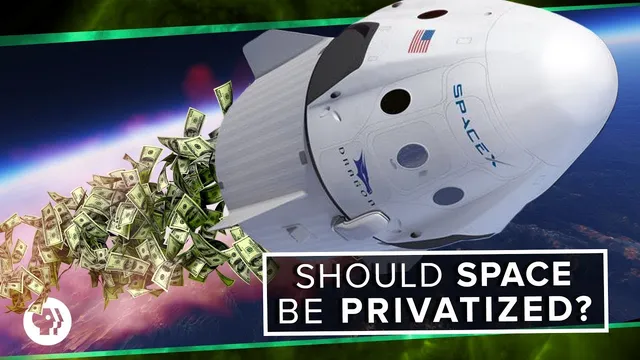
Should Space be Privatized? | Space Time
Based on PBS Space Time's video on YouTube. If you like this content, support the original creators by watching, liking and subscribing to their content.
NASA’s monopoly on space transport weakened through policy changes like the Commercial Space Launch Act of 1984 and later shifts toward commercial Earth-orbit logistics.
Briefing
Space travel is shifting from government-run programs to a mixed system where private companies increasingly handle launch and, eventually, crewed missions. The most visible proof is SpaceX’s Falcon Heavy milestone and the broader pattern of private spacecraft resupplying the International Space Station (ISS), enabled by NASA’s Commercial Orbital Transport Services (COTS) contracts. The stakes go beyond engineering: the question is who gets to decide what humanity pursues in space—elected public institutions or profit-driven (and sometimes idealistic) billionaires.
Private funding in rocketry isn’t new. Early rocket pioneers like Robert Goddard financed work personally, and modern commercial aviation grew from government support that helped private firms scale. In the US, NASA’s monopoly gradually weakened as policy encouraged commercial activity: Ronald Reagan signed the Commercial Space Launch Act of 1984, making commercial launches legal, and later administrations pushed NASA toward science and deep-space goals while private industry handled routine transport to Earth orbit. A key turning point came in 2011 with NASA’s COTS program, which funded cargo delivery to the ISS. SpaceX’s Dragon became the first private spacecraft to dock with the ISS in 2012, and Orbital ATK followed; both now regularly resupply the station. Sierra Nevada Corporation is expected to join with its Dream Chaser spacecraft, slated to dock in late 2020.
The economic logic is clearer for cargo than for people. Resupply missions are far cheaper than the old Space Shuttle model—shuttle operations cost around $4 billion per year, while ISS resupply flights run closer to $50 million each. But crewed private spaceflight has lagged. SpaceShipOne, funded by Paul Allen, reached space in 2004 with Mike Melvill as the first privately developed astronaut, winning the $10 million Ansari XPRIZE. SpaceShipTwo, backed through Virgin Galactic and Scaled Composites, has not yet become routine space tourism, and the transcript attributes the delay largely to money: satellite launches generate near-term profits, while sending humans remains a distant, high-cost market.
The policy environment is also tilting toward private expansion. The Commercial Space Launch Competitiveness Act signed under Barack Obama in 2015 allows US companies to own materials extracted from space, making asteroid mining a potentially massive profit engine. That prospect could accelerate private involvement even further, though it’s treated as a separate issue.
A central debate emerges over whether public agencies should lead “moonshot” missions that are important but not immediately profitable. National programs like Apollo and Hubble delivered major scientific and cultural returns without enriching executives. Yet private firms can move faster and take risks with less sensitivity to shifting political priorities—NASA’s goals have swung between Mars and the moon, while public opinion has constrained programs like the shuttle after the Challenger disaster.
Still, reliance on billionaire-led ventures carries risks. Backers may not live long enough to see long-term outcomes, and corporate governance can replace idealism with boardroom priorities. The transcript frames the core dilemma as democratic legitimacy: should decisions about humanity’s most consequential endeavors be shaped by investors and executives rather than voters? The conclusion is pragmatic—private spaceflight is likely here to stay—but the next challenge is designing a workable partnership that preserves public benefit while leveraging private speed and innovation.
Cornell Notes
Private spaceflight is expanding because policy and contracts have shifted routine orbital work toward commercial providers, with SpaceX’s Dragon and other cargo systems now resupplying the ISS. Crew missions remain limited: SpaceShipOne proved private human spaceflight in 2004, but regular private tourism hasn’t scaled due to economics and market timing compared with satellite launch profits. The transcript contrasts public agencies’ ability to pursue unprofitable “moonshot” science (Apollo, Hubble) with private firms’ speed and risk tolerance when political goals change. The biggest concern is democratic control and continuity—billionaire-led visions may not last, and corporate boards may prioritize returns over public benefit. The likely future is a hybrid model, but the key question is how to align public will with private enterprise.
What policy steps helped move space activity from NASA’s monopoly toward private companies?
Why did private cargo become routine faster than private crewed spaceflight?
How does the ISS resupply comparison illustrate the economic argument for commercialization?
What are the strongest pro-private arguments offered, and what examples support them?
What dangers come with relying heavily on billionaire-led space ventures?
How does the transcript connect space policy to future business opportunities like asteroid mining?
Review Questions
- What specific NASA programs and laws are cited as enabling the rise of private ISS resupply, and what did each change?
- Why does the transcript claim that private crewed spaceflight has lagged behind private cargo, even after SpaceShipOne’s success?
- What democratic and continuity concerns are raised about billionaire-led space programs, and how do they compare with the political constraints on public agencies?
Key Points
- 1
NASA’s monopoly on space transport weakened through policy changes like the Commercial Space Launch Act of 1984 and later shifts toward commercial Earth-orbit logistics.
- 2
NASA’s COTS program (starting in 2011) directly funded private cargo delivery to the ISS, enabling SpaceX’s Dragon to dock in 2012 and supporting ongoing resupply.
- 3
Commercial resupply economics are presented as dramatically cheaper than shuttle operations—about $50 million per mission versus roughly $4 billion per year for the shuttle program.
- 4
Crewed private spaceflight has not scaled into routine tourism largely because human missions are harder to monetize than satellite launches, which offer more immediate profit.
- 5
The transcript links future private expansion to laws that permit ownership of extracted space materials, including the Commercial Space Launch Competitiveness Act of 2015.
- 6
Private firms are portrayed as faster and more willing to take risks than government programs constrained by shifting political priorities and public opinion.
- 7
Overreliance on billionaire-led ventures raises concerns about democratic legitimacy and long-term continuity once visions outlive their founders or shift toward board-driven priorities.