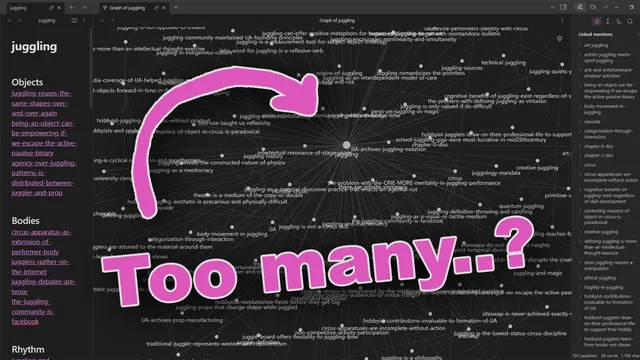
Should you limit connections in a zettelkasten?
Based on morganeua's video on YouTube. If you like this content, support the original creators by watching, liking and subscribing to their content.
Don’t cap connections by number; connections are the retrieval mechanism that makes a Zettelkasten useful.
Briefing
Limiting connections in a Zettelkasten is usually the wrong instinct. The system’s core strength comes from linking notes so ideas can be found through their relationships, not through rigid categories or artificial scarcity. When connections multiply, the real risk isn’t “too many links”—it’s clutter: lots of notes that aren’t organized in a way that makes them retrievable. Clutter happens when information is effectively unsearchable, like tossing paper notes into a box; the notes may exist, but they become unusable because there’s no structure to navigate them.
In a Zettelkasten, connections are what turn scattered notes into a navigable network. Even if a writer can’t recall a specific term, they can start from a related note and follow links until they reach the missing concept. That’s why the advice is to avoid managing connections by number. Instead, focus on making the notes themselves precise and findable. A note that expresses a single, specific, irreducible idea tends to have fewer connections than a broad note, and that specificity makes later retrieval faster and more reliable.
The practical method is “atomicity”: write notes so basic they contain only one idea, and when that idea can be reduced further, create the smaller note. This keeps the network meaningful rather than noisy. At the same time, broad topic notes aren’t automatically bad. A wide note with many links can help someone discover smaller, atomic notes beneath it. The problem arises when a broad note becomes too unwieldy—so the fix is to convert it into a hub note.
A hub note acts like an index or table of contents. It organizes subtopics and then points to the specific notes under each subtopic, so the main topic note doesn’t turn into one giant, exhausting list of links. If any subtopic still grows too large, it can be split into its own note, preserving navigability without forcing a connection limit.
Another major source of clutter is duplication—multiple notes that represent the same idea under different names. Instead of creating separate notes like “Sight Swap,” “Sight Swap Notation,” and “Juggling Notation” for what is essentially one concept, consolidate into one note and use aliases. Aliases let the single note appear under different search terms, including synonyms, common misspellings, or alternative phrases someone might use later.
So the answer to whether connections should be capped is straightforward: don’t manage connections by quantity. Manage note quality—atomic, non-duplicative notes with aliases—and use hub notes when broad topic areas become too dense to browse. With that approach, a Zettelkasten can stay searchable even as the network grows, without turning linking into a fear-driven exercise.
Cornell Notes
The key takeaway is that a Zettelkasten should not limit connections by number. Links are what make notes retrievable through relationships, so “too many connections” is usually a symptom of clutter—notes that are hard to find—not a problem with linking itself. The remedy is to make notes atomic: each note should express a single irreducible idea, and broader notes should be reorganized when they get too large. When a broad topic note becomes unwieldy, convert it into a hub note that indexes subtopics and points to specific notes. Finally, prevent clutter by removing duplicate ideas and using aliases so one note can be found under multiple search terms.
Why is limiting the number of connections usually the wrong fix in a Zettelkasten?
What does “atomicity” mean, and how does it affect connection overload?
When are broad topic notes with many links helpful, and what should replace them when they get too big?
How does aliasing prevent clutter caused by duplicate ideas?
If a note has 100+ connections, what should be changed—connections or the note structure?
Review Questions
- What distinguishes clutter from a healthy network of connections in a Zettelkasten?
- How do atomic notes, hub notes, and aliases work together to keep retrieval fast as the note graph grows?
- When should a broad topic note be split or reorganized, and what does that reorganization look like?
Key Points
- 1
Don’t cap connections by number; connections are the retrieval mechanism that makes a Zettelkasten useful.
- 2
Clutter is the real problem—notes that are hard to find—rather than the mere presence of many links.
- 3
Write most notes as atomic: each note should contain one specific, irreducible idea.
- 4
Use hub notes (table-of-contents style) when a broad topic note becomes too large to browse.
- 5
Convert overly broad concepts into more specific branch notes instead of trimming links.
- 6
Remove duplicate ideas by consolidating into one note and adding aliases for synonyms, alternative phrases, and misspellings.