SI Units in Chemistry
Based on ChemistryNotes Videos's video on YouTube. If you like this content, support the original creators by watching, liking and subscribing to their content.
Every measurement must include both a number and a unit to be meaningful (e.g., “4 grams,” not just “4”).
Briefing
Chemistry measurements rely on the SI system because units make numbers meaningful and comparable across labs worldwide. A measurement isn’t just a numeral like “4”; it’s the numeral paired with a unit such as grams. That pairing matters because the unit effectively anchors the scale—“4 grams” communicates far more than “4” alone. The SI system (Systeme International, an international standard) exists specifically so measurements in different countries can be consistent, interpretable, and scientifically useful.
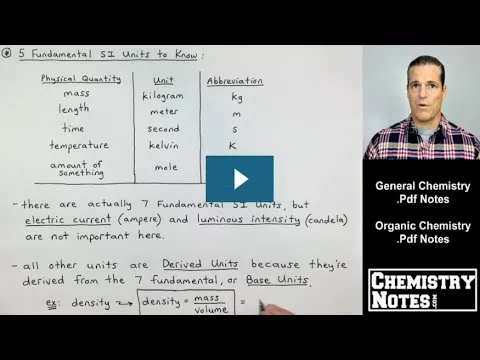
At the core of SI are base units, also called SI fundamental units. In chemistry, the most relevant base quantities are mass (kilogram, kg), length (meter, m), time (second, s), temperature (kelvin, K), and amount of substance (mole, mol). Two additional base units—electric current (ampere, A) and luminous intensity (candela, cd)—are part of SI but are used sparingly in general chemistry. The key idea is that base units are not built from other units; they are the starting points.
From these base units, all other units are derived. Volume is treated as length cubed, so it comes from the meter. Density then becomes a derived quantity: mass divided by volume. This “build from fundamentals” framework explains why units like density and volume are not standalone base units.
The transcript also stresses a practical issue: base units can be too large for typical chemistry scales. Reporting the mass of an electron in kilograms is essentially unhelpful, and measuring atomic dimensions in meters is similarly awkward. Instead, chemistry uses SI prefixes to scale quantities into more convenient ranges. The prefix system lets scientists express the same underlying unit with different magnitudes.
The larger prefixes include kilo (k), where 1 kilogram equals 1,000 grams, and mega (M), where 1 megagram equals 1,000,000 grams (10^6 grams). Smaller prefixes include deci (d) for tenths (0.1 gram), centi (c) for hundredths (100 centimeters equals 1 meter), and milli (m) for thousandths (1,000 milligrams equals 1 gram). Even smaller prefixes include micro (µ), where 10^6 micrograms equal 1 gram, and nano (n), where 10^9 nanograms equal 1 gram.
Finally, the transcript corrects an earlier simplification: mass’s SI base unit is the kilogram (not the gram). Prefixes and correct base-unit conventions set up later work on dimensional analysis and unit conversions, which depend on tracking powers of ten accurately.
Cornell Notes
SI units make chemistry measurements comparable by pairing every number with a unit (e.g., “4 grams,” not just “4”). SI is an international system with base (fundamental) units that aren’t derived from other units: kilogram (kg) for mass, meter (m) for length, second (s) for time, kelvin (K) for temperature, and mole (mol) for amount. Electric current (ampere, A) and luminous intensity (candela, cd) are also SI base units, but general chemistry uses them less often. Derived units come from combining base units, such as volume (length cubed) and density (mass divided by volume). Because chemistry often deals with extremely small or large values, SI prefixes (kilo, mega, deci, centi, milli, micro, nano) scale measurements into practical ranges for calculations and conversions.
Why does a chemistry measurement need both a number and a unit?
What are the SI base (fundamental) units most relevant to general chemistry?
How do derived units relate to SI base units?
Why are SI prefixes necessary in chemistry?
What do the transcript’s key SI prefix conversions look like?
What correction is made about the SI base unit for mass?
Review Questions
- Which SI base units are used for mass, length, time, temperature, and amount of substance in general chemistry?
- How are volume and density treated as derived units, and what base-unit relationships produce them?
- Give two examples of SI prefixes (one larger and one smaller) and state the power-of-ten relationship they represent.
Key Points
- 1
Every measurement must include both a number and a unit to be meaningful (e.g., “4 grams,” not just “4”).
- 2
The SI system provides an international standard so measurements are comparable across countries and labs.
- 3
SI base (fundamental) units in chemistry include kilogram (kg), meter (m), second (s), kelvin (K), and mole (mol).
- 4
Electric current (ampere, A) and luminous intensity (candela, cd) are also SI base units, but general chemistry uses them less often.
- 5
Derived units are built from base units; volume comes from length cubed and density comes from mass divided by volume.
- 6
Chemistry often uses SI prefixes because base units like kilograms and meters can be impractically large for atomic-scale values.
- 7
Prefix conversions rely on powers of ten (e.g., kilo = 10^3, mega = 10^6, milli = 10^-3, micro = 10^-6, nano = 10^-9).