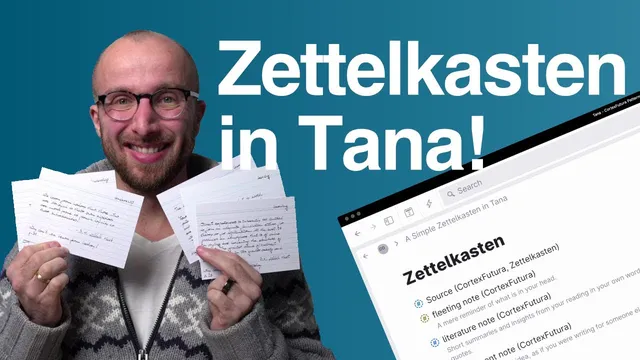
Simple Zettelkasten in Tana
Based on CortexFutura Tools's video on YouTube. If you like this content, support the original creators by watching, liking and subscribing to their content.
Use three note types with distinct jobs: fleeting notes for temporary thoughts, literature notes for source-linked summaries, and permanent notes for synthesized claims.
Briefing
A simple Zettelkasten workflow in Tana hinges on separating notes by purpose—quick “fleeting” thoughts, source-linked “literature” summaries, and durable “permanent” synthesis—then using Tana’s linking and search to turn scattered reading into a navigable idea network. The payoff is non-linear thinking: instead of hunting through margins, notebooks, or random scraps, connected notes let ideas grow into a dense web that supports later synthesis and problem-solving.
The method starts with a minimal setup built around four tag types. A bare-bones Source tag stores bibliographic basics like title and author. Fleeting notes act as an inbox for anything that pops into mind while reading—questions, observations, or reminders. These notes are intentionally disposable: they can be deleted after review, but they matter because they capture raw thoughts early and keep them searchable.
Next come literature notes, created while reading. Each literature note is a short summary written in the reader’s own words, not a copy-paste quote. Crucially, every literature note links back to its source and records where the idea came from—typically via a location field such as page number or Kindle location. That provenance makes later synthesis more reliable and easier to verify.
Permanent notes are the synthesis layer. They contain ideas independent of any single source, written in full sentences so they remain understandable even months or years later. Instead of just listing facts, permanent notes express the reader’s own conclusions, often with a topic field to group ideas by theme. Permanent notes also link to related permanent notes, creating the network that Zettelkasten is known for.
A demo uses a “history of the university in Europe” source to show the flow. Fleeting notes capture an initial question. Literature notes then extract specific claims from different pages—such as how professors began as privately funded instructors, how universities competed for professors, and how incentives tied to student numbers. From those linked summaries, permanent notes are written as higher-level takeaways, like how professor incentives changed dramatically from early German university structures to later systems. Related permanent notes then connect concepts such as education “YouTubers” to the historical “Privatdozent” model, illustrating how new analogies can branch from earlier reading.
Tana’s search capabilities make the system more powerful than a paper slip box. Users can create live searches for literature notes filtered by source, for permanent notes filtered by topic, or for plain-text terms across all notes. For example, searching for “privato Cent” returns the nodes that contain the term, enabling quick retrieval when revisiting a research thread. The result is a lightweight but structured pipeline: capture thoughts, summarize reading with provenance, synthesize into durable claims, and rely on links and search to navigate the growing idea graph.
Cornell Notes
The workflow builds a Zettelkasten inside Tana by splitting notes into three roles: fleeting notes for temporary thoughts, literature notes for source-linked summaries, and permanent notes for durable synthesis. Literature notes must be written in the reader’s own words and include provenance fields such as a linked source and a location (page number, Kindle location, etc.). Permanent notes express ideas independent of any single source, written in full sentences for long-term clarity, and they connect to other permanent notes through topic and related-note links. Tana’s live searches and full-text search make the network usable—filter by source or topic, or search for specific terms like “privato Cent” to quickly find relevant nodes.
Why keep “fleeting notes” separate from literature and permanent notes?
What makes a literature note “Zettelkasten-correct” in this setup?
How should permanent notes be written so they remain useful years later?
How does the note network get built, and what does it enable?
What practical advantage does Tana add compared with a paper slip box?
Review Questions
- What fields and writing constraints distinguish a literature note from a permanent note in this workflow?
- How do related-note links and topic grouping change the way ideas are revisited later?
- Give an example of how a term search (e.g., “privato Cent”) would help during a research project.
Key Points
- 1
Use three note types with distinct jobs: fleeting notes for temporary thoughts, literature notes for source-linked summaries, and permanent notes for synthesized claims.
- 2
Write literature notes in your own words and always attach provenance by linking to the source and recording a location like page number or Kindle location.
- 3
Treat permanent notes as long-term artifacts: full sentences, clear meaning without needing the original reading, and explicit topic labeling.
- 4
Build a network by linking permanent notes to related permanent notes and using topic fields to cluster ideas.
- 5
Capture early questions or observations as fleeting notes so they’re not lost, even if they’re later deleted.
- 6
Rely on Tana live searches to filter by source or topic and on full-text search to quickly retrieve nodes containing specific terms.
- 7
Use the literature-to-permanent pipeline to move from reading details to higher-level synthesis and analogies.