Singular Matrix Problem in SmartPLS4
Based on Research With Fawad's video on YouTube. If you like this content, support the original creators by watching, liking and subscribing to their content.
SmartPLS4 singular matrix errors often appear when a variable has variance of zero, meaning it doesn’t vary across observations.
Briefing
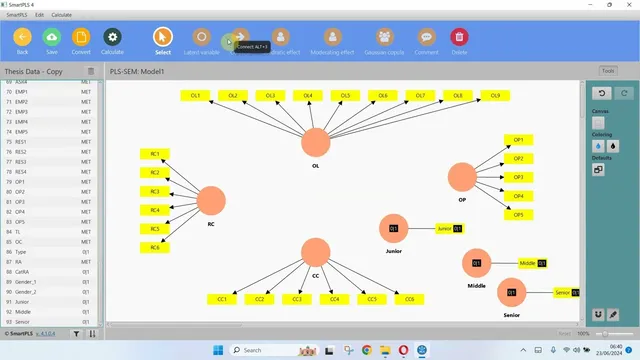
Singular Matrix problems in SmartPLS4 often trace back to variables that don’t provide enough independent information—most commonly dummy-coded categorical predictors where one category is accidentally included as its own “extra” reference. In a worked example, the model includes job rank split into three groups (junior, middle, senior) using dummy variables. After running bootstrapping, SmartPLS4 flags the issue under “info,” pointing to a variable with variance of zero—meaning it contains the same values across observations. That kind of zero-variance behavior can emerge when a grouping variable is used in path modeling, when extreme collinearity appears, or when the sample size is too small.
In the job-rank case, the root cause is the dummy-coding setup: when a categorical variable has three categories, including all dummy variables creates redundancy. With three categories, two dummy variables can end up carrying essentially the same information, leaving the model unable to estimate parameters uniquely. The fix is straightforward: keep one category out as the reference group. The example removes the “junior” dummy, reruns bootstrapping, and the singular matrix error disappears.
Once the model runs cleanly, the interpretation changes from “absolute” group effects to effects relative to the reference category. The results indicate that senior employees show a higher perception of organizational performance compared with juniors, but the difference is not statistically significant. Middle-level employees also show a higher perception than juniors, again without a statistically significant difference. The key takeaway is that the reference category is not just a technical requirement—it defines the comparison baseline for all other category effects.
The transcript also highlights that singular matrix errors can occur even without categorical predictors. In those situations, high collinearity among indicators or latent variables can produce the same estimation breakdown. The recommended troubleshooting approach is iterative: remove one variable at a time and rerun the model to pinpoint which indicator or construct triggers the instability. If the problem persists after addressing coding and collinearity, the final lever is practical rather than structural—increase the sample size so the model has enough information to estimate parameters reliably.
Cornell Notes
SmartPLS4 singular matrix errors usually signal that at least one variable provides no independent information—often detected as a “variance of zero” warning. A common cause is dummy coding a multi-category predictor and including all categories, which creates redundancy; the remedy is to drop one category as a reference group and rerun bootstrapping. After fixing the job-rank coding (removing the “junior” dummy), the model estimates successfully and group comparisons become relative to the reference category. If singularity remains, the likely culprit is high collinearity among indicators or latent variables, which can be diagnosed by removing variables one at a time. When coding and collinearity checks don’t resolve it, increasing sample size can be necessary.
What does SmartPLS4’s “variance of zero” warning imply in a singular matrix problem?
Why does dummy coding a three-category variable (junior/middle/senior) trigger singular matrix issues when all categories are included?
How does removing one dummy category change interpretation of results?
If there are no categorical predictors, what other mechanism can still cause singular matrix problems?
What is the practical last resort if singular matrix problems persist after coding and collinearity checks?
Review Questions
- In a dummy-coded predictor with three categories, what specific modeling change prevents redundancy in SmartPLS4?
- What step-by-step strategy helps identify which indicator or construct is causing collinearity-driven singular matrix errors?
- If the singular matrix error remains after removing redundant dummies and checking collinearity, what adjustment is recommended and why?
Key Points
- 1
SmartPLS4 singular matrix errors often appear when a variable has variance of zero, meaning it doesn’t vary across observations.
- 2
Dummy coding a multi-category predictor requires dropping one category as a reference; including all categories can create redundant (linearly dependent) predictors.
- 3
After removing a reference category, group effects should be interpreted as differences relative to that baseline.
- 4
When singularity occurs without categorical predictors, high collinearity among indicators or latent variables is a common cause.
- 5
A practical diagnosis method is to remove one variable at a time and rerun the model to find the offending construct.
- 6
If coding and collinearity fixes don’t resolve the issue, increasing sample size can improve model identifiability and estimation stability.