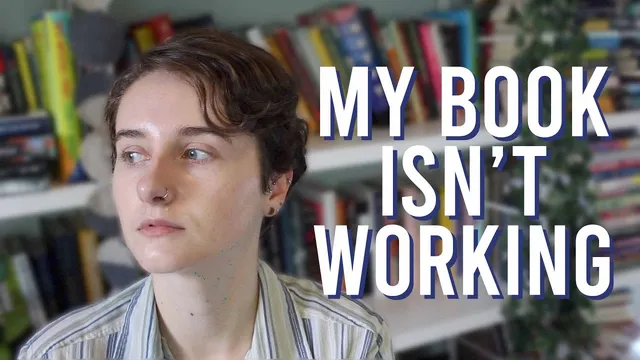
So my book is kind of bad... | Writing Insecurities, Struggles, etc.
Based on ShaelinWrites's video on YouTube. If you like this content, support the original creators by watching, liking and subscribing to their content.
Rereading “Saltbirds” didn’t restore confidence because the first 20,000 words produced little to no emotional response, unlike her earlier novels.
Briefing
A draft of Jalen’s new novel, “Saltbirds,” isn’t failing because the prose is unreadable—it’s failing because it doesn’t generate feeling. After rereading the first 20,000 words, she reports feeling “nothing” emotionally, unlike her earlier novels “Holding a Ghost” and “Honey Vinegar,” which made her feel something for the characters and the events as she read. That emotional disconnect matters because her writing process relies on a physical, embodied empathy: when a character “clicks,” she feels their pain in her body and the story gains momentum. With Rowan, the “Saltbirds” protagonist, she can’t locate the sadness that usually unlocks that empathy, even though she’s interested in the character and finds many lines and passages strong on the sentence level.
The insecurity driving this moment isn’t the old fear of being a bad writer; it’s a more rational-sounding doubt about whether the project itself is fundamentally misfiring. She distinguishes between insecurity as irrational self-critique and insecurity as a signal worth listening to—especially when rereading repeatedly fails to recalibrate her relationship to the book. In her case, the usual remedy (reading back to see what’s working) backfired: the draft didn’t just feel imperfect; it felt inert.
She then inventories what seems structurally off. “Saltbirds” is relationship-heavy, with multiple threads that are closely connected but don’t “braid” into plot movement. Instead of events that escalate and cause change, the book cycles through interactions—rotating through characters and relationships—without enough external or internal “spark” between threads. She also suspects the novel may be more plotless and deeply internal than she expected, and she’s wrestling with why that shift feels threatening when she previously loved plotless work.
A key pressure point is comparison. She’s trying to replicate what worked in “Honey Vinegar,” mapping characters and scenes as if they should deliver the same kind of emotional payoff. That comparison, combined with the stakes of a likely debut trajectory, makes the draft feel like it must justify itself immediately. She also points to a reluctance to experiment and to keep writing when the draft isn’t working—yet she can’t identify exactly what’s missing.
Her search for a craft answer runs into a wall: she believes there’s no single writing tip that can fix what she’s experiencing, describing it as an energetic “crackle” problem—multiple elements demanding connection—rather than a solvable mechanical flaw. She cites a CBC article quote attributed to Anna Ling K: the power of a story comes from the heat created when seemingly unrelated things must be connected.
With that in mind, she chooses action over analysis. She’s pausing her usual approach and committing to “light” NaNoWriMo, aiming to write every day to force immersion and see whether momentum returns. The plan is to keep hacking away, accept that much of what she writes will be bad, and potentially rewrite the beginning entirely—because the only way to find what’s wrong, she concludes, is to keep writing until the missing connection finally appears.
Cornell Notes
“Saltbirds” isn’t emotionally landing for Jalen the way her earlier novels did. Rereading the first 20,000 words leaves her feeling “nothing,” which she treats as a red flag because her best work comes from embodied empathy—when she understands a character’s sadness, she feels it physically and the story gains urgency. She suspects the problem isn’t just line-level quality but a lack of “heat” and connection between story elements: relationship threads don’t braid into plot movement, and she can’t find the sadness that would unlock Rowan’s emotional core. She also feels pressure to replicate “Honey Vinegar,” which may distort how she judges what the new book needs. With no clear craft fix, she’s turning to daily drafting (light NaNoWriMo) to force immersion and discover what’s missing through continued writing.
Why does rereading the first 20,000 words make “Saltbirds” feel worse instead of better?
What does she mean by the “sadness” that unlocks her empathy for a character?
How does she diagnose the structural issue in “Saltbirds”?
What role does comparison to “Honey Vinegar” play in her struggle?
Why does she believe outlining may not work for this kind of story?
What decision does she make to break the cycle of analysis?
Review Questions
- What specific emotional test does she use to judge whether “Saltbirds” is working, and what result did it produce?
- Which two structural/creative explanations does she offer for why the novel feels inert (thread interaction and plot expectations)?
- How does her view of “insecurity” change from earlier writing struggles, and how does that affect her next steps?
Key Points
- 1
Rereading “Saltbirds” didn’t restore confidence because the first 20,000 words produced little to no emotional response, unlike her earlier novels.
- 2
Her writing “click” depends on embodied empathy: identifying a character’s core sadness unlocks physical urgency and reader-facing emotion.
- 3
She reframes insecurity as potentially rational signal—doubt may indicate the project itself isn’t working yet, not that she’s untalented.
- 4
She suspects “Saltbirds” lacks braided momentum: relationship threads rotate through scenes without enough events or intrigue that spark across threads.
- 5
She believes comparison to “Honey Vinegar” is distorting her judgment and increasing pressure tied to debut expectations.
- 6
She argues some story problems aren’t solvable by craft tips; the missing element may be an “energetic crackle” that forces connections.
- 7
Her solution is behavioral: commit to daily drafting via light NaNoWriMo to force immersion and discover what’s missing through continued writing.