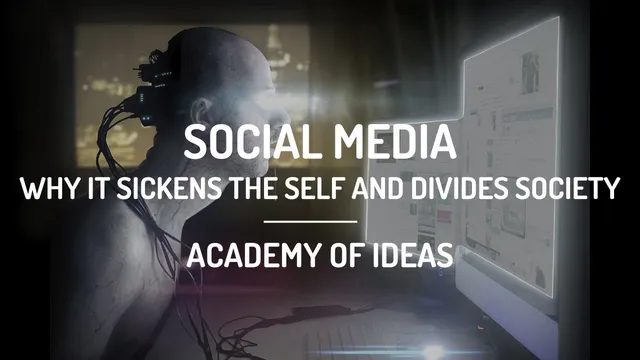
Social Media - Why it Sickens the Self and Divides Society
Based on Academy of Ideas's video on YouTube. If you like this content, support the original creators by watching, liking and subscribing to their content.
Social media is framed as pushing many users toward “profilicity,” an identity built for audience approval rather than inner self-definition.
Briefing
Social media is portrayed as a major identity-shaping force that can “sicken the self” and, by extension, divide society. The core claim is that online life pushes many people away from building a stable inner self and toward managing a public persona for approval. That shift matters because self-concept—what people believe about who they are—affects how they handle life’s challenges, what they value, and how they treat others. When large numbers of individuals adopt fearful, approval-dependent selfhood, society becomes an emergent product of those weakened self-concepts.
The argument traces how identity formation mechanisms changed over time. In earlier Western life, “sincerity” dominated: identity was largely assigned through social roles tied to family and community—class, gender, religion, ethnicity, and profession—and people tried to live those roles properly. Later, increased social mobility and equality of opportunity weakened those inherited role structures, making “authenticity” the prevailing model: individuals discover, realize, or create their own identity, turning selfhood into a personal responsibility.
Social media, however, is said to trigger a regression to a different mechanism called “profilicity,” which resembles sincerity in being other-directed. Instead of family and community judging one’s performance of predetermined roles, a generalized peer audience—hundreds, thousands, or millions—judges and also helps shape the roles people try to play. Profilicity works through selective self-presentation: posting curated images and information, or passively consuming the profiles of admired personalities and using those idealized portrayals as templates for real life. A key consequence is a feedback loop in which digital profiles and in-real-life selves begin to merge, with people adjusting their behavior to match what performs well online.
That approval economy is described as producing hyper-conformity. Success on social platforms is measured by likes, shares, and follows, and the pressure intensifies as algorithms reward certain behaviors and viewpoints. The result is not just conformity to peers, but conformity to algorithmic standards set by powerful tech interests. If someone becomes too unique—or if their values diverge from what the crowd finds acceptable—they risk shunning, shaming, and ostracism. In this framing, social media rewards appearances and popular-culture values more than cultivating a harmonized mind, healthy body, or fulfilling life.
The harms extend beyond personal limitation. Profilicity is also said to harden belief systems and fuel polarization because moral stances become part of a permanent public identity. Once people invest heavily in a cause as a marker of who they are, correcting the underlying narrative can feel like denying the self that the profile represents. The text cites the idea that people may prefer news that confirms feared worst-case scenarios because it validates the identity tied to the cause; if an issue like climate change or civil rights were to be “no longer an issue,” the social validity of the profile would collapse.
Finally, the argument links these dynamics to broader institutional manipulation and surveillance. Algorithmic curation is framed as serving powerful corporate and government interests, and the next step—hinted for a subsequent video—is a “crowd-sourced panopticon,” a dystopian world where people function as both prisoners and guards under pervasive monitoring.
Cornell Notes
The central claim is that social media reshapes identity by shifting people toward “profilicity”—a public, audience-driven self built to win approval. Instead of relying on inherited roles (sincerity) or inner self-discovery (authenticity), people curate profiles and then adjust their real lives to match what performs well online, creating a feedback loop where digital and in-person selves merge. This approval system encourages hyper-conformity through metrics like likes and shares and through algorithmic pressures. It also makes beliefs more rigid because moral stances become part of a long-lasting identity, so correcting facts can feel like rejecting the self. The result is a polarized society and a deeper risk of manipulation and surveillance.
What does “profilicity” mean, and how does it differ from sincerity and authenticity?
How does social media create a feedback loop between online profiles and real-life selves?
Why does profilicity promote hyper-conformity?
How does social media identity formation contribute to polarization?
What role do algorithms and institutional interests play in the argument?
Why is the health of society linked to the health of self-concepts?
Review Questions
- How does the transcript connect identity formation mechanisms to measurable social media behaviors like likes and follows?
- What reasons does the transcript give for why people may resist correcting beliefs even when confronted with contrary facts?
- In what ways does profilicity resemble sincerity, and in what ways does it differ from authenticity?
Key Points
- 1
Social media is framed as pushing many users toward “profilicity,” an identity built for audience approval rather than inner self-definition.
- 2
The transcript argues that self-concept shapes behavior and values, so widespread approval-dependent identity formation can degrade social well-being.
- 3
Profilicity works through curated self-presentation and modeling oneself on idealized profiles, creating a feedback loop that merges online and real-life selves.
- 4
Engagement metrics and algorithmic incentives encourage hyper-conformity, increasing pressure to align with crowd opinion.
- 5
Permanent public records of moral stances make belief correction harder, contributing to rigidity and polarization.
- 6
Algorithmic curation is portrayed as serving corporate and government interests, meaning users may unknowingly adopt agendas.
- 7
The broader trajectory hinted for later is a “crowd-sourced panopticon,” where people function as both monitored subjects and active enforcers.