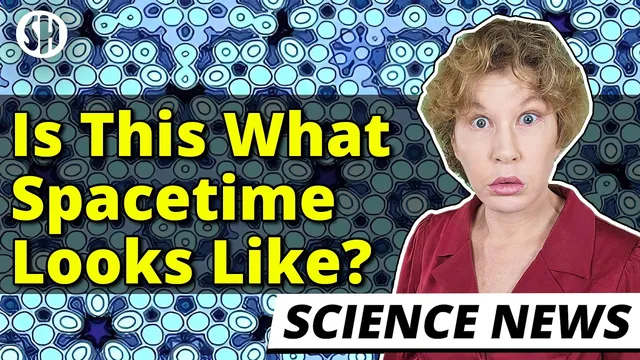
Space & Time Are Quasicrystals, Physicists Claim
Based on Sabine Hossenfelder's video on YouTube. If you like this content, support the original creators by watching, liking and subscribing to their content.
A quasi-crystal structure is proposed as an underlying geometry for spacetime, aiming to reconcile general relativity with quantum physics at short distances.
Briefing
A new quantum-gravity proposal suggests that space and time might have the mathematical structure of a quasi crystal—a pattern that never exactly repeats—rather than the smooth continuum used in Einstein’s general relativity. If the idea holds up, it could do double duty: offer a candidate “stuff” for spacetime and help explain why the laws of physics look the way they do at macroscopic scales while still becoming compatible with quantum behavior at very short distances.
In standard physics, matter is built from molecules, atoms, and smaller constituents like quarks and gluons. By contrast, general relativity treats spacetime as a continuum: an infinitely fine differentiable manifold with no underlying material made of discrete parts. The trouble is that general relativity does not mesh cleanly with quantum theories describing particles. Many approaches to quantum gravity therefore assume spacetime has an underlying structure—sometimes framed as “spacetime atoms” or networks—so that quantum effects can emerge without destroying the successes of Einstein’s theory.
The new paper’s key move is to borrow from quasi-crystal physics. Quasi crystals are mathematically tied to Penrose tilings: they show order without periodic repetition. Unlike ordinary crystals, which repeat their pattern exactly, quasi crystals repeat only in an infinite variety of shifted arrangements. Real quasi crystals also exist in laboratories and were recognized with the 2011 Nobel Prize in Chemistry for their unusual electrical and thermal properties, giving the concept credibility beyond pure math.
The proposal addresses a major obstacle that kills simpler “crystal spacetime” ideas. If spacetime were like a regular lattice of atoms, then motion through it would produce detectable distortions. The transcript illustrates this with a square lattice: a moving observer would see length contraction, turning the lattice into a non-square shape. That would let one detect absolute motion—something Einstein’s relativity forbids. More seriously, when quantum particles move through a discretized spacetime, their behavior depends on how their paths align with the lattice directions, leading to observable consequences that experiments do not show. Regular-crystal discretizations therefore tend to produce a “nightmare” of mismatches with known physics.
Quasi crystals help because their non-repeating structure can avoid the clean directional artifacts of a periodic lattice. The authors also argue that quasi-crystal structure must be extended beyond space alone to include time as well, aiming for a theory that stays close to Einstein’s predictions at large distances while changing at short scales to become quantum-compatible. They further suggest the quasi-crystal pattern could effectively span more than three spatial dimensions, with extra “width” dimensions tied to how quantum particles experience the universe’s scale and relate to particle masses and gravity.
Still, the proposal remains early. It does not yet specify how quantum particles actually propagate through the quasi-crystal spacetime, leaving a crucial gap between the mathematical framework and testable dynamics. The overall assessment is that the approach is creative and potentially important, but far from a complete, useful theory of quantum gravity.
Cornell Notes
The proposal reframes spacetime as having the ordered-but-nonrepeating structure of a quasi crystal, motivated by the mismatch between general relativity and quantum particle theories. Regular “crystal spacetime” models run into severe problems: motion through a periodic lattice would produce detectable anisotropies (e.g., a square lattice would look non-square under length contraction), and quantum particle dynamics would depend on alignment with lattice directions—effects not seen experimentally. Quasi crystals, linked to Penrose tilings, avoid exact periodic repetition while retaining mathematical order. The authors extend the quasi-crystal idea to include both space and time and suggest it may involve effective extra spatial dimensions. The work is viewed as a first step because it does not yet provide a concrete rule for how quantum particles move through this structure.
Why do “regular crystal” models of spacetime run into trouble with relativity?
How does discretizing spacetime create unwanted observable effects for quantum particles?
What makes quasi crystals different from ordinary crystals in the relevant mathematics?
Why does the proposal extend quasi crystals to include time, not just space?
What role do extra effective dimensions play in the proposal?
What key gap remains before the framework becomes a usable quantum-gravity theory?
Review Questions
- What specific experimental or conceptual problem arises when spacetime is modeled as a regular periodic lattice?
- How do quasi crystals’ non-repeating patterns (Penrose-tiling-like order) help avoid the pitfalls of periodic crystal spacetime?
- What additional ingredient is still missing for the quasi-crystal spacetime idea to become a full quantum-gravity theory?
Key Points
- 1
A quasi-crystal structure is proposed as an underlying geometry for spacetime, aiming to reconcile general relativity with quantum physics at short distances.
- 2
General relativity treats spacetime as a smooth continuum, but quantum theories for particles do not fit naturally with that assumption.
- 3
Periodic “crystal spacetime” models conflict with relativity because motion would distort the lattice in detectable ways (e.g., a square lattice would not remain square under length contraction).
- 4
Regular lattices also create alignment-dependent quantum dynamics, leading to observable consequences that are not seen.
- 5
Quasi crystals offer ordered but non-periodic structure, mathematically connected to Penrose tilings and physically realized in laboratory materials.
- 6
The proposal extends quasi-crystal ideas to include both space and time and suggests the structure may involve effective extra spatial dimensions.
- 7
The framework is still incomplete because it does not yet specify how quantum particles propagate through the quasi-crystal spacetime.