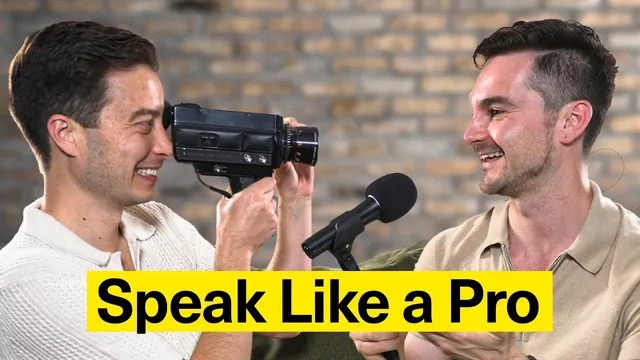
Speak Like YOU Mean It: The 3-Step Flow Formula! (ft. Michael Gendler of Ultraspeaking)
Based on Tiago Forte's video on YouTube. If you like this content, support the original creators by watching, liking and subscribing to their content.
Reframe nervousness as adrenaline and stop magnifying it with labels like “I’m nervous right now.”
Briefing
The core shift behind “Speak Like YOU Mean It” is treating speaking pressure as normal physiology—and using that awareness to move from performance to flow. Instead of trying to talk yourself out of nerves or forcing “excited” energy, Michael Gendler frames nervousness as adrenaline: a bodily signal that matters only because the moment matters. When speakers stop magnifying the feeling (“I’m nervous”) and start working with it (“I’m feeling adrenaline”), they reduce the threat response and regain naturalness.
From there, the conversation lands on a practical mindset and a repeatable flow model. Gendler argues that “public speaking” is largely a mental category: whether it’s a stage, a camera, an interview, or a meeting, people raise the stakes in their heads and then try to “live up” to an imagined standard. That standard is often performative—hand gestures, posture, the “suit and tie” Toastmasters-era template—or shaped by what people think a TED Talk should look like. The result is a gap: someone who can speak confidently in a meeting may still reject the label “public speaking” because the imagined version of that role feels incompatible with who they think they are.
The remedy is a move from “impress mode” to “express mode.” Impress mode is driven by external evaluation—trying to look impressive, add value in a way that satisfies other people, and succeed on criteria the speaker can’t control. Express mode treats speaking as a vehicle for sharing an idea from inside, similar to talking with a therapist or a close friend: the goal becomes getting the message across rather than managing appearance. Gendler says the surprising payoff is that expressiveness tends to read as impressive, especially in an authenticity-driven culture.
Flow is the mechanism that makes express mode possible. Speaking works best when the inner critic quiets down—when people stop monitoring how they’re coming across, stop worrying about what to say next, and stop judging whether they’re “making sense.” Exercises and games aim to bypass the thinking brain so speakers can experience flow directly, then validate it through feedback in small groups. The “level-up” isn’t learning to speak better; it’s learning to feel more flow.
To make the approach actionable, the discussion culminates in a three-step speaking formula: (1) speak before you think—start talking to avoid overthinking that leads to hesitation and doubt; (2) pause and breathe—when momentum drops or a tangent starts, stop speaking and take a full inhale/exhale to reset; and (3) end strong—carry confidence through the finish line because the thinking/critical brain often reactivates at the end, shrinking speakers’ confidence right when audiences remember the most. Techniques like the “newscaster” cadence and a one-sentence “summary prompt” help land the plane by giving the brain a clear final instruction.
The broader claim is that these speaking skills generalize to life: people who avoid pausing in speech often avoid pausing in their schedules, while expanding expressive range can show up as more courage and presence beyond the room. The practical takeaway is simple: trust yourself enough to start messy, use pauses as punctuation, and hold confidence through the last seconds—because speaking doesn’t end when the words stop; it ends in the seconds after.
Cornell Notes
The conversation reframes speaking anxiety as adrenaline and argues that natural communication comes from shifting attention away from performance and toward expression. “Impress mode” is unstable because it depends on other people’s judgment; “express mode” treats speaking as a vehicle to share ideas from inside, which tends to come across as compelling. Flow is the state where the inner critic quiets and speaking becomes less monitored and more intuitive, and it can be trained through games, small-group practice, and validation. A practical three-step formula ties it together: speak before you think, pause and breathe when momentum slips, and end strong by carrying confidence through the final seconds. Ending strong matters because the critical brain often reactivates at wrap-up, causing speakers to shrink right when audiences remember most.
Why does advice like “tell yourself you’re excited” fail for many speakers?
What’s the difference between “impress mode” and “express mode,” and why does it matter?
How does flow change speaking, and what blocks it?
What does “speak before you think” mean for analytical people who want structure?
Why is “pause and breathe” treated as a core skill rather than a nervous habit?
What does “end strong” specifically target, and how can it be practiced?
Review Questions
- How do adrenaline and attention interact to make nervousness feel threatening, and what mental shift reduces that effect?
- Describe the three-step speaking formula and give one concrete example of how you would apply each step in a meeting.
- Why does the critical brain often reappear at the end of a talk, and what tools help prevent “weak landing” behavior?
Key Points
- 1
Reframe nervousness as adrenaline and stop magnifying it with labels like “I’m nervous right now.”
- 2
Treat speaking pressure as a mental category problem: stakes rise when “public speaking” is imagined as a different, higher-status role.
- 3
Move from impress mode (external judgment) to express mode (sharing ideas from inside) to unlock naturalness.
- 4
Train flow by reducing inner monitoring; speaking improves when the inner critic quiets and validation follows practice.
- 5
Use “speak before you think” to avoid overthinking that causes hesitation and doubt.
- 6
When momentum slips, pause and breathe—silence becomes punctuation and a reset button.
- 7
End strong by carrying confidence through the last seconds; use techniques like a newscaster cadence or a one-sentence summary prompt to land the plane.