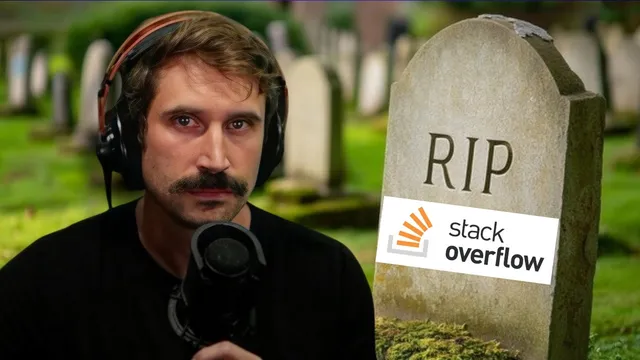
Stack Overflow Is Almost Dead
Based on The PrimeTime's video on YouTube. If you like this content, support the original creators by watching, liking and subscribing to their content.
Stack Overflow’s question volume has dropped sharply, with monthly activity described as reaching levels similar to 2009.
Briefing
Stack Overflow’s decline isn’t just an AI story—it’s a long slide that accelerated as new tooling made the site less necessary. The clearest signal in the discussion is a sharp drop in the number of questions posted, with monthly activity reaching levels comparable to Stack Overflow’s early days in 2009. That matters because Stack Overflow wasn’t merely another forum; it was a major training and reference source for developers, and its weakening ecosystem changes where programmers go when they get stuck.
The conversation traces two overlapping forces. First comes moderation and community friction. A key data point highlighted from a graph shared by Mark Gravel (a top Stack Overflow contributor) shows questions starting to decline around 2014—around the same time moderators reportedly improved “efficiency” by closing more questions faster and removing low-quality posts more aggressively. Several participants connect that shift to lived experience: legitimate questions felt unwelcome, users stopped asking, and the site increasingly felt like a place where people were punished for not fitting the rules. The argument isn’t that duplicate closures remove “questions” from the world; it’s that the experience of being closed—often for being “opinion-based” or otherwise not matching strict standards—discouraged newcomers from returning.
Second comes the changing search-and-answer landscape. The transcript points to a recurring spike at the start of each year—often associated with new programmers trying to learn—followed by a rapid falloff as those users stop asking. Then, in the AI era, the decline accelerates further. As ChatGPT (referred to as “Chat Chippity”) becomes widely available, the number of questions asked drops quickly, with the claim that answers are “similar” in quality because the system is trained on Stack Overflow data. Even before that, the discussion suggests that other sources—SEO and aggregators—already reduced the need to post fresh questions.
A major theme is that Stack Overflow’s advantage—its large repository of high-quality coding Q&A—was undermined by product choices that didn’t meet developers where they work. The transcript claims Stack Overflow failed to prioritize editor integration, despite the fact that many developers use tools like VS Code. The proposed “missed move” is a Stack Overflow plugin that would let users ask questions and pull solutions directly inside their editor, reducing friction compared with leaving the IDE to search and post.
By the end, the decline is framed as both inevitable and preventable: moderation policies and community dynamics weakened the site before AI arrived, while AI and better integrated alternatives made the remaining value harder to justify. The discussion also speculates about what comes next—Discord servers, WhatsApp, Telegram groups, and other community spaces—where developers can still get human help, even if Stack Overflow’s specific model is running out of momentum.
Cornell Notes
Stack Overflow’s question volume has fallen dramatically, with monthly activity reportedly reaching levels similar to its 2009 launch period. The decline is linked to two forces: stricter moderation and community friction beginning around 2014, and later AI-driven alternatives that reduce the need to ask on the site. A graph shared by Mark Gravel is used to connect moderation “efficiency” (faster closures and more removals) with earlier drops in posting. The discussion also argues Stack Overflow squandered its data advantage by not pushing editor integration—so developers could ask and retrieve answers without leaving their IDE. The result is a platform that became less attractive over time, then faced acceleration as tools like ChatGPT made answers easier to obtain elsewhere.
What does the transcript treat as the most important evidence of Stack Overflow’s decline?
How does moderation policy enter the explanation, and what timing is emphasized?
Why does the transcript argue that AI accelerated the decline rather than causing it from scratch?
What product-design failure is highlighted as a major missed opportunity?
What future alternatives are suggested for developers who still want human help?
Review Questions
- Which two time periods does the transcript use to separate “moderation/community” decline from “AI/tooling” acceleration?
- What specific moderation mechanism (e.g., faster closures, removal of low-quality posts, “opinion-based” labeling) is linked to user disengagement?
- How does the transcript justify editor integration as a decisive factor in whether developers use a Q&A platform?
Key Points
- 1
Stack Overflow’s question volume has dropped sharply, with monthly activity described as reaching levels similar to 2009.
- 2
A decline beginning around 2014 is linked to moderation changes that increased closures and removals, discouraging newcomers from asking.
- 3
The transcript treats AI tools like ChatGPT as an accelerator that reduces the need to post questions, especially because AI is trained on Stack Overflow data.
- 4
SEO and aggregators are cited as earlier forces that already reduced demand for posting fresh questions.
- 5
The discussion argues Stack Overflow’s data advantage was undermined by not prioritizing editor integration, such as a VS Code plugin for in-IDE Q&A.
- 6
The proposed lesson is that developers choose the lowest-friction workflow; integration beats requiring users to leave their tools.
- 7
Community help is expected to shift toward Discord and other chat/group platforms where developers can still get human answers.