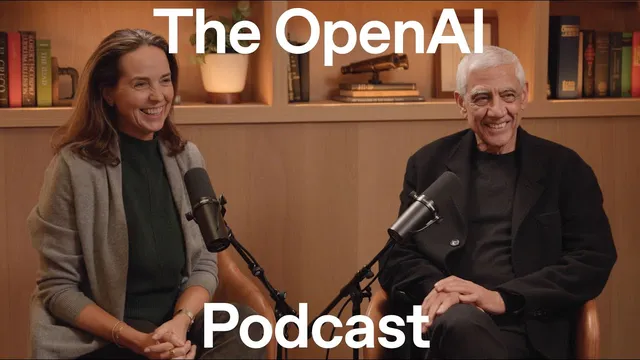
State of the AI industry — the OpenAI Podcast Ep. 12
Based on OpenAI's video on YouTube. If you like this content, support the original creators by watching, liking and subscribing to their content.
AI’s near-term bottleneck is compute availability, so demand is constrained more by capacity than by lack of interest.
Briefing
AI’s next phase hinges less on whether models get smarter and more on whether people and companies learn to use that capability to complete real tasks—trip planning, contract review, clinical triage support—because compute availability is the main bottleneck today. In 2025, “vibe coding” and agent-like experimentation grabbed attention; in 2026, multi-agent systems are expected to mature enough to deliver visible outcomes, first inside enterprises for end-to-end workflows and later for consumers in messy, multi-step situations.
The discussion frames the industry as moving along a “capability gap” continuum. Most users still operate AI as a chat interface for questions, even though the real value comes from turning prompts into outcomes. On the consumer side, the goal is shifting from “ask and answer” to “task worker” behavior—booking travel across calendars, reservations, and flight schedules; generating meal plans for specific health needs; or helping people prepare for medical conversations. On the enterprise side, the same continuum applies, but with vertically specialized deployments that can transform core business processes. Examples range from healthcare workflows like drug discovery and hospital operations (e.g., admission and discharge timing) to retail outcomes such as higher conversion rates and larger basket sizes.
A key adoption argument is that usage growth will outpace capability growth because learning curves lag behind model improvements. Only a small fraction of people are believed to be using a meaningful portion of available AI capability, so the number of weekly users—cited as 800 million ChatGPT users—should expand further, with a long runway (described as roughly a decade) for broader, deeper adoption. The “bubble” debate is addressed directly: demand is constrained mainly by compute, not by lack of interest. The analogy used is electricity—people can’t use the full range of what’s possible until they learn what to do with it.
Health is treated as both the clearest marker of acceleration and the hardest regulatory domain. Usage signals are already large: 230 million people ask ChatGPT health questions weekly, and 66% of U.S. physicians report using it in daily work. Yet diagnosing and prescription-writing face legal and regulatory constraints; no AI medical device is approved yet, and institutions like the FDA and the American Medical Association limit what systems can do. Even so, the practical near-term impact is framed as augmentation: helping doctors stay current, supporting triage and differential diagnosis, and giving consumers better-prepared conversations and second opinions.
On compute and investment, the CFO perspective ties spending to revenue and future capacity. Compute capacity is described as rising from 200 megawatts to 600 megawatts and then to 2 gigawatts, alongside ARR growth from $2B to $6B and then to over $20B. Decisions must be made years ahead because data centers and orders can’t be created instantly. The broader market is also investing heavily, with global hardware and chip spending rising by hundreds of billions.
Finally, the conversation argues that “bubble” metrics based on stock prices miss the real signal. Vinod Khosla proposes measuring AI demand by operational usage—API calls or internet traffic analogs—because those reflect real utility rather than investor sentiment. The enterprise and startup implications are clear: agents are still early (only a minority of companies use them today), but there’s room for startups to build moats around proprietary data, complex workflows, permissions, and identity—especially where general models can’t safely or efficiently handle governance-heavy tasks like procurement approvals. The outlook extends beyond software into robotics and a future where labor and expertise become cheaper, raising the question of what societies will do when more services become effectively free—housing remains a major unresolved challenge.
Cornell Notes
The core claim is that AI’s biggest bottleneck is not intelligence—it’s the “capability gap” between what models can do and how people and companies actually use them. In 2026, multi-agent systems are expected to mature from demos into workflows with measurable impact, especially in enterprises, while consumer task automation (like trip planning) follows later. Adoption will likely lag capability for years: only a small share of users are using a large fraction of available AI capability today, so usage can expand dramatically even without a new model breakthrough. Health is already showing large real-world usage, but regulatory limits constrain diagnosis and prescriptions, making augmentation (second opinions, symptom research, clinician support) the near-term win. Compute investment is framed as demand-driven and revenue-correlated, with compute capacity rising alongside ARR, while “bubble” talk is challenged using API-call demand as the more meaningful metric.
Why does the conversation treat “compute availability” as the main constraint on AI demand?
What changes from 2025 to 2026 in terms of AI capabilities and where impact will appear first?
How does the discussion reconcile large health usage with regulatory limits?
What metric does Vinod Khosla use to challenge “AI bubble” thinking?
How does OpenAI’s compute investment strategy get justified in the conversation?
Where do startups fit if general models keep improving?
Review Questions
- What does the “capability gap” mean in practice, and how does it shape expectations for 2026 agent maturity?
- Why does the conversation argue that API-call volume is a better “bubble” indicator than stock prices?
- Which health use cases are framed as likely to expand despite regulatory constraints, and what limits remain?
Key Points
- 1
AI’s near-term bottleneck is compute availability, so demand is constrained more by capacity than by lack of interest.
- 2
2026 is expected to bring multi-agent systems into real, end-to-end enterprise workflows, with consumer task automation following as it becomes less cumbersome.
- 3
Most users still treat AI as a question-answer tool; the industry’s value proposition depends on shifting toward outcome-based “task worker” behavior.
- 4
Health adoption is already widespread (230 million weekly health questions; 66% of U.S. physicians using ChatGPT), but diagnosing and prescribing remain constrained by FDA/AMA and medical-device approval gaps.
- 5
Compute investment is justified through revenue correlation and long lead times, with compute capacity rising alongside ARR (200 megawatts → 600 megawatts → 2 gigawatts; $2B → $6B → $20B+).
- 6
“Bubble” narratives based on stock prices are challenged; operational demand like API calls is offered as a more reality-based metric.
- 7
Startup opportunities concentrate on proprietary data, permissioning/identity, and complex workflow governance that general models can’t safely or efficiently handle alone.