Statistics for Research - 37 - Moderation Analysis using SPSS with Continuous Variables
Based on Research With Fawad's video on YouTube. If you like this content, support the original creators by watching, liking and subscribing to their content.
Moderation in SPSS is tested by adding an interaction term (moderator × independent variable) to a regression predicting the dependent variable.
Briefing
Moderation analysis in SPSS can test whether role ambiguity changes the strength of the relationship between collaborative culture and organizational performance. In this setup, collaborative culture (built from six indicators averaged into a composite) is treated as the independent variable, organizational performance is the dependent variable, and role ambiguity is the moderator. The key hypothesis is that higher role ambiguity weakens the positive link between collaborative culture and organizational performance—so the interaction between role ambiguity and collaborative culture should be statistically significant and negative.
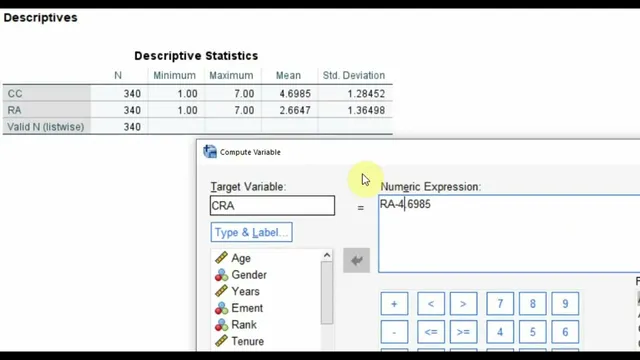
Before running regression, the workflow emphasizes preprocessing to make the interaction term interpretable and reduce multicollinearity. The analysis starts by mean-centering the independent and moderator variables: collaborative culture is centered by subtracting its sample mean (reported as 4.6985), and role ambiguity is centered by subtracting its mean (reported as 2.6647). After centering, SPSS creates a centered collaborative culture variable (CCC) and a centered role ambiguity variable. The mean-centered values have a mean of zero, which stabilizes the regression when an interaction term is added.
Next comes the interaction term—the “keyword” in moderation. Using Transform → Compute Variable, the analysis multiplies centered role ambiguity by centered collaborative culture to create an interaction variable (int… = RA × CC). The regression then tests three pieces: (1) collaborative culture predicting organizational performance, (2) role ambiguity predicting organizational performance, and (3) the interaction predicting organizational performance. In the reported results, adding the interaction increases R², and the interaction term is significant with a negative coefficient. That negative sign is interpreted as evidence that role ambiguity weakens the collaborative culture → organizational performance relationship, matching the hypothesis. Without the interaction, both collaborative culture and role ambiguity show significance, with role ambiguity negatively associated with organizational performance.
The session also compares alternative scaling choices and shows that results can shift depending on how variables are standardized. One approach uses standardized (Z-score) versions of collaborative culture and role ambiguity to create the interaction term, then runs regression with standardized organizational performance. Another approach repeats the regression using the original (non-standardized) dependent variable while keeping the interaction based on standardized predictors. The coefficients and the interaction effect magnitude change across these options: mean-centering tends to produce a “preferred” and more stable pattern, while mixing standardized and non-standardized dependent variables can alter the reported path coefficients. The practical takeaway is to use mean-centering for the predictors and, if standardization is used, keep the dependent variable consistent with that scaling.
Overall, the SPSS procedure demonstrates how to operationalize moderation with composite variables, mean-centering, interaction-term creation, and regression-based significance testing—then validates the interpretation by checking the sign and significance of the interaction coefficient.
Cornell Notes
Moderation analysis tests whether a third variable changes the strength of a relationship between an independent variable and a dependent variable. Here, collaborative culture predicts organizational performance, while role ambiguity moderates that link. SPSS moderation is implemented by mean-centering collaborative culture and role ambiguity (subtracting their means), then creating an interaction term as the product of the centered variables (RA × CC). A regression model including collaborative culture, role ambiguity, and the interaction term shows whether the interaction is significant; a significant negative interaction indicates that higher role ambiguity weakens the collaborative culture → organizational performance relationship. The session also compares mean-centering versus Z-score standardization and shows that coefficient values can change if scaling choices are inconsistent, especially for the dependent variable.
What does it mean for role ambiguity to “moderate” the collaborative culture → organizational performance relationship?
Why mean-center collaborative culture and role ambiguity before creating the interaction term in SPSS?
How is the interaction term created for moderation analysis in SPSS?
How does the regression output determine whether moderation is present?
Why do results change when using standardized (Z-score) variables instead of mean-centered variables?
Review Questions
- In moderation regression, which term’s significance and sign determine whether the moderator weakens or strengthens the independent variable’s effect?
- What preprocessing step is used to reduce multicollinearity when building an interaction term in SPSS, and how is it computed?
- How can inconsistent use of mean-centering versus Z-score standardization affect the reported regression coefficients?
Key Points
- 1
Moderation in SPSS is tested by adding an interaction term (moderator × independent variable) to a regression predicting the dependent variable.
- 2
Composite variables can be created by averaging multiple indicators (e.g., collaborative culture from six items) before running moderation.
- 3
Mean-centering predictors (subtracting their means) helps stabilize the regression when interaction terms are included.
- 4
A significant interaction term indicates moderation; a negative interaction coefficient supports the claim that the moderator weakens the relationship.
- 5
Role ambiguity weakening the collaborative culture → organizational performance link is concluded when the interaction term is significant and negative.
- 6
Using standardized (Z-score) variables can change coefficient values, so scaling choices—especially for the dependent variable—should be kept consistent.