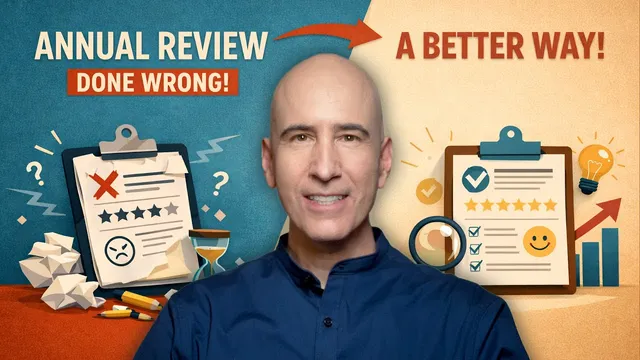
Stop Reviewing Your Year Like a Scorecard
Based on August Bradley's video on YouTube. If you like this content, support the original creators by watching, liking and subscribing to their content.
Treat annual review as narrative sensemaking, not a pass/fail audit of productivity.
Briefing
Annual reviews often get treated like a scorecard: tally wins and losses, compare completed goals to stalled ones, and judge the year by productivity metrics. That approach misses the point. A year is less a set of discrete outcomes and more an unfolding narrative—an evolving chapter in who someone is becoming. When the focus shifts from “Did I do enough?” to “How did I change?” the review becomes a tool for understanding growth, not grading performance.
In a story-based review, the central question becomes how a person responded to pressure and what the year demanded that they grow into. Progress isn’t linear in real life, and repeated friction isn’t random noise—it’s curriculum. The same patterns tend to reappear across work, relationships, energy, and decisions, signaling lessons that still need to be learned before the next level is reached. Instead of labeling stalled projects or disruptions as isolated failures, the narrative lens treats them as plot twists: events that clarify what no longer works and force new skills, insight, and identity shifts.
A key reframing targets what gets called “the antagonist.” Failure isn’t the enemy in this framing; comfort is. Comfort shows up as convenience, familiar routines, and the slow accumulation of micro-negotiations—trading the future someone wants for the present that feels safe. Character, the argument goes, isn’t revealed by what someone does when things are easy; it’s revealed by what they tolerate when it’s hard. That means the moments that look like setbacks often matter more than the highlights because they reveal the real constraints on change.
The year also has themes, not just goals. Themes such as constraint, expansion, recovery, ambition, patience, integration, and reinvention tend to repeat until they’re understood. When someone reconstructs the year as a story arc, those themes surface naturally—often through the emotional signature of “setbacks” and the consistent way projects stall or disruptions arrive “on schedule.” Plot twists don’t cancel the story; they sharpen it by exposing what must be replaced and what new direction is required.
This narrative approach changes how planning starts. Goals remain useful, but they’re tactical. The deeper work is designing for evolution: asking what kind of year someone is authoring, what role they’re stepping into (explorer, builder, healer, leader, apprentice), what internal shift must happen for the chapter to make sense, and which recurring obstacles they’re finally willing to confront rather than work around. The payoff is a review that interprets patterns instead of merely auditing outcomes—because life isn’t a ledger to balance. It’s a story to tell, and the next chapter’s tone, theme, and direction are choices made starting now.
Cornell Notes
Annual reviews work poorly when they function like a scorecard—counting wins, losses, and efficiency to decide whether the year “succeeded.” A story-based review treats the year as an unfolding narrative and asks how someone evolved, how they responded to pressure, and what the year demanded they grow into. Repeated friction across work, relationships, energy, and decisions is framed as curriculum, not coincidence. “Setbacks” become plot twists that clarify what no longer works and force new skills and identity shifts. Instead of starting next year with goals alone, the approach emphasizes themes, roles, and behavioral practice—designing for evolution rather than grading performance.
Why does a scorecard-style annual review miss something important?
What counts as the “antagonist” in this framework, and why does that matter?
How should repeated problems be interpreted?
What is a “plot twist” in an annual review, and how should it be handled?
What replaces goals as the main organizing principle for the next year?
How does this approach change the way someone plans next year?
Review Questions
- Which recurring friction patterns showed up across multiple areas of life (work, relationships, energy, decisions), and what lesson might they be signaling?
- Where did comfort—convenience, familiar routines, or micro-negotiations—quietly steer choices away from a desired future?
- What theme (e.g., constraint, expansion, recovery, integration) is most likely to repeat next year, and what specific behavioral practice would demonstrate it?
Key Points
- 1
Treat annual review as narrative sensemaking, not a pass/fail audit of productivity.
- 2
Shift the core question from “Did I do enough?” to “How did I change, and what did I learn under pressure?”
- 3
Interpret repeated friction as curriculum, not coincidence, and look for the same emotional signatures in “setbacks.”
- 4
Reframe the antagonist as comfort—convenience and familiar patterns—so growth focuses on what gets tolerated when it’s hard.
- 5
Use plot-twist thinking: disruptions can clarify what no longer works and force new skills and identity shifts.
- 6
Plan next year around themes and roles, with goals kept tactical rather than the main driver of meaning.
- 7
Design for evolution by choosing the internal shift and behavioral practice that match the next chapter’s theme.