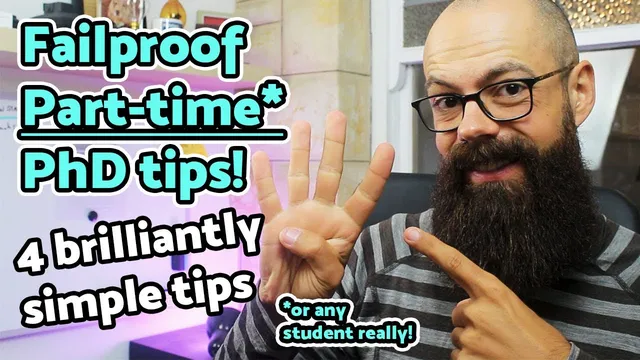
Successful part time PhD students | 4 fail proof tips!
Based on Andy Stapleton's video on YouTube. If you like this content, support the original creators by watching, liking and subscribing to their content.
Use dated record keeping (lab-book style) to preserve context for experiments, ideas, and progress, which can also support accountability and intellectual property.
Briefing
Part-time PhD work can quietly derail momentum—especially when days away from the desk cause forgotten starting points and lost context—but steady systems can keep research moving. The core fix is simple: build a paper trail and a quick “restart” routine so the next work session picks up exactly where the last one ended.
A first line of defense is rigorous record keeping, modeled on lab notebooks used in STEM. Those notebooks function as dated diaries of experiments, ideas, and progress, which matters not only for personal clarity but also for accountability and intellectual property. The practical recommendation is to leave a short, actionable note before stepping away for any significant period. Writing a brief “Hi [name], this is what you’ve just done” list—experiments completed, proposals drafted, grant applications submitted, papers read, chapters finished—turns into a morning checklist. The note should also specify what comes next: follow up with the right person, complete unfinished tasks, respond to reviews, or continue the next experiment. Even short breaks benefit from this habit, because it prevents the common frustration of sitting down and not remembering what to do first.
Second, capture inspiration immediately with a physical notepad and pen carried in daily life. The transcript emphasizes that creative breakthroughs often arrive when stepping away from a problem—during a walk, shower, commute, or at night—when the brain continues working in the background. Without a notebook, those flashes fade quickly. Digital notes are described as less reliable for this purpose; the key is fast, frictionless capture so ideas can be reviewed later and either developed or discarded.
Third comes self-discipline, framed as the unglamorous engine behind progress. The approach is to break the day into small, bite-sized chunks and focus attention on the next concrete activity toward the PhD end goal. Starting is treated as the hardest step, because the mind generates reasons to delay. A tactic is to commit to a tiny window—“five minutes”—knowing that momentum often expands the session into 30–40 minutes once work begins. The underlying message: trick the brain into action, then let momentum do the heavy lifting.
Fourth, avoid comparisons that sap motivation. Social media and lab culture can make part-time students feel permanently behind, but progress belongs to each person’s own “race.” The transcript urges focusing on what can be controlled: timelines, immediate next steps, and incremental improvement. External achievements may reflect different opportunities or advantages, not superior ability.
Taken together, the guidance is less about finding motivation and more about designing continuity: dated records to restore context, a carried notebook to preserve insights, disciplined starting routines to sustain momentum, and a mindset that measures progress internally. Breaks—whether for holidays, conferences, or even longer pauses—are treated as negotiable with supervisors and universities, as long as the systems for returning to work are in place.
Cornell Notes
Part-time PhD progress often stalls when breaks erase context—what was done, what comes next, and which ideas appeared off-desk. The solution starts with dated record keeping and a quick “restart note” that lists completed tasks and the next actions to take. Inspiration should be captured immediately using a physical notepad and pen, since breakthroughs frequently arrive when stepping away from a problem. Self-discipline is built by committing to very small work sessions (e.g., five minutes) so momentum carries the rest. Finally, motivation stays steadier when comparisons are replaced with focus on controllable timelines and incremental progress.
Why does record keeping matter so much for part-time PhD students, beyond personal organization?
What’s the purpose of writing a note in “third person,” and what should it contain?
Why does the transcript insist on a physical notepad and pen instead of a digital app?
How does the “five minutes” tactic help with self-discipline?
What’s the recommended mindset shift regarding comparison with other researchers?
Review Questions
- What specific elements should a “restart note” include to prevent wasted time after a break?
- Describe a situation where stepping away from a problem could produce an insight—and how the physical notepad habit would capture it.
- How does committing to a very short work session change the psychology of starting, according to the transcript?
Key Points
- 1
Use dated record keeping (lab-book style) to preserve context for experiments, ideas, and progress, which can also support accountability and intellectual property.
- 2
Before any significant break, leave yourself a short restart note listing what’s completed and—most importantly—what comes next.
- 3
Carry a physical notepad and pen to capture off-desk inspiration immediately, since those ideas often vanish without quick documentation.
- 4
Build self-discipline by starting with tiny commitments (like five minutes) so momentum expands the work session naturally.
- 5
Break the day into bite-sized tasks focused on the next concrete action toward the PhD end goal.
- 6
Avoid demotivating comparisons by focusing on controllable timelines and incremental improvement within your own PhD journey.
- 7
Negotiate breaks (holiday, conference, longer pauses) with supervisors and universities, but maintain continuity through the restart and capture systems.