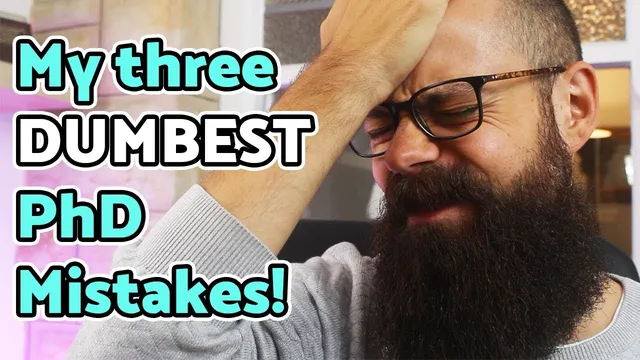
The 3 dumbest mistakes I made during my PhD!
Based on Andy Stapleton's video on YouTube. If you like this content, support the original creators by watching, liking and subscribing to their content.
Start the PhD day with the hardest task before checking emails or social media to prevent momentum loss.
Briefing
The most damaging mistake described is wasting early PhD momentum on social media—especially Facebook—until work pressure catches up later. After moving from the UK to Australia in 2007, the researcher used Facebook to stay connected, but the habit turned into long morning scrolls that derailed focus. Distractions compounded: checking social media first thing in the day made it harder to start experiments, data work, or writing, and the schedule never stabilized. The result showed up near the end of year two and the start of year three, when “future you” suddenly faced a shortage of data and the need to scramble for more. The fix offered is behavioral rather than motivational: start the day with the hardest task (“eat the frog”) before emails or anything distracting, then handle admin later. Consistency is framed as the real safeguard—regular blocks of focused work (about 1.5 to 3 hours daily) prevent the slow drift that can leave weeks unaccounted for.
A second mistake centers on workplace boundaries. The researcher treated an academic contact like a friend, confusing friendliness with personal camaraderie. After being unable to attend training due to a scheduling conflict, they sent a deliberately casual, joking excuse—claiming “Wednesdays are my lying day” and that they wouldn’t get out of bed until 11 o’clock—thinking it would land as banter. Instead, the tone escalated to the supervisor and led to consequences. The takeaway is not that warmth is forbidden, but that PhD relationships still operate under hierarchy: supervisors and trainers deserve professional respect, and humor or informality can cross a subtle line.
The third—and most expensive—mistake involved breaking a $20,000 atomic force microscopy component. While using atomic force microscopy to study solar cell surfaces, the researcher needed to adjust a small lever that controlled a mirror/laser/detector alignment. Lacking an Allen key, they took the delicate AFM head to a university workshop staffed by skilled builders accustomed to heavy-duty tools. The workshop staff found a matching Allen key and began turning it, but the adjustment mechanism had a limited travel range; pushing too far caused a “ping,” followed by the equipment head breaking. The researcher immediately faced the reality of what was destroyed, and the supervisor—who owned the equipment—was informed. Even after attempting repairs, the mirror damage left the system “never the same again,” making this the clearest example of how a small technical shortcut can become a major financial and experimental setback.
Across all three stories, the throughline is practical: protect daily focus, keep professional boundaries with academic staff, and treat expensive instruments and training procedures with strict care. When mistakes happen, the researcher emphasizes owning up to them and accepting the consequences rather than trying to hide or minimize the damage.
Cornell Notes
The researcher’s three biggest PhD mistakes share one theme: small, avoidable choices that compound into major costs—time, professional trouble, and money. First, social media became a morning habit that delayed important work and created end-of-year pressure when data was lacking. Second, a joking, overly familiar email to an academic trainer crossed workplace boundaries and led to escalation with the supervisor. Third, an attempt to adjust an atomic force microscopy component without the right tools (and with workshop-style force) resulted in breaking a $20,000 AFM head, with lasting performance damage. The practical fixes are to “eat the frog” before distractions, keep communications professional, and handle high-value equipment with careful, procedure-based adjustments.
Why did social media become a high-impact problem during the PhD, not just a harmless distraction?
What went wrong in the “friendly” email, and what boundary lesson does it highlight?
How did the $20,000 AFM break happen, step by step?
What does “eat the frog” mean in this context, and how is it supposed to change daily workflow?
What principle is emphasized when mistakes occur in a PhD setting?
Review Questions
- Which daily habit created the most delayed pressure later in the PhD, and what specific change was proposed to prevent it?
- What distinction between “friendly” and “friends” is central to the email mistake, and how did it lead to escalation?
- Why was the AFM repair attempt unlikely to restore full performance, even after a partial fix?
Key Points
- 1
Start the PhD day with the hardest task before checking emails or social media to prevent momentum loss.
- 2
Treat academic relationships as workplace relationships: friendliness is allowed, but “friend” behavior can backfire.
- 3
A small technical adjustment can become catastrophic when high-value equipment is handled with the wrong tools or force.
- 4
University workshops can be excellent for fabrication, but delicate scientific instruments still require procedure-appropriate care.
- 5
Consistency matters: regular focused work prevents weeks from disappearing and reduces end-of-year scrambling.
- 6
When mistakes happen, report them and accept consequences rather than trying to cover them up.