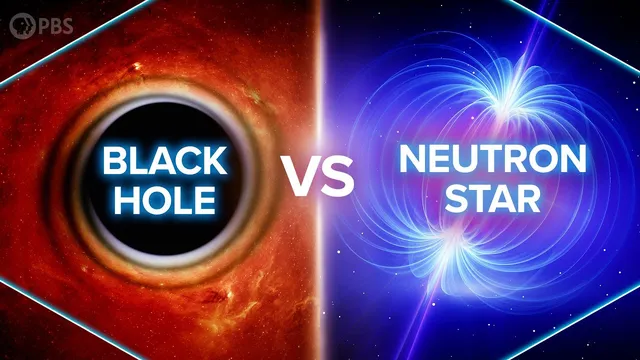
The Boundary Between Black Holes & Neutron Stars
Based on PBS Space Time's video on YouTube. If you like this content, support the original creators by watching, liking and subscribing to their content.
The 2019 gravitational-wave event inferred component masses of about 23.2 and 2.59 solar masses, placing the smaller object at a boundary between neutron-star and black-hole regimes.
Briefing
A gravitational-wave merger detected in 2019 appears to involve a “small” black hole candidate paired with a companion mass of 2.6 times the Sun—an object that sits right on the boundary between neutron stars and black holes. The masses inferred from the waveform are about 23.2 and 2.59 solar masses, and the smaller mass is the problem: it is heavier than most neutron-star measurements and lighter than the black-hole masses astronomers typically see. With no accompanying burst of light, the system’s nature remains ambiguous, but the stakes are high because either outcome would force a rethink of physics at the most extreme densities.
The event was picked up by LIGO in Washington State and Louisiana and by Virgo in Italy as the detectors registered tiny changes in the lengths of their kilometer-scale arms. The timing across the three observatories narrowed the source to arcs on the sky, prompting rapid telescope sweeps for an electromagnetic counterpart—an approach that worked in 2017 when two neutron stars collided and produced light across the spectrum. This time, nothing was found. That absence fits two scenarios: the merger could have involved black holes that swallowed each other without a flare, or it could have included a neutron star that was simply consumed by the heavier companion before any detectable radiation escaped.
The mass of the lighter object is what makes the detection unusually informative. Neutron stars are the ultra-dense remnants of supernova cores, packed with roughly one-and-a-half solar masses into a sphere only about city-sized. Their surface gravity is so extreme that escape velocity approaches half the speed of light, and neutron stars are thought to be near a threshold where adding more mass would push them into becoming black holes. Unlike ordinary matter, neutron-star matter is governed by quantum physics: as mass increases, the star’s radius does not behave like a simple scaling law and can even shrink at the highest masses. That leads to a “phantom event horizon” concept—an effective horizon scale that grows with mass while the surface can move inward—so the overlap of these scales marks the transition to a true black hole.
The uncertainty lies in the star’s interior. Near the center, neutrons may transform into different forms of quark matter, potentially including strange quarks. Those unknown states determine how the star’s size changes with mass and therefore set the maximum stable neutron-star mass. Prior estimates place that maximum in the range of roughly 2 to 3 solar masses, with observational constraints from neutron-star mergers, pulsars, and X-ray binaries typically landing below 2.6 solar masses. The new candidate therefore sits at or beyond the theoretical edge.
On the black-hole side, astronomers have long observed a gap: black holes in X-ray binaries appear to start around five solar masses, consistent with stellar evolution models where a successful supernova leaves behind a neutron star, and only then does additional infalling material push the remnant above the black-hole threshold. A 2.6-solar-mass black hole would be hard to produce in that picture. If the lighter object is truly a neutron star, the event would probe the densest possible quantum states of matter. If it is a black hole, it would challenge assumptions about how stars collapse and how mass thresholds are crossed. Either way, the detection opens a new test of gravity and matter under conditions that are otherwise inaccessible.
Cornell Notes
A 2019 gravitational-wave event measured two merging objects at roughly 23.2 and 2.59 solar masses, with the smaller mass landing in a “no-man’s-land” between known neutron stars and the lightest observed black holes. No electromagnetic counterpart was detected, so the system could have been two black holes, or a neutron star swallowed quickly by a heavier black hole. Neutron stars are expected to have a maximum stable mass set by uncertain physics of ultra-dense matter (possibly involving quark matter and strange quarks), with many estimates and observations placing typical limits below 2.6 solar masses. Confirming whether the 2.6-solar-mass object is a neutron star or a black hole would either test the extreme interior of neutron stars or force revisions to models of how stellar collapse produces black holes.
Why does a 2.6-solar-mass object create tension with both neutron-star and black-hole expectations?
How did the detectors infer the masses of the two objects from the gravitational-wave signal?
Why was the lack of an electromagnetic counterpart considered plausible rather than decisive?
What physics sets the maximum mass of a neutron star?
What would each interpretation imply for astrophysical models?
Review Questions
- What observational evidence supports the inferred masses of about 23.2 and 2.59 solar masses, and what key ambiguity remains because no light was detected?
- How do neutron-star interior uncertainties (e.g., possible quark matter and strange quarks) affect the predicted maximum neutron-star mass?
- Why do stellar-collapse models predict a minimum black-hole mass around 5 solar masses, and how would a 2.6-solar-mass black hole challenge that picture?
Key Points
- 1
The 2019 gravitational-wave event inferred component masses of about 23.2 and 2.59 solar masses, placing the smaller object at a boundary between neutron-star and black-hole regimes.
- 2
No electromagnetic counterpart was detected, which is consistent with either a black-hole merger or a neutron star being swallowed without a detectable flare.
- 3
Neutron stars are near a stability threshold where extreme gravity and quantum interior physics determine whether they collapse into black holes.
- 4
Uncertain core composition—potentially including quark matter and strange quarks—drives uncertainty in the maximum stable neutron-star mass, often estimated around 2–3 solar masses.
- 5
Observed neutron-star masses from pulsars and merger constraints typically fall below 2.6 solar masses, making the new candidate unusually heavy.
- 6
Black holes observed in X-ray binaries appear to start around about 5 solar masses, aligning with collapse models that require additional infalling mass to jump from neutron stars to black holes.
- 7
Determining whether the 2.6-solar-mass object is a neutron star or a black hole would either probe the densest quantum matter or challenge assumptions about how low-mass black holes form.