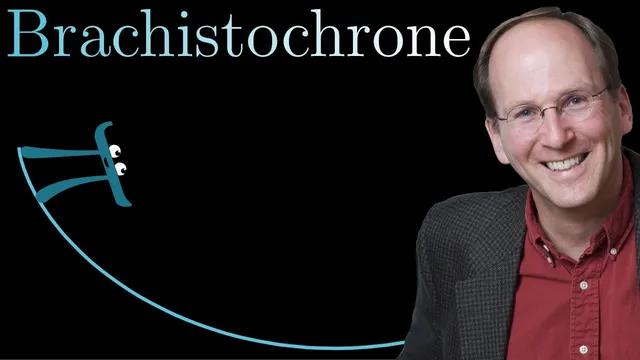
The Brachistochrone, with Steven Strogatz
Based on 3Blue1Brown's video on YouTube. If you like this content, support the original creators by watching, liking and subscribing to their content.
The brachistochrone’s fastest path is not a straight line because early steepness is crucial for building speed under gravity.
Briefing
The brachistochrone problem asks for the curve connecting two points that makes a particle slide under gravity in the least possible time—and the surprising answer is not a straight line or even a simple circular arc. The core insight is that “fastest descent” balances two competing effects: a shorter path tends to favor a straighter route, while getting up to speed quickly requires starting steeply, which lengthens the route. That tradeoff turns a seemingly geometric question into a calculus-of-variations problem with a rich history.
Johann Bernoulli posed the challenge in June 1696 to mathematicians across Europe, partly as a rivalry move against his brother Jacob and partly to establish intellectual dominance over figures like Leibniz and (despite Newton’s retirement from active math) Isaac Newton. The famous legend says Newton solved it overnight and submitted an anonymous solution to the Philosophical Transactions; Bernoulli supposedly recognized Newton’s authorship “by his claw,” though the story’s exact truth is uncertain. What matters is that Bernoulli’s approach became the template for later solutions.
Bernoulli’s method leans on Fermat’s principle of least time, the idea that light chooses the path that minimizes travel time. Instead of a particle sliding down a chute, the problem is reframed as light moving through layered media with different speeds. Snell’s law then supplies the local rule for how light bends at each boundary: the quantity (sine of the incidence angle)/(speed of light) remains constant across layers. For the sliding particle, energy conservation gives the speed as proportional to the square root of the vertical drop y, so the “effective light speed” in the layered-medium analogy also scales like √y.
In the continuous limit of infinitely thin layers, Bernoulli’s condition becomes a differential constraint on the time-minimizing curve: for any point on the optimal path, the ratio (sine of the angle between the tangent and the vertical)/(square root of the vertical distance from the start) must be constant. Bernoulli recognized this condition as the differential equation of a cycloid—the curve traced by a point on the rim of a rolling wheel.
The modern geometric proof attributed to Mark Levy makes the connection feel inevitable. It treats the wheel’s point P as if it swings from an instantaneous center of rotation at the contact point C with the ceiling. Because a circle’s tangent is perpendicular to its radius, the cycloid’s tangent line is perpendicular to PC, creating right-triangle relationships that force a specific trigonometric identity. Those similar triangles yield exactly the same Snell-like invariant: (sine θ)/√y stays constant along the cycloid, matching Bernoulli’s requirement.
The discussion ends with two challenges. One asks how to vary the wheel’s rotation rate so that a point on the rim stays locked to a particle sliding along the cycloid; the surprising answer is that the wheel rotates at a constant rate. The other reframes the brachistochrone in a different coordinate system: in the t–θ plane (time versus the direction angle of the velocity), brachistochrone solutions become straight lines, hinting at a deeper shortest-path interpretation beyond the usual x–y geometry.
Cornell Notes
The brachistochrone problem seeks the curve between two points that minimizes travel time for a particle sliding under gravity. Straight lines and circular arcs fail because the fastest route must start steeply to gain speed quickly, even if that increases path length. Johann Bernoulli’s solution uses Fermat’s least-time principle by mapping the particle’s motion to light traveling through layered media, where Snell’s law enforces a local invariant. In the continuous limit, the invariant becomes (sin θ)/√y = constant along the optimal curve, which matches the differential equation of a cycloid. Mark Levy’s geometric argument—using an instantaneous center of rotation at the wheel’s contact point—derives the same invariant from cycloid geometry, making the cycloid connection feel structural rather than coincidental.
Why isn’t the shortest geometric path (a straight line) the fastest descent under gravity?
How does Fermat’s least-time principle translate the brachistochrone into a light-bending problem?
What exact invariant characterizes Bernoulli’s time-minimizing curve?
Why does that invariant identify a cycloid?
How does Mark Levy’s geometry proof derive the same invariant from cycloid mechanics?
What surprising result appears when tracking a particle along a cycloid while changing the wheel’s rotation rate?
Review Questions
- What physical principle lets Bernoulli convert a particle-on-a-chute optimization into a light-path problem, and what local law replaces it at layer boundaries?
- How do energy conservation and Snell’s law combine to produce the invariant (sin θ)/√y = constant?
- In Levy’s proof, what role does the instantaneous center of rotation at the contact point C play in turning cycloid geometry into the Snell-like condition?
Key Points
- 1
The brachistochrone’s fastest path is not a straight line because early steepness is crucial for building speed under gravity.
- 2
Bernoulli’s solution reframes the particle problem as light traveling through layered media using Fermat’s least-time principle.
- 3
Snell’s law supplies the local bending constraint: (sin θ)/v remains constant across each interface, which becomes a continuous condition on the optimal curve.
- 4
Energy conservation for the sliding particle implies v ∝ √y, turning the Snell-like constraint into (sin θ)/√y = constant along the optimal trajectory.
- 5
That differential condition matches the cycloid, explaining why the cycloid emerges as the time-minimizing curve.
- 6
Mark Levy’s geometric proof uses the wheel’s contact point as an instantaneous center of rotation to derive the same invariant directly from cycloid triangles.
- 7
A related dynamical twist shows that keeping a rim point locked to a sliding particle requires a constant wheel rotation rate, not a changing one.