The Cosmology Crisis Just Got Even Worse
Based on Sabine Hossenfelder's video on YouTube. If you like this content, support the original creators by watching, liking and subscribing to their content.
Multiple datasets increasingly favor dark energy that was stronger in the past and weaker today, challenging the cosmological-constant assumption.
Briefing
Cosmology’s “dark energy” problem has intensified: multiple, independent datasets now point to dark energy being stronger in the past and weaker today, rather than behaving like a constant cosmological constant. The latest reinforcement comes from a new analysis of cosmic microwave background (CMB) measurements from the South Pole Telescope, which both confirms a long-running mismatch in the Hubble expansion rate and again finds a preference for time-varying dark energy. If the trend holds up, it would mark a genuine Kuhnian-style crisis—where the simplest model of the universe no longer fits the data.
Last year’s tentative signals already raised eyebrows. The Dark Energy Survey (DES) used observations of how supernova light changes with distance, while DESI (Dark Energy Spectroscopic Instrument) tracked patterns in the large-scale distribution of galaxies and clusters—specifically baryon acoustic oscillations left over from sound waves in the early universe. Both efforts reported only modest statistical significance (around three sigma), meaning the results were not yet definitive but were unlikely to be pure statistical flukes (roughly a 1-in-1,000 chance).
The new development strengthens the case by adding a third, more precise line of evidence. The South Pole Telescope’s measurements—focused on a small patch of sky and capturing both temperature and polarization of the CMB—reproduce the same directional preference: dark energy appears to have been stronger earlier, potentially even stronger than a pure cosmological constant would allow. The CMB-based analysis also confirms the “Hubble tension” at 6.2 sigma relative to local measurements, while the significance for rejecting a constant dark energy remains in the same ballpark as earlier results (about three sigma). Combining the CMB data with DESI nudges the preference further, though not dramatically.
The implications extend beyond fitting parameters. If dark energy truly changes over cosmic time, it could help ease the Hubble tension by altering how the universe’s expansion history is reconstructed. More fundamentally, a non-constant dark energy suggests a field permeating space. In particle physics, fields typically connect to particles—either dark energy corresponds to a new particle species or it links to an existing one, such as the Higgs boson. The transcript notes that such ideas have been floated before, but none have been convincing so far; the updated evidence could push researchers to revisit them.
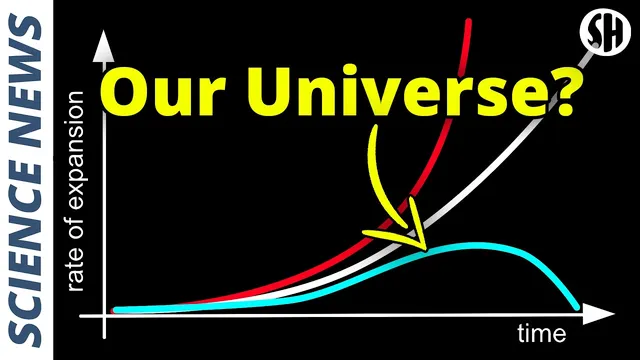
A weaker or disappearing dark energy would also change the universe’s long-term fate. A constant dark energy implies ever-faster expansion. A weakening component could slow expansion and, in more speculative scenarios, make a future recollapse plausible—reviving interest in cyclic-universe models with recurring big bangs.
Still, the confidence isn’t absolute. The analysis relies on model assumptions embedded in parameter fits, raising the possibility that the tension reflects not only dark energy physics but also how cosmological models are being applied. The bottom line: the pattern of results is not “going away,” and the next round of scrutiny will determine whether this is a real shift in fundamental physics or a sign that the current modeling framework needs revision.
Cornell Notes
Independent cosmology measurements are increasingly favoring dark energy that weakens over time instead of behaving like a constant cosmological constant. DES (supernova distances) and DESI (baryon acoustic oscillations in galaxy clustering) previously reported tentative ~3σ evidence for a weaker present-day dark energy. A new South Pole Telescope CMB analysis (temperature and polarization from 2019–2020 data) again finds the same preference and also confirms the Hubble tension at 6.2σ. While the rejection of constant dark energy remains around ~3σ, combining CMB with DESI increases the overall significance. If confirmed, time-varying dark energy could help with the Hubble tension and points toward a field-like component tied to particles, with major consequences for the universe’s fate.
What does “dark energy getting weaker” mean in these analyses?
How do DES, DESI, and the South Pole Telescope each contribute to the same conclusion?
What is the Hubble tension, and how does the new CMB result relate to it?
Why does a non-constant dark energy point toward particle physics ideas?
What would weakening (or vanishing) dark energy imply for the universe’s future?
What caution remains even if the trend persists?
Review Questions
- Which three observational probes are cited as independent lines of evidence for weakening dark energy, and what cosmic era does each primarily probe?
- How do the reported significances (~3σ for weakening dark energy and 6.2σ for the Hubble tension) differ in meaning?
- What kinds of particle-physics interpretations become more plausible if dark energy behaves like a field rather than a constant?
Key Points
- 1
Multiple datasets increasingly favor dark energy that was stronger in the past and weaker today, challenging the cosmological-constant assumption.
- 2
DES infers the dark-energy trend using supernova brightness versus distance, probing later cosmic history.
- 3
DESI finds a similar preference using baryon acoustic oscillation imprints in galaxy and cluster distributions from the early universe.
- 4
A new South Pole Telescope CMB analysis (temperature and polarization, 2019–2020 data) reproduces the weakening-dark-energy preference and confirms the Hubble tension at 6.2σ.
- 5
The evidence against constant dark energy remains around ~3σ, but combining CMB with DESI increases the overall significance.
- 6
If dark energy is time-dependent, it could help reconcile the Hubble tension and suggests a field-like component linked to particles.
- 7
Parameter fits depend on assumed cosmological models, leaving room for alternative explanations beyond dark-energy physics alone.