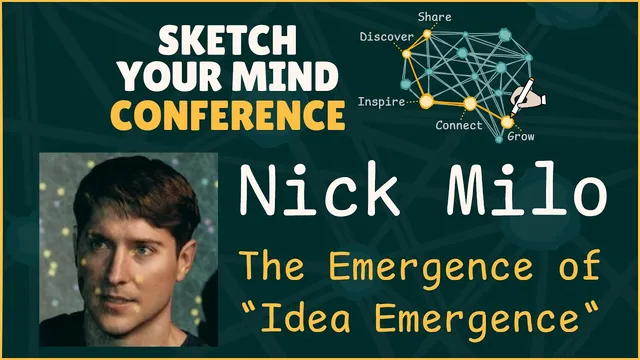
The Emergence of "Idea Emergence" with Nick Milo - Sketch Your Mind Conference, 2025
Based on Zsolt's Visual Personal Knowledge Management's video on YouTube. If you like this content, support the original creators by watching, liking and subscribing to their content.
Idea emergence treats personal knowledge management as an evolutionary process where ideas grow into structured insight through linking, clustering, and synthesis.
Briefing
Nick Milo’s “idea emergence” model reframes personal knowledge management as a natural process: ideas don’t just get stored—they grow from raw fragments into structured, reusable “intellectual assets” when the right linking and thinking conditions are in place. The core claim is that linked-note systems create a new thinking environment where clusters of related notes can “collide,” producing insights that are then unified and turned into outputs—without starting from a blank page.
The model starts with a pandemic-era observation: once linked notes became widely practiced online, the benefits of linking moved from theory to lived experience. Milo describes an evolution of his own framework from a messy early diagram into a five-level hierarchy. At the base, “emergence level one” is simple capture—turning something important into a note. “Level two” adds linking, which creates context but can also become overwhelming when everything is just a tangle of connections. “Level three” introduces a “map of content,” where selected related notes are pulled into a single space to assemble, collide, and unify—explicitly borrowing the logic of thesis/antithesis/synthesis. “Level four” scales up from one map to many maps, enabling higher-order thinking and making it easier to draft new work because much of the groundwork already exists. “Level five” is the “home note,” a launchpad and time-machine-like hub that lets a person navigate backward and forward through their thinking.
Milo then tackles a practical problem: the model can sound too cerebral unless it’s made visible. He simplifies the concept into a visual metaphor—seeds becoming a forest, then mapped into multiple “maps,” and finally organized under a home base. To make the invisible process feel concrete, he animates the movement from scattered notes to clustered clusters, arguing that clustering creates “tension,” which forces questions and sparks. Those sparks—especially when blank spaces are treated as placeholders for what’s missing—are where new ideas can emerge even from gaps.
A second framework, ARC (Add, Relate, Communicate), addresses another bottleneck: people spend too much time collecting and not enough time creating. Milo argues that sensemaking follows a sequence—collect/capture/experience (Add), contextualize/critique/collide (Relate), then transform into publishable work (Communicate). He reports that most people get stuck between Add and Relate, and he offers a diagnostic lens: over-collecting compresses the middle where relating and development should happen. When stuck, he recommends forcing the shift from consumer to creator with a simple “because” prompt (“That’s interesting to me because…”), and if that still fails, moving forward to a concrete deliverable so only the notes that matter get pulled into the work.
Finally, Milo unifies the vertical “idea emergence” ladder with the horizontal ARC workflow into a single system where notes are captured, developed, synthesized, and then communicated—repeated over time. The payoff is reusability: past work becomes a living ecosystem that makes future projects faster, richer, and less dependent on starting from scratch. In the Q&A, he emphasizes that meaningful links are self-made (not AI-generated), and he recommends practical tools for visual sensemaking—Excalidraw, Figma, and Keynote animations—alongside Obsidian as the linked-note backbone.
Cornell Notes
Nick Milo’s “idea emergence” model treats personal knowledge management as an evolutionary process: ideas move from raw capture into structured insight when linked notes are assembled into “maps of content” and then unified. The framework runs through five levels—note capture (L1), linking (L2), map-based assembling/colliding/unifying (L3), multi-map scaling (L4), and a “home note” hub (L5). He pairs this with ARC (Add, Relate, Communicate) to diagnose a common failure mode: people over-collect and under-create, getting stuck between collecting and relating. Milo argues that clustering creates tension that triggers questions and sparks, while empty negative space can be used as a placeholder to surface what’s missing. The result is reusable “intellectual assets” that make future outputs easier to produce.
What does “idea emergence” mean in Milo’s framework, and why does it matter for PKM?
How do the five emergence levels work, and what problem does each level address?
What is the “collide” step, and how can ideas emerge from gaps rather than existing links?
How does ARC (Add, Relate, Communicate) diagnose why people get stuck?
What practical tactics does Milo offer to move from Add to Relate (or from sparks to remarks)?
How does Milo decide whether a link is meaningful, especially in an AI-heavy world?
Review Questions
- How do emergence level three’s “map of content” mechanics (assembling/colliding/unifying) address the navigation problem created by emergence level two’s linking?
- In ARC terms, what specific behaviors count as “Add,” what counts as “Relate,” and what counts as “Communicate,” and where do most people get stuck?
- What does Milo mean by using negative space as a prompt, and how would you apply the “what’s missing?” question to a cluster of notes you already have?
Key Points
- 1
Idea emergence treats personal knowledge management as an evolutionary process where ideas grow into structured insight through linking, clustering, and synthesis.
- 2
The five-level hierarchy runs from note capture (L1) to linking (L2), map-based assembling/colliding/unifying (L3), multi-map scaling (L4), and a home-note hub (L5).
- 3
Clustering notes is framed as a driver of “tension,” which triggers questions and sparks that can convert blank placeholders into meaningful new content.
- 4
ARC (Add, Relate, Communicate) targets a common bottleneck: people over-collect and under-create, often getting stuck between collecting and relating.
- 5
A practical “because” prompt (“That’s interesting to me because…”) is offered as a way to shift from consumer mode to creator mode.
- 6
When stuck, defining a concrete deliverable/deadline can pull only the relevant ideas forward and prevent backlog hoarding.
- 7
Meaningful links are self-made; Milo discourages AI-generated linking because it can remove cognitive ownership and clarity about why connections matter.