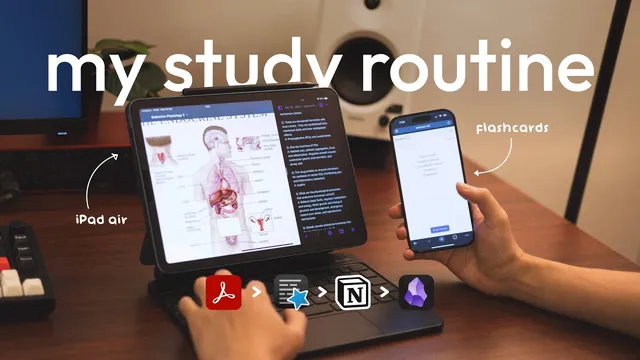
the exact asian study routine that got me straight A's in school.
Based on Kai Notebook's video on YouTube. If you like this content, support the original creators by watching, liking and subscribing to their content.
Read upcoming topics about one week before class using the syllabus or seniors’ notes, and start building flashcards early rather than waiting.
Briefing
A one-week-ahead study routine built around early reading, flashcard creation, and disciplined spaced repetition is presented as the system behind consistently top grades. The core move is starting before class: upcoming topics are reviewed roughly a week in advance using the syllabus or notes from seniors, then turned into flashcards immediately rather than waiting until after lectures. For general physiology—described as a subject heavy on memorization—this pre-class groundwork is paired with understanding-first reading, so flashcards don’t become a substitute for learning.
The workflow centers on a split-screen setup. PowerPoints and recorded lectures from professors are opened while Obsidian runs alongside them. Flashcards are generated inside Obsidian using a plugin that converts typed content into card format, creating a searchable database of questions the learner can skim later. The routine emphasizes comprehension before card-making: if confusion appears—such as a specific uncertainty about acetylcholinesterase during muscle contraction—the learner switches to other sources or watches YouTube explanations to resolve the concept. A typical study block lasts one to four hours, and a single lecture session (example given: about 94 slides) can produce around 200 flashcards.
After encoding on an iPad, the process moves to a computer to import and convert the cards into Anki, the flashcard app credited as the engine of long-term retention. The learner warns against making Anki the “main tool” too early; memorization alone is treated as only part of the job, with understanding described as roughly 30% of the battle. Once cards are in Anki, reviews follow the app’s scheduling: “good” extends the interval, “easy” pushes it further, “hard” brings it sooner, and an incorrect recall forces the card back for quicker repetition. The routine includes a practical stopping rule—finish all cards before sleep—so daily review doesn’t spill into the next day.
To manage ongoing progress, the learner tracks revision status in Notion using a coded database with per-subject revision trackers that record how many days have passed since the last review. A template is promoted for this system, reinforcing the idea that organization supports consistency. Before exams, a “scouting” step is added: gather as much test information as possible by asking classmates and seniors about likely multiple-choice questions or essay prompts, then log quiz details in the same Notion task tracker.
The routine is rounded out with a daily shutdown habit using an all-in-one calendar-to-do app, described as integrating tools like Google Calendar and Notion into one place, including a “ritual” feature to confirm tasks are done or rescheduled. The overall message is that grades come from starting early, building a high-quality flashcard database, and letting spaced repetition do the heavy lifting—while keeping comprehension as the foundation so the cards remain easier to recall over time.
Cornell Notes
The routine starts a week before class by reading the upcoming topic using the syllabus or seniors’ notes, then creating flashcards early instead of waiting for after lectures. Understanding comes first: if a concept is unclear (example: acetylcholinesterase during muscle contraction), the learner switches sources or watches a YouTube explanation before turning it into cards. Flashcards are built in Obsidian with a plugin that converts typed content into card format, then imported into Anki for spaced repetition scheduling (“good,” “easy,” “hard,” and re-bury for incorrect answers). Progress is tracked in Notion with revision timers per subject, and exams are prepared with a “scouting” step—asking others what to expect and logging details in Notion. The system matters because it combines early preparation, comprehension, and long-term review discipline.
Why does the routine begin a week before class, and how is that time used?
How do Obsidian and Anki fit together in the workflow?
What does “understanding-first” mean in practice, and what happens when confusion appears?
How does Anki’s grading system drive the review schedule?
What role does Notion play beyond storing notes?
What is the “scouting” step, and how does it change exam preparation?
Review Questions
- How does the routine balance early flashcard creation with the requirement to understand concepts first?
- Describe the end-to-end process from pre-class reading to Anki review, including the purpose of Obsidian and Notion.
- What specific actions in Anki correspond to “good,” “easy,” “hard,” and incorrect recall, and how do they affect future review timing?
Key Points
- 1
Read upcoming topics about one week before class using the syllabus or seniors’ notes, and start building flashcards early rather than waiting.
- 2
Use a comprehension-first rule: resolve confusion with alternate sources or YouTube explanations before encoding facts into flashcards.
- 3
Build and organize flashcards in Obsidian using a plugin that converts typed content into card format, creating a reusable question database.
- 4
Convert/import flashcards into Anki and follow spaced repetition daily, using “good,” “easy,” “hard,” and re-bury to control review intervals.
- 5
Track revision timing per subject in Notion with a revision-status database so reviews stay consistent across the semester.
- 6
Before exams, scout likely question types by asking seniors and classmates, then log what’s known in Notion to guide targeted studying.